Naval War College 1933 Military Documents Archive Secret Battle Plans Charts USN

When you click on links to various merchants on this site and make a purchase, this can result in this site earning a commission. Affiliate programs and affiliations include, but are not limited to, the eBay Partner Network.

Naval War College 1933 Military Documents Archive Secret Battle Plans Charts USN:
$4500.00
Naval War College 1933 Archive Secret Battle Plans Charts Theses Chester Lewis
Description:
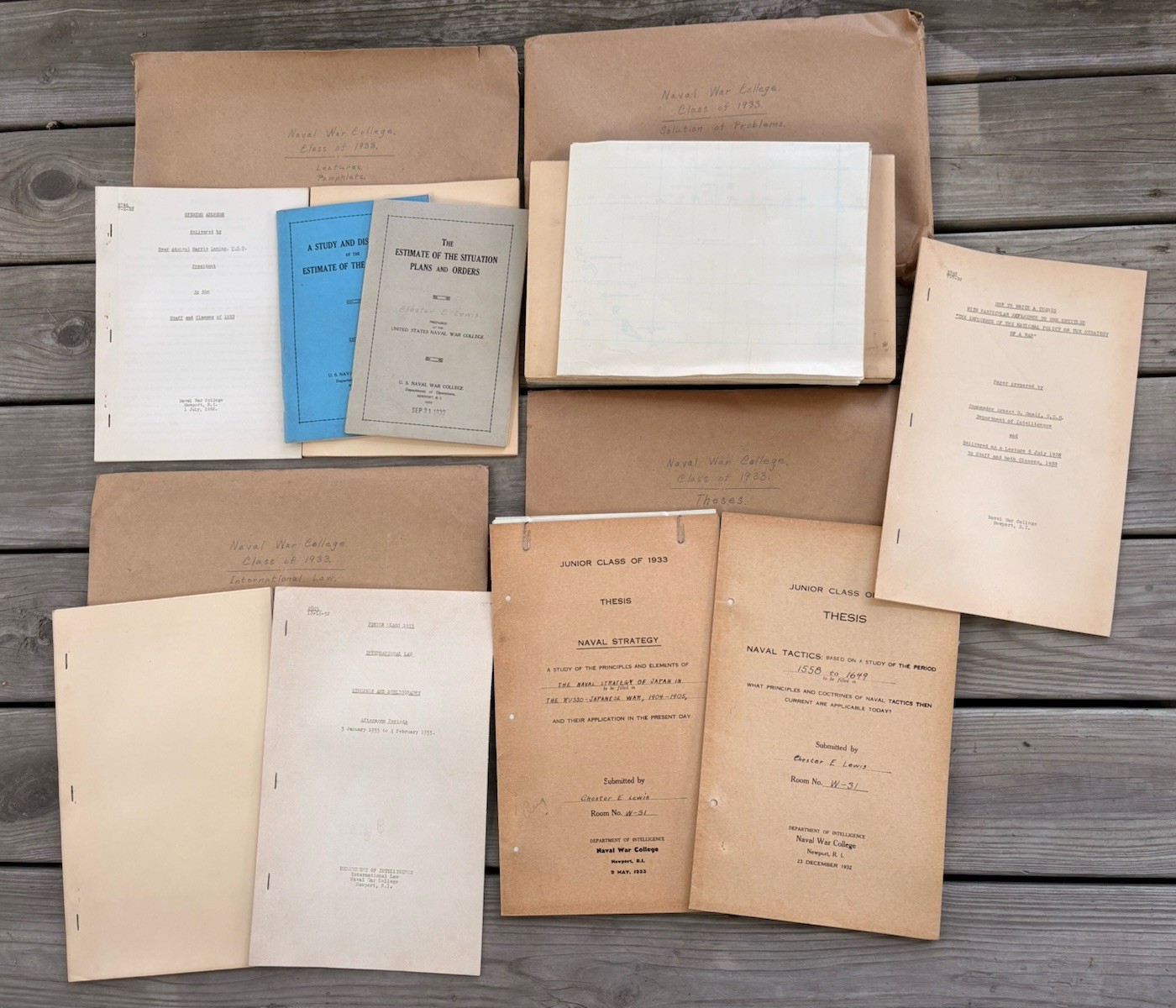
Today for sale we have a substantial original archive from the United States Naval War College at Newport, Rhode Island, retained by Lieutenant Commander Chester E. Lewis, United States Navy, a member of the Junior Class of 1933, room number W 31. The material remains housed in the original kraft envelopes he labeled in his own hand, four in all, marked Naval War College Class of 1933 and divided by subject into Solutions of Problems, International Law, Theses, and Lectures and Pamphlets. Each envelope holds a number of separate documents, far more than could reasonably be photographed, and what follows describes the contents in representative detail rather than exhaustively.
A note on scope. The listing photographs are limited to twenty four images and those images account for only a very small fraction of what is here. The four envelopes hold a large volume of typed problem sets, orders, lectures, course material, theses, critiques, tables, and plotted charts, and the great majority of that material appears in neither the photographs nor the description below. What follows covers representative examples chosen to show the character and quality of the archive. Everything described is present, but a great deal more is present than could be described or photographed.
The Solutions of Problems envelope contains classroom war gaming material. Tactical Problem IV 1933 JR includes the Blue Battle Plan Number One, typed on file 1234 and stamped SECRET, issued from the Blue Fleet Flagship BB 38 at latitude 19 degrees 30 minutes north, longitude 75 degrees 20 minutes west, dated 13 October at 1800. The plan sets out the full task organization by Battle Line, Detached Wing, Airrons with SARATOGA, Subdivs, and Light Forces, and states the mission as the destruction of the Red Fleet in order to maintain the security of Blue lines of supply and communication through the Caribbean. The assumptions paragraph addresses enemy gunnery superiority at ranges of twenty two thousand to twenty three thousand yards, superior enemy battle line speed, the expected employment of an enemy detached wing of battle cruisers, and the presence of air spot. Paragraph three assigns tasks flank by flank, with instructions for forces opposite the enemy van and the enemy rear, and closes over the signature of the Admiral Commanding Blue Fleet.
The opposing side is present as well. Operation Order Number Seven for RED is printed on pink stock, issued from the Red Fleet Flagship H.M.S. Nelson at latitude 15 degrees north, longitude 70 degrees west, and organizes the Main Body, an Air Force under Rear Admiral B with Furious and Eagle, a Submarine Force, and Northwest, Reserve, and Southwest Scouts. The intelligence paragraph reports Blue departing Colon on five October with destination unknown, two Blue battleships and destroyers off Costa Rica on nine October, and a tropical hurricane centered on Old Providence Island making flying impractical west of seventy degrees. Scouting lines, bearings, scouting distances, and speeds are all spelled out in full. A separate typed sheet gives the Blue battle radio frequency plan, a ruled grid assigning specific frequencies to the Commander in Chief, Battle Line, Detached Wing, Airrons, individual Desrons, Batdivs, Crudivs, and Comdesrons, followed by the recognition procedure calling for a single letter challenge changing every fifteen minutes beginning with the letter a at 1800, a reply beginning at z and working backward, and an emergency red rocket answered by a green rocket. There is also a Trafalgar exercise problem in which the operation order is signed in the role of Nelson, Admiral, BRITISH Navy, Commander in Chief, ordering the overpowering of the rear of the Allied fleet from three ships ahead of the center of the line and naming the capture of the Allied Commander in Chief as the secondary objective. Chester Lewis signed that page in ink beneath the typed line for the British Flag Secretary.
Accompanying these are large fold out comparative strength tables, hand entered in pencil across dozens of ruled columns, tabulating OWN FORCES against ENEMY FORCES by ship type including BB, CV, CA, CL, DL, and DD, with speed, radius at ten knots, main and secondary battery caliber and maximum range, antiaircraft battery, torpedo tubes on broadside, deck and submerged, mines, depth charges, and aircraft complement by VF, VO, VB, and VS, summarized at the foot of the sheet. A hand lettered leaf lists the enemy units assumed to be present, giving Batdivs 2 and 3 at ten battleships, Crudivs 4 and 5, Crudivs 1, 2, 3, and 9 at fourteen light cruisers, Desrons 2, 4, and 6 at four destroyer leaders and thirty eight destroyers, and CV 4.
The mapping is among the strongest material here. There is a large blueprint titled Class of 1933 Search Problem, Staff Solution, showing the western Pacific from Okinawa south to Guam and Pelew with plotted search legs, cruiser and scout tracks labeled by hull, submarine stations, aircraft sorties noted as take off 5 April 1015 and land 5 April 1900 at Pelew, and a dated key running from 4 April through 6 April. Alongside are two examples of United States Hydrographic Office chart No. 5050, Strategic Plotting Chart No. 1, published at Washington in September 1916 under the authority of the Secretary of the Navy, edition of August 1923, covering Taiwan, the Nansei Islands, the Philippines, the Bonins, the Marianas, and the Caroline Islands. Both are heavily worked in pencil with the student solution, showing BLUE FLEET and ORANGE force tracks, dated positions through 4, 5, and 6 April, the Bonin Guard and Guam Force, Polillo Force, Orange Crudivs and Subdivs by number and strength, protractor plots at Saipan and off the Bonins, notations such as BLUE passes unobserved and course and speed calls, and the labeled BLUE AREA across the Carolines. One of the charts is titled in pencil SEARCH PROBLEM and signed Chester E. Lewis with his room number below.
The Lectures and Pamphlets envelope holds a confidential lecture on National Strategy delivered by Captain D. W. Knox, United States Navy, Retired, at Newport on 7 October 1932, carrying the notice that the copy is not to pass out of the custody of officers of the United States Naval or Military Service and may be retained by the officer to whom issued. Knox opens with an assessment of American shortsightedness in international affairs and the absence of a coherent national strategy, and the text runs at length from there. Also present is the Opening Address delivered by Rear Admiral Harris Laning, United States Navy, President of the Naval War College, to the Staff and Classes of 1933 on 1 July 1932, in which he tells the incoming officers that the College does very little teaching and that the most common misunderstanding among new students concerns what they will be asked to do. Two printed College publications are included, the blue wrappered A Study and Discussion of the Estimate of the Situation, Department of Operations, 1933, and The Estimate of the Situation, Plans and Orders, prepared at the United States Naval War College in 1932, date stamped SEP 21 1932 and signed on the cover by Chester E. Lewis. A paper by Commander Ernest G. Small, Department of Intelligence, titled How to Write a Thesis, delivered as a lecture on 5 July 1932 to Staff and both Classes, is present with its annotated bibliography.
The Theses envelope contains Lewis's own submitted work along with the graded faculty responses. His first thesis, NAVAL TACTICS, Based on a Study of the Period 1558 to 1649, What Principles and Doctrines of Naval Tactics Then Current are Applicable Today, was submitted 23 December 1932 to the Department of Intelligence. Clipped to the front is the critique from the Naval War College dated 13 January 1933, calling the work a well considered analysis of the tactics of the period, stressing particularly the idea of range bands and cooperation as applied to present day tactics, signed in ink by Milton S. Davis, Captain, United States Navy, Head of Department of Intelligence, along with a second slip in the same hand reading An excellent paper, sound and clear. His second thesis, NAVAL STRATEGY, A Study of the Principles and Elements of the Naval Strategy of Japan in the Russo Japanese War of 1904 to 1905 and Their Application in the Present Day, was submitted 9 May 1933 and is a thick brad bound typescript with a candid preface admitting the work began as a dissertation because he did not know what proposition he could advance until the writing was nearly finished. Bound within are hand drawn illustrations, including a pen and ink chart of the Sea of Japan and Yellow Sea locating Vladivostok, Port Arthur, Chemulpo, Fusan, Takeshiki, Sasebo, Kure, and Hakodate, initialed in the corner, and a hand ruled distance table in nautical miles between the Japanese naval ports and the Korean and Manchurian objectives. The governing Directive for Thesis on Tactics is present as well, explaining that eight historical periods were allocated with roughly five student officers assigned to each, and quoting Le Vicomte des Morogues from 1764 on the dependence of tactics upon arms before turning to Mahan.
The International Law envelope contains the Junior Class 1933 course material from the Department of Intelligence, including the synopsis and bibliography for the afternoon periods running 3 January 1933 to 4 February 1933, and Situation I, which asks the student to define international law and its bases, to define contraband, continuous voyage, blockade, Kirkwall Practice, internment as applied to ships, piracy, arbitration, reprisal, embargo, asylum, angary, visit and search, and economic sanctions, and then poses a problem in which a general of state X boards the neutral merchant vessel CHIN and orders her to load troops for a port in the area of active operations while a neutral destroyer lies anchored close by. The graded return for Lewis follows, marked 95 with the comment A satisfactory solution, again signed by Captain Milton S. Davis. An extensive library bibliography accompanies the course, listing Hyde, Stockton, Garner, Moore, Oppenheim, Jessup, and the Hague and Geneva Conventions among many others.
Taken together this is the surviving academic and war gaming record of one officer's year at Newport during the period when the College was working through the Pacific and Caribbean problems that shaped fleet thinking in the decade before the war. The presence of the original labeled envelopes, the problem sets for both sides, the plotted charts and blueprint solution, the signed faculty critiques, and Lewis's own signature throughout makes this a cohesive body of material rather than a scattering of loose papers.
The Naval War College at Newport, Rhode Island was the graduate level school of the United States Navy, where officers of middle and senior rank studied strategy, tactics, and international law. The Junior Class of 1933 sat squarely in the interwar period. The problems preserved here follow the College color code in which BLUE represents the United States and RED and ORANGE represent the opposing powers, and the scenarios move between a Caribbean fleet action against a battle line built around H.M.S. Nelson with Furious and Eagle in support, and a Pacific search and screening problem plotted across the Marianas, the Carolines, the Bonins, and the approaches to Guam, Saipan, Truk, Yap, Ulithi, and Pelew. Officers worked these problems, submitted written solutions, and had them returned graded and critiqued by the department heads. That full cycle is represented here, from problem statement through student solution through signed faculty response.
The color designations in these documents are not arbitrary game labels. They are the color code of the actual United States contingency war plans of the period, in which BLUE was the United States, ORANGE was Japan, and RED was the British Empire. The Pacific search and screening problem plotted on the charts, with BLUE working against ORANGE across the Marianas and Carolines, reflects the framework of War Plan Orange, the long running American plan for a naval war against Japan that was refined for two decades in large part through gaming at Newport. The Caribbean battle problem, with its RED fleet built around H.M.S. Nelson, reflects the War Plan Red and Red Orange contingencies against Britain and a combined Anglo Japanese threat. After the war Fleet Admiral Chester Nimitz remarked that the conflict with Japan had been played out in the game rooms at Newport so many times and in so many ways that nothing in the Pacific came as a surprise. Material like this is a surviving physical trace of that process, worked by one officer on the standard chart series in 1933.
This archive will be of interest to collectors and researchers in a number of fields, including interwar United States Navy history in the years leading up to World War II, naval war gaming and fleet problems, Naval War College and Department of Operations and Department of Intelligence publications, classified and confidential military documents and typescripts marked SECRET and CONFIDENTIAL, operation orders and battle plans and task organization documents, battle radio frequency plans and recognition signals, order of battle and fleet strength tables, battleships and battle cruisers and aircraft carriers including SARATOGA, cruiser divisions and destroyer squadrons and submarine divisions, early naval aviation and air spot doctrine, Hydrographic Office charts and Strategic Plotting Chart No. 5050, blueprints and plotted maps, Pacific theater geography covering the Marianas and Caroline Islands and Bonin Islands and Okinawa and Formosa and the Philippines, Caribbean and Panama and Guantanamo operations, War Plan Orange and War Plan Red and the color coded contingency war plans, the strategy to defeat Japan, the Russo Japanese War and the Imperial Japanese Navy and Port Arthur and Vladivostok, Mahan and Nelson and Trafalgar, naval tactics and naval strategy and national strategy, international law and prize law and contraband and blockade and neutrality, and named officer provenance including Chester E. Lewis, Milton S. Davis, Harris Laning, D. W. Knox, and Ernest G. Small.
Condition is very good overall for age with the expected honest wear. The kraft envelopes are toned with edge tears and chipping at the corners and the flaps are loose on some. Interior typescripts are clean and legible with light toning and occasional foxing. Staples, brads, and paper clips show light oxidation with corresponding tannish offsetting on adjacent pages. The large plotting charts have the original fold lines throughout with a few short separations and light soil at the corners, and the blueprint shows fold creasing patterns consistent with age. All text and plotting remain fully readable. Sold as found from a Maryland estate. Additional photographs of any individual document are available on request.
~FAST SHIPPING~+~SHORT HANDLING TIME~+~60 DAYS FOR RETURN & REFUND IF YOU CHANGE YOUR MIND~+~EXPERIENCED IN PACKAGING~
+~SUPERIOR CUSTOMER SUPPORT FROM MYSELF AND ~+ SUPPORT/GUARANTEED BUYER POLICIES~+~I CARE ABOUT EACH OF MY CUSTOMERS! I WILL ALWAYS DO MY BEST TO ENSURE THE BEST CUSTOMER SERVICE AND TIMELY SHIPPING WITH 60 DAY REFUNDS ETC.... IM ALWAYS RECEIVING NEW INVENTORY ON CONSIGNMENT....I LIST ITEMS DAILY.... AND PLAN TO INCREASE MY LISTINGS AS MUCH AS POSSIBLE.... IF YOU ARE INTERESTED IN COMBINED SHIPPING I WILL ALWAYS DO SO! CONSIDER SAVING MY PAGE TO BE UPDATED WHEN I'VE MADE NEW LISTINGS~+~PLEASE DON'T HESITATE WITH ANY QUESTIONS OR CONCERNS!~+~I WILL SHIP WORLDWIDE. BASED FROM 50311.~+~ WILL SHIP TO THE FOLLOWING U.S. STATES: AK, AL, AR, AS, AZ, CA, CO, CT, DC, DE, FL, GA, GU, HI, IA, ID, IL, IN, KS, KY, LA, MA, MD, ME, MI, MN, MO, MP, MS, MT, NC, ND, NE, NH, NJ, NM, NV, NY, OH, OK, OR, PA, PR, RI, SC, SD, TN, TX, UM, UT, VA, VI, VT, WA, WI, WV, WY
~THANK YOU!!!~
Naval War College 1933 Military Documents Archive Secret Battle Plans Charts USN:
$4500.00
Related Items:
AMERICAN REVOLUTIONARY WAR HUMAN HEAD NAVAL SWORD, 1 OF 3 SIMILAR TO KENNEDY'S
$16995.00
Confederate Naval Cutlass -Original 1861 US Civil War Short Sword-Rare
$7505.00
UNIQUE 14K MASONIC JEWEL OF CIVIL WAR NAVAL HERO USS TECUMSEH DAMN THE TORPEDOES
$5549.77