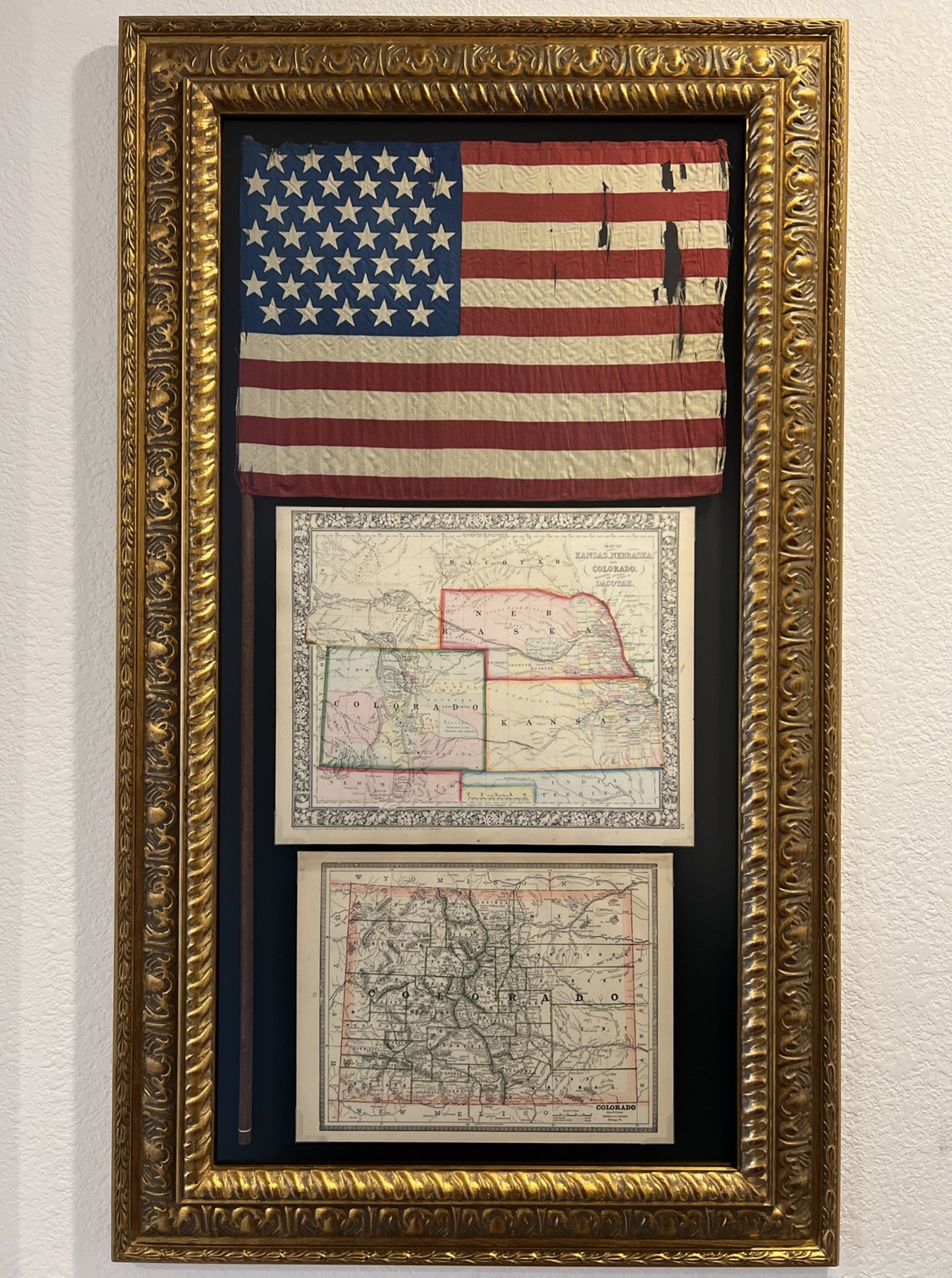
Antique 38 Star Signed American Flag Silk Colorado Maps 1861-1886 Framed USA US

When you click on links to various merchants on this site and make a purchase, this can result in this site earning a commission. Affiliate programs and affiliations include, but are not limited to, the eBay Partner Network.

Antique 38 Star Signed American Flag Silk Colorado Maps 1861-1886 Framed USA US:
$6825.00
Beautiful Framed Signed Silk 38 Star American Flag with Antique Colorado Maps before and after statehood in 1876 as the Centennial state. Provenance letter included. The Flag has stars in a globe formation in the canton 5, 6, 5, 6, 5, 6, 5. The first map from 1861 is Colorado Territory as it was created at the beginning of the US Civil War before statehood. The second antique map from 1886 showing post statehood development. Flag staff signed by original owner along with provenance from current family on original family farm parchment. Signature is visible but not super legible.
Gold Gilt Framed Ornate Layered Wood and under immersive Anti-Glare Glass. Flag is securely mounted to acid free backer and a sealed backing to divert dust infiltration. Maps held in place and lightly spaced from glass with clear corner holders. Heavy duty wire hanger and bumpers to protect your wall. One of a kind conversation piece and amazing Centennial State Colorado History on display.
Large Frame about 26-1/4 x 44-3/4 inches. 1-1/2 inch frame depth. Flag 12-1/2 x 17-1/2 inches.
Very good condition overall, delicate silk Flag has lots of holes light folds, light stains, some separation from original pole started. Maps are in very good condition, faded browned. Intricate ornate frame is in excellent shape. Glass also in excellent condition.
Insured and packed with ultimate care. UPS or FedEx delivery. Local Pickup recommended in Colorado.
The 38-star U.S. Flag, Colorado statehood, and the Civil War are closely linked through the timeline of westward expansion, the Union’s preservation during 1861–1865, and Reconstruction-era politics. Colorado’s path from territory to state unfolded against the backdrop of the war, with its mineral wealth and strategic location playing supporting roles—though no major Civil War battles occurred within its borders. The 38-star Flag came later, in 1877, as a direct result of Colorado becoming the 38th state exactly 100 years after the Declaration of Independence.
Colorado Territory Forms on the Eve of the Civil War (1861)
The Colorado Territory was officially organized by Congress on February 28, 1861—just weeks before Confederate forces fired on Fort Sumter in April 1861, igniting the Civil War. Its borders were carved from parts of the Kansas, Nebraska, New Mexico, and Utah territories, driven by the 1858–1859 Pike’s Peak Gold Rush that brought thousands of settlers.
At the time, the U.S. Flag had 34 stars (after Kansas joined in January 1861). During the war it would add two more:
• 35 stars (West Virginia, 1863)
• 36 stars (Nevada, 1864–1865)
Colorado was a new, sparsely populated frontier territory (roughly 25,000–34,000 people in 1860–1861, including many miners). Sentiments were divided, but it leaned Union overall, though Confederate sympathizers were active enough to block early statehood offers.
Broader U.S. map in 1860, just before Colorado Territory was formed and the war began.
Colorado’s Role in the Civil War (1861–1865)
The territory was strategically valuable because of its gold and silver mines, which both sides wanted to finance the war effort. Confederate Brig. Gen. Henry Sibley’s New Mexico Campaign (1861–1862) aimed to seize the Southwest, including Colorado’s mines, and open a path to California.
• Union support: Territorial Governor William Gilpin quickly raised the 1st Colorado Infantry Volunteers. About 4,900 Colorado men served the Union. The 1st Colorado played a key part in the Battle of Glorieta Pass (March 1862, in what is now New Mexico), often called the “Gettysburg of the West.” Union forces (including Colorado troops) destroyed the Confederate supply train, forcing Sibley’s retreat and securing the Southwest for the Union.
• No formal Civil War battles took place inside Colorado itself.
• Some Confederate sympathizers lived in the territory and helped thwart four statehood attempts between 1862 and 1866.
• Tragically, Colorado Volunteers were also involved in the Indian Wars; the 3rd Colorado Cavalry carried out the Sand Creek Massacre (November 1864) against Cheyenne and Arapaho civilians.
Colorado’s gold helped the Union economically, and its troops helped keep Confederate forces out of the far West
Delayed Statehood Attempts (1860s–1875)
Coloradans first tried for statehood in 1859 (as “Jefferson Territory”), but Congress did not act. After becoming an official U.S. territory in 1861, there were repeated pushes in the 1860s. Four attempts failed (1862, 1863, 1864, 1866), largely due to:
• Small population (President Andrew Johnson vetoed one bill, arguing Colorado wasn’t ready and should remain a territory to avoid extra taxation and representation issues).
• Reconstruction politics: Johnson did not want to admit new states while former Confederate states were still out of the Union.
• Local opposition, including from Confederate sympathizers and debates over suffrage and governance.
It took five tries over 17 years. The final successful effort came in 1876 under President Ulysses S. Grant, who signed the proclamation on August 1, 1876—exactly 100 years after the Declaration of Independence. Colorado earned the nickname “Centennial State.” Its borders remained the same as the territory’s.
Front page of the Rocky Mountain News (January 1, 1876) captures the excitement in Denver as Colorado prepared for statehood and the nation’s centennial celebrations.
The 38-Star Flag (1877–1890)
By law and tradition, a new star is added to the U.S. Flag on the next Fourth of July after a state joins the Union. Colorado’s admission on August 1, 1876, meant the official 38-star Flag debuted on July 4, 1877. It remained the official Flag until July 3, 1890 (when it was replaced after several new states joined in 1889–1890).
• The 13 stripes stayed the same (representing the original colonies).
• Star arrangements varied widely before 1912 (no official pattern existed), so you’ll see 38-star Flags in circles, rows, or other designs. Some were even produced early (as early as 1870) in anticipation of statehood or for the 1876 Centennial Exposition in Philadelphia.
• The Flag symbolized post-Civil War national growth and unity during the centennial era.
In short: The Civil War created the urgent context for Colorado’s territorial organization and military contributions. Post-war politics delayed statehood until the nation’s 100th birthday in 1876. That directly produced the 38-star Flag the following year—a lasting emblem of Colorado’s place in the expanding Union. Today, Colorado still celebrates August 1 as Statehood Day, and the 38-star Flag remains a popular historical symbol of that milestone.
Antique 38 Star Signed American Flag Silk Colorado Maps 1861-1886 Framed USA US:
$6825.00
Related Items:

Antique Vintage Bronze French Crystal Beaded Basket Chandelier Ballroom 38” HUGE
$29500.00

18C Large Antique Russia Russian Church Icon of the Mother of God "Sign" 38x30in
$19000.00

Antique 38 Chevy Runs Nice Original Condition Very Nice Paint See Photos
$17000.00