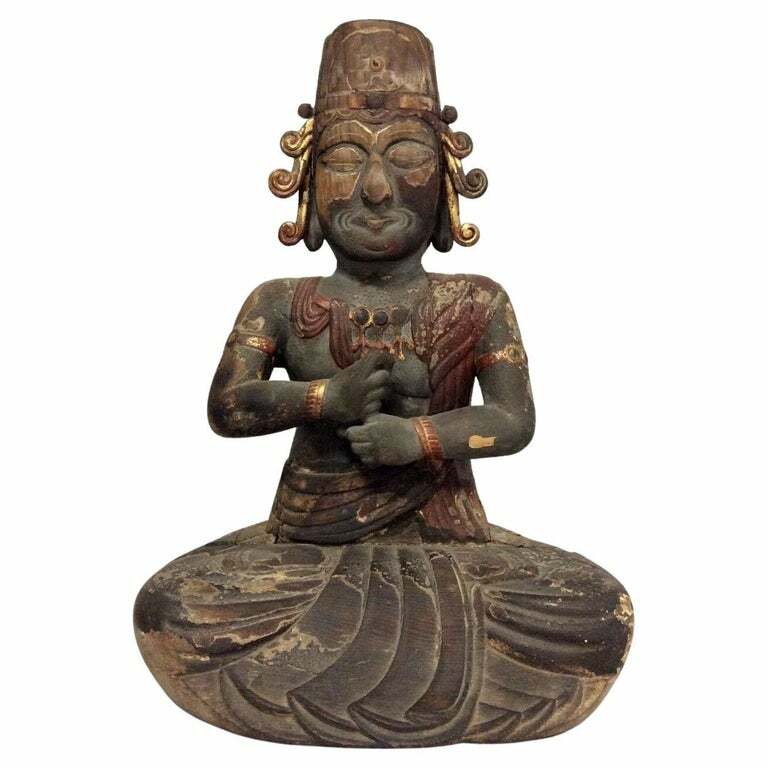
Antique Japanese Wooden Wood Sculpture Statue Buddha Temple Figure 16–17th Cent

When you click on links to various merchants on this site and make a purchase, this can result in this site earning a commission. Affiliate programs and affiliations include, but are not limited to, the eBay Partner Network.

Antique Japanese Wooden Wood Sculpture Statue Buddha Temple Figure 16–17th Cent:
$7551.50
Late Muromachi to Early Edo Japanese Buddhist Temple Figure (16th–17th Century)
18 inches (46 cm) tall × 13.5 inches (34 cm) wide
Wood • Yosegi-Zukuri • Lacquer • Mineral Pigments • Gold Leaf • Temple-Used
This remarkable Japanese Buddhist temple figure was carved in the late Muromachi to early Edo period (16th–17th century) — a time when Japan was transitioning from medieval civil war to unified national peace. At nearly half a millennium old, it stands as an extraordinary survivor of devotional use, artistic tradition, and spiritual continuity.
Constructed using yosegi-zukuri, the classical Japanese multi-block carving technique, the sculpture consists of carefully shaped wood segments joined, hollowed, and sealed from below with a rectangular plug. This method, perfected in the 10th–12th centuries and carried forward into the Edo period, allowed sculptors to reduce cracking, lighten the figure for altar placement, and create an inner chamber for relics, charms, or sutra fragments. Visible block seams, centuries of drying cracks, pegged joints, and later repair pins all testify to its age and long life inside a temple.
Traces of original lacquer, mineral pigments, and genuine gold leaf cling to the surface in islands of red, black, and gilded highlights. These are not modern paints but remnants of early Japanese lacquerwork: urushi resin applied in thin layers, shaded with natural pigments, and finished with gold leaf meant to shimmer beneath lantern light. Over 300–450 years, these layers have developed the coveted “sharkskin” texture — tiny dimples formed as lacquer, binder, and pigments naturally contracted and oxidized.
This surface — worn smooth in places, textured in others — is exactly what master appraisers look for in Edo-period temple sculpture.
A Bodhisattva of Compassion (Kannon)This figure represents a Bodhisattva, almost certainly Kannon (Avalokiteshvara) — the most beloved embodiment of mercy in Japanese Buddhism. Unlike Buddhas, who appear plain and unadorned, Bodhisattvas wear jewelry, sashes, crowns, and decorative ornaments symbolizing their active engagement with the human world.
The Chest JewelryAcross the chest lies a carved necklace with three rounded pendants, representing the Three Jewels:
Buddha
Dharma (teachings)
Sangha (community)
This royal regalia is classic Bodhisattva iconography, marking the figure as a celestial helper, not an enlightened monk.
The Crown & Five-Lobed EmblemAt the center of the crown sits a round, five-lobed floral medallion — the detail you noticed that resembles a sand dollar. This is the crown boss, not an object held in the statue’s hands.
This medallion is a stylized lotus-mandala, symbolizing the Five Wisdoms of esoteric Buddhism:
Mirror-Like Wisdom
Wisdom of Equality
Wisdom of Discernment
All-Accomplishing Wisdom
Dharmadhatu Wisdom — the essence of reality
Crowning the Bodhisattva with this emblem indicates a being who channels cosmic enlightenment through compassion.
Hair CurlsThe sweeping side curls — bold, flame-like, and gilded — are hallmarks of esoteric Bodhisattva representation. They symbolize:
radiating spiritual energy
flowing compassion
divine presence made visible
Their survival on your piece is remarkable.
Closed EyesThe half-lidded eyes are a traditional mokuzō gaze:
serene
perceiving suffering without earthly sight
rooted in deep meditation
Bodhisattvas close their eyes not to withdraw, but to listen.
Hand Gesture (Mudra)The hands meet near the chest in a variation of the anjali / gassho gesture — a posture of:
prayer
humility
compassion
Together, these elements firmly place the figure in the lineage of Kannon, worshiped for intercession, mercy, and protection.
DEVOTIONAL WEAR & TEMPLE USEThis piece exhibits unmistakable devotional wear from centuries of human interaction:
Shoulders, knees, and chest areas are smooth from touch
Pigment islands erode where worshippers pressed beads or cloth
The surface carries smoke, incense, and oil residue
Repairs — wooden pegs, later iron pins — were made by temple caretakers
This is not a tourist carving. It lived a working religious life, absorbing millions of moments of human contact.
Every softened edge is a fingerprint of history.
THE WORLD WHEN THIS WAS NEW (1550–1650)To understand its age, you need to understand its world. When this Bodhisattva was placed on its altar, everything around it — in Japan and beyond — was radically different.
JapanThe Sengoku (“Warring States”) period was ending.
Samurai warlords battled for control.
Castles like Himeji were being built or fortified.
Tea masters such as Sen no Rikyū were shaping aesthetics.
Christianity briefly arrived and was later suppressed.
By 1603, Tokugawa Ieyasu unified Japan, beginning 250 years of peace.
Villagers, farmers, and artisans prayed to Kannon for stability after generations of war.
Your statue might have been carved in the last decades of conflict — or the first years of peace.
China & East AsiaThe Ming Dynasty was collapsing.
The Qing Dynasty was on the verge of taking power.
Maritime trade routes shifted dramatically.
Esoteric Buddhism still flowed through temples and mountain regions across Japan.
EuropeWhile this statue was being carved:
Michelangelo and Shakespeare were alive.
The Spanish Armada was defeated (1588).
Galileo was being challenged for his astronomical discoveries.
The printing press was only a century and a half old.
The first English colonies didn’t yet exist in North America.
Most Europeans had no accurate idea that Japan even existed.
North AmericaIndigenous nations thrived across the continent.
Jamestown had not yet been founded (1607).
The Mayflower voyage was decades away (1620).
Maine was untouched wilderness.
Your Bodhisattva was already old when the first settlers reached New England.
SUMMARY OF SIGNIFICANCEThis figure is an authentic, spiritually charged example of Japanese Buddhist sculpture, characterized by:
16th–17th century date (late Muromachi to early Edo)
Yosegi-zukuri multi-block construction
Original lacquer, pigments, and gold leaf
Crown boss with five-lobed esoteric emblem
Closed meditative eyes, flame-like hair curls
Hands in compassionate offering gesture
Deep devotional patina from centuries of temple handling
A clear identity as Kannon, Bodhisattva of Mercy
It survived samurai warfare, temple rituals, the unification of Japan, global exploration, and centuries of human devotion. It is not merely an antique — it is a relic of spiritual life in a world that no longer exists.
Antique Japanese Wooden Wood Sculpture Statue Buddha Temple Figure 16–17th Cent:
$7551.50
Related Items:
ANTIQUE KEROSENE OIL GWTW CHINESE JAPANESE DRAGON AWAJI BANQUET VICTORIAN LAMP
$125000.00
ANTIQUE ART NOUVEAU JAPANESE CHINESE PORCELAIN DRAGON BACCARAT GLASS OIL LAMP
$110000.00
ANTIQUE ART NOUVEAU JAPANESE CNINESE MEIJI BRONZE SLAG GLAS SHADE KEROSENE LAMP
$88000.00