RED STAR GOZNAK 1935 WOMAN WORLD RECORD PARACHUT 7035m COOPERATION FRANCE-GERMAN

When you click on links to various merchants on this site and make a purchase, this can result in this site earning a commission. Affiliate programs and affiliations include, but are not limited to, the eBay Partner Network.

RED STAR GOZNAK 1935 WOMAN WORLD RECORD PARACHUT 7035m COOPERATION FRANCE-GERMAN:
$7999.00
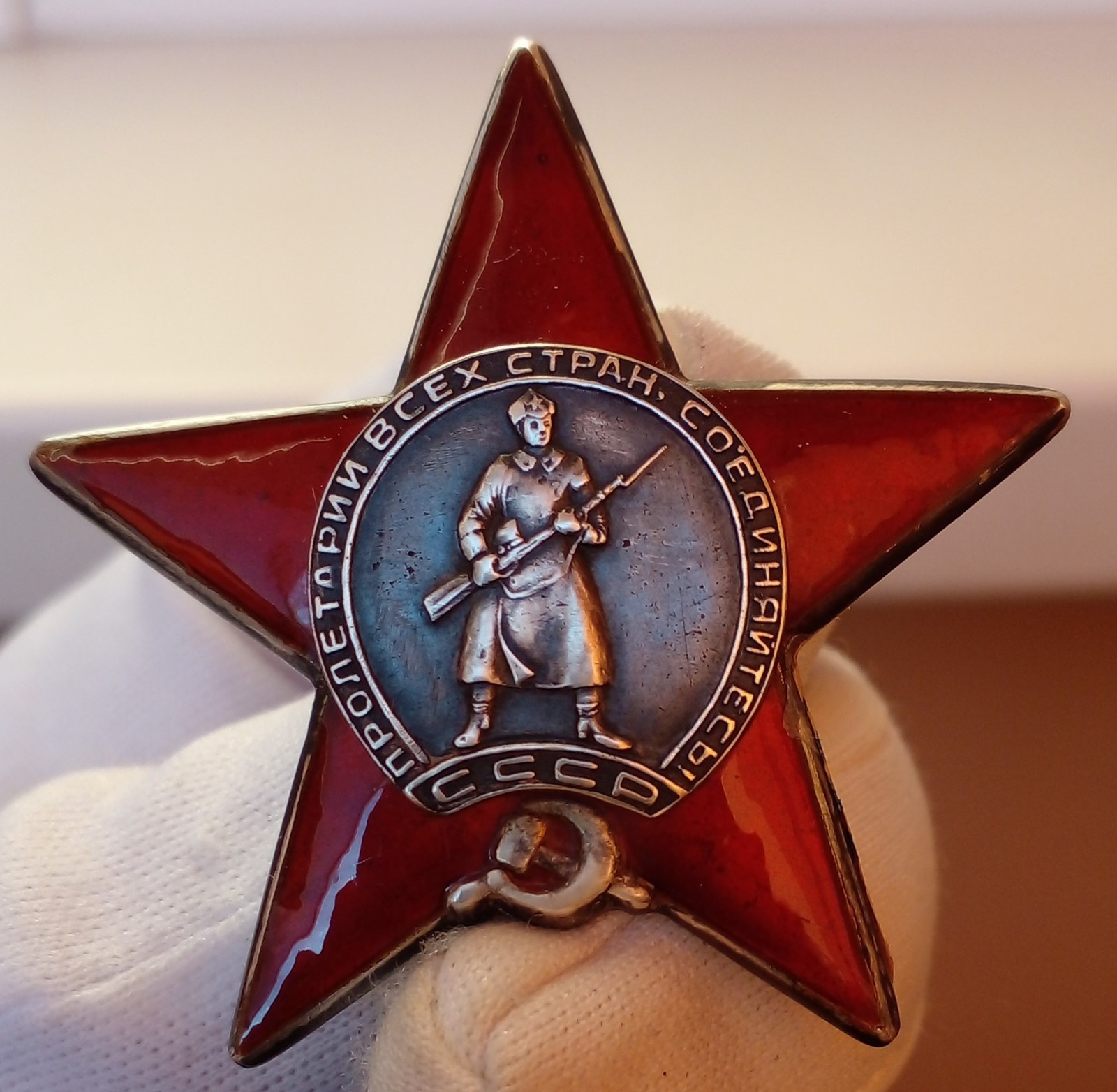
The 1935 Order of the Red Star awarded by Goznak to a female parachutist instructor (N.V. Babushkina, 1915–1936) for a record-breaking, ultra-high parachute jump from an altitude of 7,035 meters WORLD RECORD. An incredible achievement, even today, 90 years later, unparalleled in history!
I would especially like to highlight a remarkable detail: instructor N.V. Babushkina was directly involved in briefing and training aviation groups from France and Germany, a rather unusual event under the "totalitarian regime."*****From 1930 to 1935, only 2 to 5 *WOMEN" were awarded the Order of the Red Star produced by GOZNAK***
***FROM THE MEMORIES OF GOZNAK EMPLOYEES, “MASTERS OF THE OLD SCHOOL OF ...**FABERGE**... WORKED ON
THE ORDERS OF THE RED STAR OF 1930-35!!!
***BIOGRAPHY
Nadezhda (Nata) Vasilyevna Babushkina (March 14, 1915 – June 27, 1936) was a legendary Soviet parachutist, world record holder, and one of the first female high-altitude jumpers in the USSR. For her phenomenal jump from the stratosphere and her popularization of aviation sports, she earned the nickname "the hummingbird of Soviet parachuting."
*** Order Specifications and Catalog Information
Order of the Red Star, Type 1, Goznak.
Silver, enamel of complex texture, consisting of two soldered halves, with a bronze base flange and a special nut, also with a bronze flange-cup.
Weight m = 18.3 grams (nut m = 7.2 grams) — within the standard.
I would especially like to note the presence of a museum inventory tag:
"Babushkina N. "KZ" Goznak 1935 I.N. No. 117 lv."
And the tags on the nut are in English — this suggests that the order was likely exhibited at international exhibitions.
The first type of order was awarded between 1930 and 1936 (approximately). Approximately 800 copies were produced. An extremely rare variety.
The main element of the first type of order is a five-pointed star, the rays of which are covered in red enamel. Unlike all subsequent types, the five-pointed star is made in two parts. The front part of the order was made separately, and the back part was then joined together by soldering. The interior of the badge is hollow. A central round medallion depicting a Red Army soldier was soldered onto the front. Unlike other types of the order, the Red Army soldier on the central medallion faces us (on later types, the soldier faces to the right).
The reverse also differs from subsequent types. The reverse is smooth. On the reverse, the threaded pin and the round platform at its base (flange) are made of bronze. The flange is two-stage, protruding slightly above the surface of the reverse. The stamped "GOZNAK" hallmark is located below the threaded pin (at 6 o'clock on the dial). The order number is located above the pin (at 12 o'clock) and is stamped in 1.5 mm high numerals. The clamping nut is 36 mm in diameter. A two-stage bronze flange with a threaded hole is soldered onto the reverse of the nut. The lowest known order number is 18, the highest is 781. Nadezhda (Nata) Vasilyevna Babushkina (March 14, 1915 – June 27, 1936) was a legendary Soviet parachutist, world record holder, and one of the first women to achieve high altitude in the USSR. For her phenomenal jump from the stratosphere and her popularization of aviation sports, she earned the nickname "the hummingbird of Soviet parachuting."
For a more detailed analysis, I will explain a few nuances. The format of the "GOZNAK" stamp varies every 100 numbers, as does the shape and geometry of the numbered punch.
Obverse: outline of a Red Army soldier, his shoes (foot wraps), notch, and field under the letters.
Reverse: Every 50–100 numbers may vary in small details: stamp, punch, brush grain (surface treatment), number of turns, weight.
INTERNATIONAL COOPERATION WITHIN THE FRAMEWORK OF THE TRAINING PROGRAM FOR FRENCH AND GERMANS
Here are key facts about her international activities:
Demonstration of skill before Pierre Laval: One of her most famous occasions was her performance before high-ranking foreign guests, including the French Foreign Minister (and later Prime Minister), Pierre Laval. The Soviet leadership used the jumps of Babushkina and her colleagues as proof of the USSR's technical and athletic superiority.
Instructor activities and exchange of experience: In the 1930s, the USSR actively collaborated with France in the field of aviation. Soviet instructors at the OSOAVIAKhIM Higher Parachute School, where Babushkina studied and worked, participated in training foreign specialists and exchanging experience. During this period, Soviet mass parachuting techniques attracted great interest from the French, who later built their airborne forces based on Soviet developments.
Cooperation with the Germans: Until the mid-1930s, there was close military-technical cooperation between the USSR and Germany (through the Lipetsk Aviation School and other projects). Although there are fewer direct records of Babushkina as a personal instructor for German officers, she was part of an elite group of parachutists who demonstrated their achievements to attachés and specialists from various countries, including Germany, until relations sharply cooled.
Babushkina didn't just jump—she was a promoter of the sport. She was invited to meetings with foreigners as an example of the "new Soviet person."
AWARD CIRCUMSTANCES
The official document confirming the award of the Order of the Red Star No. *** to Nadezhda (Nata) Babushkina is the resolution of the Central Executive Committee (CEC) of the USSR dated August 15, 1935.
Archival data and award details:
Reason for the award: setting a world record in a high-altitude group jump without (800–7,000+ meters)
What it looked like: a parachutist would step onto the wing or step of a biplane (for example, an R-5 or ANT-7) and, on command from the pilot, push off backward or sideways.
Characteristics: During the first 3–5 seconds, the speed of the fall was slow; the air had not yet "supported" the body, and the athlete experienced a state of complete weightlessness.
2. Freefall and acceleration (prolonged portion)
Dynamics: During the first 10–12 seconds, the body accelerated to terminal velocity—approximately 180–200 km/h (50 meters per second).
Body position (a problem from the 1930s): Athletes fell in a "soldier" position, flat, or in a random pose. The rigid aerodynamic "frog" position, common today, had not yet been taught. At this point, the oncoming airflow transformed into a powerful, elastic wall. A powerful roar of wind would roar in her ears.
Time control: the skydiver held her hand in front of her eyes, staring fixedly at a mechanical stopwatch attached to her wrist or chest, counting down the seconds of the pull (10, 20, or 40 seconds).
3. Critical Moment: Entering a Random Spin
In Nata Babushkina's high-altitude jumps (including the fatal jump in Yoshkar-Ola), a highly dangerous aerial phenomenon occurred:
A spin (a random fall): due to the lack of a stabilizing parachute, the air current would pick up the body and spin it "overhead" (somersault) or horizontally.
Disorientation: During rapid spins (up to 2-3 revolutions per second), the sky and the ground merged. It became impossible to visually judge the altitude. Centrifugal force pinned the arms to the body, preventing the athlete from reaching the rip cord.
4. Canopy deployment (normal vs. emergency)
In normal mode: at the right second, the athlete pulled the ring on her chest. A ripcord opened the container. A small spring parachute flew out, pulling the white silk canopy of the main parachute (the round PL-1 or PD-1 canopies were used at the time). A strong dynamic impact occurred, and the speed decreased to 5 m/s.
In the fatal jump of 1936, Nata Babushkina was spinning violently in the air. Trying to right her body and stop the spin, she lost control of her altitude. The jump was performed from a low altitude (only 800 meters), where she had only seconds to tighten the canopy. She pulled the ring just 40 meters from the ground. The canopy broke free from the container and began to inflate, but was physically unable to reduce its downward velocity.Archival and reference materials in electronic form!!!
ORDER WITH NO ANALOGUES!!! SENSATION!!!
A COMPREHENSIVE EXPANDED EXAMINATION WAS CONDUCTED FOR THE ORDER!!!
MORE DETAILED INFORMATION CAN YOU RECEIVE IN PRIVATE BY CONTACTING ME WITH A PERSONAL QUESTION?
IN THE INTERESTS OF THE CLIENT, FOR THE PURPOSE OF ANONYMITY, THE ORDER MARKING IS PARTIALLY HIDDEN)
P/S FROM THE COLLECTION OF THE ALL-UNION MUSEUM!!!
WORLDWIDE DELIVERY BY SPECIAL COURIER SERVICES (FedEx ..DHL Express Mail Service) TO YOUR DOOR!!!
RED STAR GOZNAK 1935 WOMAN WORLD RECORD PARACHUT 7035m COOPERATION FRANCE-GERMAN:
$7999.00
Related Items:
Rare Star Wars Darth Maul Dual Lightsaber Not Red Mysterious Collectible BLU/GRN
$1000000.00
Documented Soviet Order of the Red Star #21 GOZNAK
$54999.99

2025 Topps Chrome SpongeBob SquarePants Patrick Star /5 True Red #24 5/5 Bookend
$49999.99