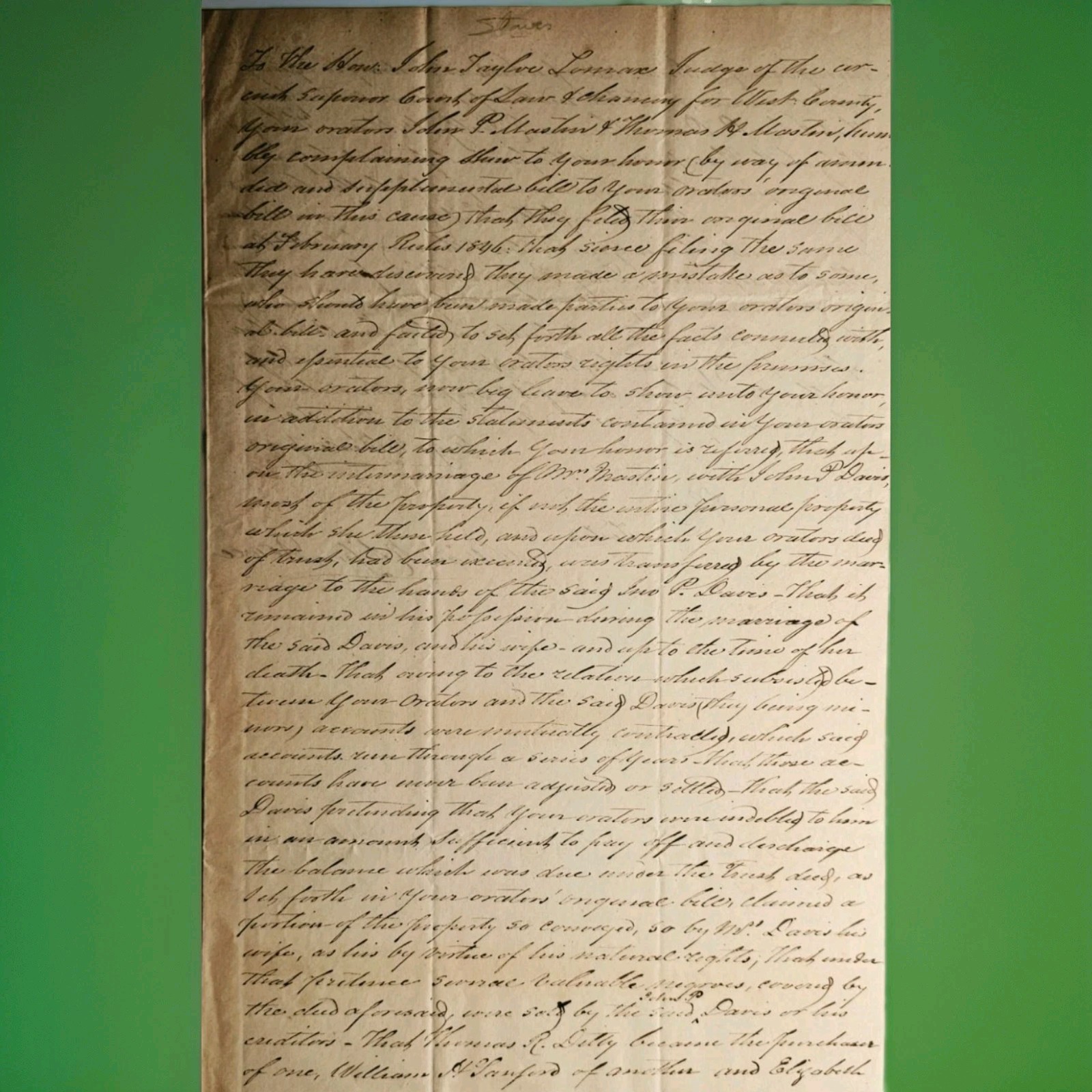
1846 Virginia Slavery Chancery Court Manuscript Judge John Tayloe Lomax York Co

When you click on links to various merchants on this site and make a purchase, this can result in this site earning a commission. Affiliate programs and affiliations include, but are not limited to, the eBay Partner Network.

1846 Virginia Slavery Chancery Court Manuscript Judge John Tayloe Lomax York Co:
$1495.00
The document alleges that property belonging to a woman identified as Mrs. Preston, later the wife of John P. Davis, had been subject to a deed of trust before her marriage. After her marriage, Davis obtained possession of her personal property pursuant to the marital-property regime of the period.
Of particular historical significance, the complainants state that “several valuable negroes” covered by the trust deed were subsequently sold by Davis or his creditors. Three purchasers are specifically named: Thomas R. Diggs, William H. Sanford, and Elizabeth Thompson.
Machen and Martin petition the court to compel those purchasers to “surrender up the slaves so by them purchased” to the complainants or to a court-appointed trustee.
An unusually direct primary-source record illustrating the intersection of American slavery, antebellum Virginia law, marriage and property rights, creditor claims, trusts, and chancery litigation.
Full DescriptionOffered here is an original handwritten Virginia chancery court document dating from 1846, addressed:
“To the Hon: John Taylor [Tayloe] Lomax Judge of the circuit Superior Court of Law & Chancery for York County”
The manuscript is an amended and supplemental bill filed by John P. Machen and Thomas H. Martin, who explain that their original bill had been filed at the February Rules, 1846.
They tell the court that after filing the first complaint, they discovered that certain necessary parties had been omitted and that additional facts concerning their rights under a deed of trust needed to be presented.
Marriage, Trust Property & John P. DavisThe dispute centers on property held by a woman identified as Mrs. Preston before her marriage to John P. Davis.
The document states:
“upon the intermarriage of Mrs Preston, with John P. Davis, most of the property, if not, the entire personal property which she then held, and upon which Your orators deed of trust, had been recorded, was transferred by the marriage to the hands of the said Jno P. Davis”
This passage is particularly interesting for the history of American women's property law. Before the widespread enactment of Married Women's Property Acts, marriage could radically alter a woman's legal control over her personal property.
According to the bill, the property remained in Davis's possession throughout the marriage and until his wife's death.
The complainants also describe a complicated financial relationship between themselves and Davis, involving accounts extending over a number of years that had never been fully adjusted or settled.
Enslaved People Sold Despite the TrustThe most historically significant passage concerns enslaved people included among the property governed by the deed of trust.
The complainants allege that Davis asserted ownership rights arising from his marriage and that:
“under that pretence several valuable negroes, covered by the deed aforesaid, were sold by the said Davis or his creditors”
The manuscript then identifies three individual purchasers:
“Thomas R. Diggs became the purchaser of one, William H Sanford of another and Elizabeth Thompson of a third.”
Thus, this document records at least three separate transfers of enslaved human beings whose ownership was being contested in a Virginia chancery proceeding.
The names of the enslaved individuals themselves unfortunately do not appear in this supplemental bill. They may have been identified in the original bill, deed of trust, inventories, depositions, or subsequent court papers associated with the case.
Court Asked to Recover the Enslaved PeopleMachen and Martin ask Judge Lomax to make Davis, Diggs, Sanford, Thompson and the defendants from the original proceeding formal parties to the supplemental litigation.
The prayer for relief contains the especially striking request:
“that the defendants, Diggs Sanford & Thompson may be directed to surrender up the slaves so by them purchased, to Your orators or to such trustee as this Hon: Court shall appoint”
The document therefore goes beyond merely mentioning slavery. The ownership and physical surrender of enslaved people constitutes one of the principal remedies sought from the court.
The complainants additionally ask for an accounting between themselves and John P. Davis to determine the outstanding financial obligations associated with the trust.
The petition concludes with the traditional chancery request:
“for such further & more general relief as this Court shall deem fit & proper & the nature of the case may require”
It is endorsed:
Mayo & Beale p.q.
followed by:
A Copy
Teste,
William R Lifson D.C.
The “Teste” notation indicates this example was issued as an authenticated court copy.
People MentionedJudge John Tayloe Lomax — 1781–1862John Tayloe Lomax is by far the most historically prominent individual associated with the document. Born in Caroline County, Virginia, in 1781, Lomax became an important Virginia lawyer, jurist, legal scholar, and educator.
In 1826 he became the first professor of law at the University of Virginia, teaching there until 1830. UVA describes him as a lawyer particularly knowledgeable in real-property law and chancery practice—precisely the fields involved in this document.
Lomax left the University of Virginia in 1830 to accept appointment as a Virginia circuit judge and remained on the bench for more than two decades.
He was also the author of major legal treatises, including works concerning real property and the law of executors and administrators, making him an important figure in antebellum American legal scholarship.
Lomax himself was also a participant in Virginia's slaveholding society. UVA's historical research records that the 1850 census listed him as owning seven enslaved people.
His involvement gives this manuscript additional interest for collectors of University of Virginia, Virginia judicial, legal, and slavery history.
John P. MachenJohn P. Machen is one of the two complainants or “orators” bringing the chancery action.
The document indicates that Machen and Thomas H. Martin held rights under the earlier deed of trust and maintained long-running financial accounts with John P. Davis.
I have not located enough reliable biographical evidence to attach this John P. Machen conclusively to a particular genealogical profile. He should therefore be identified conservatively as the York County-area Virginia litigant named in this 1846 proceeding rather than conflated with similarly named individuals.
Thomas H. MartinThomas H. Martin is the second complainant.
Together, Martin and Machen claim rights under the deed of trust and ask the court to recover property that they allege had improperly passed out of the trust.
As with Machen, presently available indexed material does not securely distinguish this Thomas H. Martin from the numerous Virginians of the same name. The manuscript itself is therefore an important primary genealogical record for him.
Mrs. Preston / Mrs. DavisThe woman at the center of the property arrangement is identified first as Mrs. Preston.
She subsequently married John P. Davis, after which the document refers to her as Davis's wife or Mrs. Davis.
According to the complainants, she held substantial personal property before the marriage, including property covered by their deed of trust. That property apparently included the enslaved individuals who later became the subject of the dispute.
She had died by the time described in this pleading.
Her appearance is especially relevant to research into antebellum women's property rights and coverture, because the bill expressly states that her personal property was transferred into her husband's possession through marriage.
John P. DavisJohn P. Davis was Mrs. Preston's husband and a central defendant.
The complainants allege that after their marriage he took possession of her personal property and retained it throughout the marriage.
Davis subsequently claimed that Machen and Martin owed him enough money to extinguish the balance due under the trust deed.
Most importantly, the pleading alleges that Davis claimed part of the trust property through his “marital rights” and that enslaved people covered by the trust were sold either by Davis himself or by his creditors.
Thomas R. DiggsThomas R. Diggs is specifically named as the purchaser of one enslaved person.
The complainants ask the court to compel Diggs to surrender the enslaved individual he had purchased.
This makes Diggs more than a peripheral witness: he became a defendant because ownership of the person he purchased was directly challenged under the earlier deed of trust.
William H. SanfordWilliam H. Sanford is identified as the purchaser of another enslaved person formerly included in the trust property.
Like Diggs, he was to be brought before the chancery court and potentially required to surrender the individual he had purchased.
Elizabeth ThompsonElizabeth Thompson is identified as purchaser of a third enslaved person.
Her inclusion is noteworthy because the document expressly identifies a woman participating in the antebellum slave market as a purchaser and defendant in the resulting property litigation.
The complainants likewise request that she surrender the enslaved individual to them or to a trustee appointed by the court.
Mayo & BealeThe pleading is endorsed “Mayo & Beale p.q.”
They were acting as counsel for the complainants. The abbreviation p.q. is derived from the traditional legal usage pro querente / pro querentibus, indicating representation of the complainant or complainants.
I would refrain from attaching specific first names to the attorneys without examination of the York County bar and court records for the period.
William R. Lifson, D.C.At the conclusion appears:
“A Copy / Teste, / William R Lifson D.C.”
Lifson was functioning in a court-clerk capacity, with “Teste” certifying the document as a true or official copy. The exact expansion of “D.C.” should be treated cautiously without consulting the contemporary York County court personnel records, but it likely represents a deputy clerk or comparable clerk's designation.
Historical ImportanceThis manuscript has several overlapping collecting angles:
Slavery & African American history: It records the sale of at least three enslaved people and a legal effort to recover them from their purchasers.
Virginia history: An original York County chancery record from the final two decades before the Civil War.
Legal history: Excellent primary evidence of antebellum trust law, creditor litigation, equity practice and chancery procedure.
Women's history: The litigation explicitly describes how a woman's personal property passed into her husband's possession following marriage.
Marriage & coverture: The husband specifically asserted his “marital rights” as justification for claiming property subject to the trust.
University of Virginia history: Addressed to John Tayloe Lomax, UVA's first professor of law.
Judicial history: Lomax was one of Virginia's leading antebellum judges and remained on the circuit bench until the 1850s.
Genealogy: Names Machen, Martin, Davis, Diggs, Sanford, Thompson, Preston, Mayo, Beale and Lifson in a precisely dated Virginia legal context.
ConditionOriginal period manuscript with expected fold lines, age toning, edge wear, minor staining/handling marks and other signs of age and archival use. Ink remains generally strong and the principal text is highly legible. Please examine all photographs carefully for exact condition.
This is an original 1846 document, not a reproduction.
A compelling primary-source artifact documenting how enslaved people, marriage property, trusts and creditor claims were adjudicated within antebellum Virginia's legal system, with an important association to Judge John Tayloe Lomax and the early history of the University of Virginia School of Law.
1846 Virginia Slavery Chancery Court Manuscript Judge John Tayloe Lomax York Co:
$1495.00
Related Items:
1846 Virginia Slavery Chancery Court Manuscript Judge John Tayloe Lomax York Co
$1495.00

Arlington VA postcard WEST FACADE LEE MANSION RUTH PERKINS SAFFORD 9/12 AW1846
$32.13
Vintage 24-A Virginia Annandale Chapel 1846 Lions Club Pin
$5.99