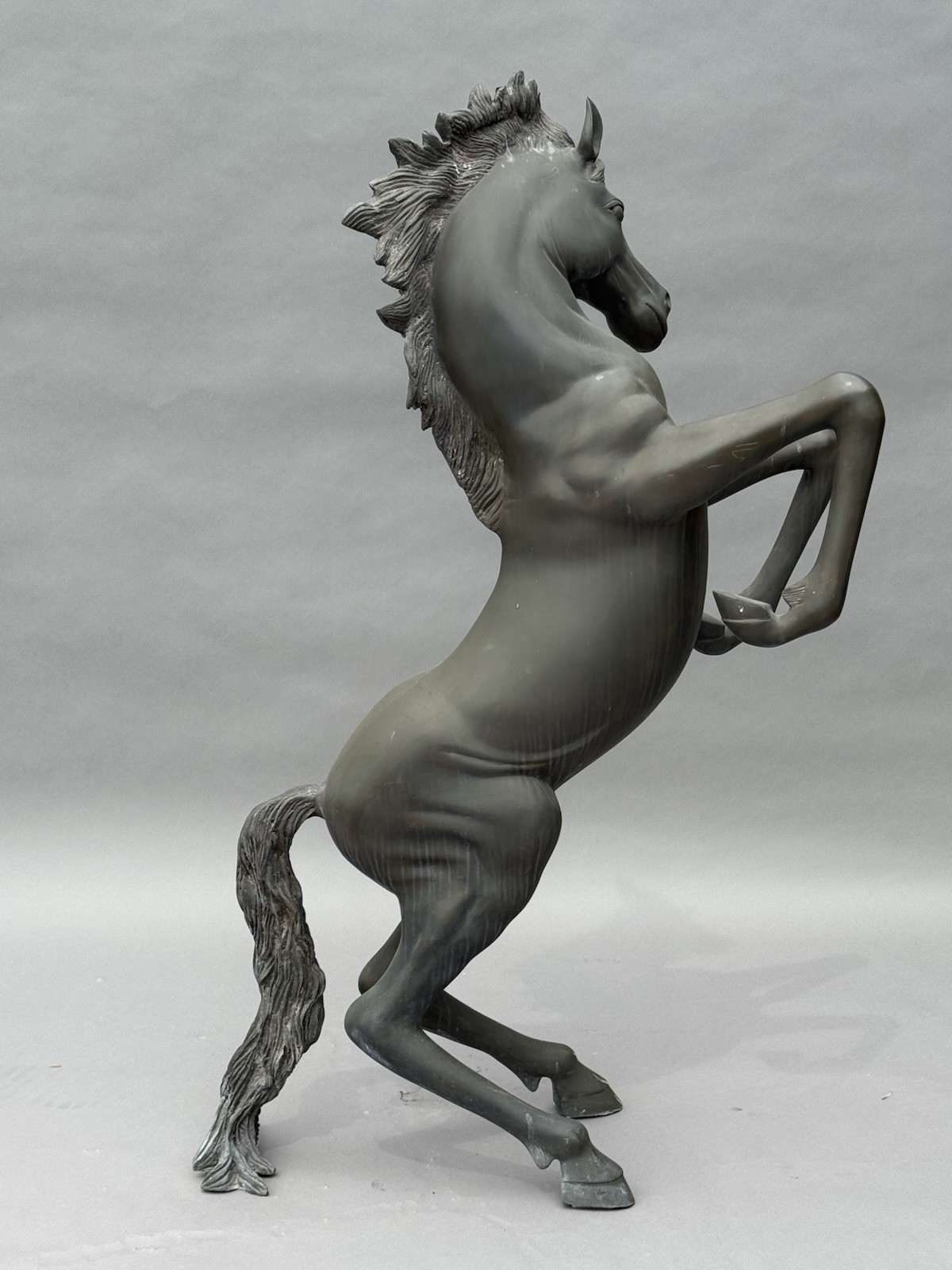
PIERRE JULES MENE ANTIQUE FRENCH BRONZE WILD STALLION HORSE STATUE SCULPTURE 56”

When you click on links to various merchants on this site and make a purchase, this can result in this site earning a commission. Affiliate programs and affiliations include, but are not limited to, the eBay Partner Network.

PIERRE JULES MENE ANTIQUE FRENCH BRONZE WILD STALLION HORSE STATUE SCULPTURE 56”:
$25000.00
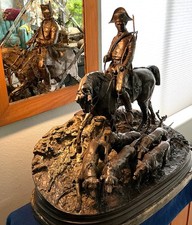
EXTRAORDINARY FRENCH ANTIQUE 19TH CENTURY WILD STALLION BRONZE HORSE STATUE-SCULPTURE BY REVERED FRENCH WILDLIFE SCULPTOR PIERRE JULES MENE. (French 1810-1879) THIS STRIKING, LIFE-SIZE SCULPTURE STANDS AN IMPRESSIVE 56 INCHES TALL, MASTERFULLY CAPTURING THE RAW POWER AND ELEGANT GRACE OF A REARING STALLION. MÊNE’S METICULOUS ATTENTION TO DETAIL IS EVIDENT IN THE STRIKING MUSCULATURE, DYNAMIC POSE, AND INTRICATE MANE AND TAIL, BRINGING THIS WILD HORSE TO LIFE. CAST IN SOLID BRONZE, THIS MASTERPIECE EMBODIES THE ARTISTIC GENIUS OF MÊNE AND REFLECTS THE HIGHEST LEVEL OF 19TH-CENTURY FRENCH CRAFTSMANSHIP. A TRULY REMARKABLE PIECE FOR DISCERNING COLLECTORS. THIS WORK IS SIGNED BY PIERRE JULES MENE ON THE HOOF. IT’S OVER 100 YEARS OLD. EXCELLENT OVERALL CONDITION. MILD SCRATCHES AS SHOWN.
DIMENSIONS: 56” H x 32” L x 15” W
PROVENANCE: PRIVATE ESTATE, LAGUNA NIGUEL, CALIFORNIA
Pierre Jules (P.J.) Mene (1810 - 1879) was active/lived in France. Pierre Jules Mene is known for Realistic animal sculpture, dogs, horses, and wildlife.
Pierre Jules (P.J.) Mene
Born: 1810 - Paris, France
Died: 1879 - Paris, France
Pierre Jules Mene (P. J. Mene) was born in Paris in March 1810 and died in Paris at number 9 Rue de L'Entrepot on May 21, 1879. The son of a metal turner, he received his earliest teaching on sculpture and foundry work from his father, and he opened his foundry in the 1850s, creating lost-wax castings of his sculptures in bronze. Although primarily self-taught, Mene was encouraged by sculptor René Compaire and was also influenced by two painters: Edwin Landseer of England, with his expressive sentimentality, as well as Carle Vernet of France, in capturing spirit, grace, and compositional beauty in sculptural form.
Much of Mene's early studies were made at the "Jardin des Plantes" in Paris, where he developed an excellent talent for animal sculpture. He first exhibited the bronze statuette entitled Dog and Fox at the Paris Salon in 1838 and exhibited regularly until his death. He received four awards from the Paris Salon: Second Class in 1848, First Class in 1852 and 1861, and a Third Class award in 1855. Mene did not sculpt statues, but bronze statuettes, generally of domestic and farm animals at rest (horses, dogs, cows, bulls, sheep, and goats). He modeled over 150 subjects and received the "Cross of the Legion of Honor" in 1861. He exhibited in England at the Great Expositions of 1855, 1867, and 1878, where he was praised as the "Landseer" of sculpture.
P. J. Mene was one of the most prolific and popular sculptors of the Animalier School and one of its earliest pioneers. His sculptures were widely collected by the public. The only sculpture acquired by the State of France during his lifetime was the bronze Mounted Huntsman and His Hounds. Charming and charismatic, Mene was socially accepted in various French artistic communities.
Mene's earliest works (such as Tiger and Alligator) reflected Antoine-Louis Barye's influence, but in contrast with the romantic style of Barye, Mene's style evolved in a contrasting way. He excelled in realistic portrayals of animals, sculpting each in their natural habitat, capturing fleeting movements and delicate details. Generally, his sculptures were portraits with a hint of human personality. Mene was praised for his "perfection in modeling the figures of animals, and for the truth and beauty of his representations." He worked in the Juste Milieu, blending romantic and naturalist elements while retaining a degree of traditionalism.
Mene's casts were of the highest quality and patinas. The last cast of an addition was edited as sharply as the first, and he was meticulous in the after-work of his bronze casts, chiseling extremely fine details. His bronzes were signed in block letters "P. J. Mene" with no foundry marks. He taught his son-in-law, Auguste Cain, who continued Mene's foundries from 1879 to 1892. Subsequently, Mene's models were sold to the Susse Freres Foundry, which cast well into the 20th century.
He lived his entire life in Paris, although he traveled from time to time; he took part in the Great Exhibitions of 1851 and 1862 in London and attained popularity in England second only to that he enjoyed in France.
He modeled mostly domestic animals, frequently horses; his bronzes of horses and jockeys were among his most popular, and other equestrian subjects attracted favorable attention. His models of pointers, setters, and foxhounds suggest a familiarity with shooting and foxhunting, although nothing is known of his participation in field sports.
Mêne died in Paris in 1879.
Museums:
Great Plains Art Museum (Lincoln, NE)
R W Norton Art Gallery (Shreveport, LA)
PIERRE JULES MENE ANTIQUE FRENCH BRONZE WILD STALLION HORSE STATUE SCULPTURE 56”:
$25000.00
Related Items:
PIERRE JULES MENE ANTIQUE FRENCH BRONZE WILD STALLION HORSE STATUE SCULPTURE 56”
$25000.00
PIERRE JULES MENE (PJ MENE) = FRENCH BRONZE CASTING (not a re-cast). made 1869.
$7500.00

Pierre Jules Mene (Fr. 1810-1879) Spaniel Capturing a Duck 18" Bronze
$5500.00