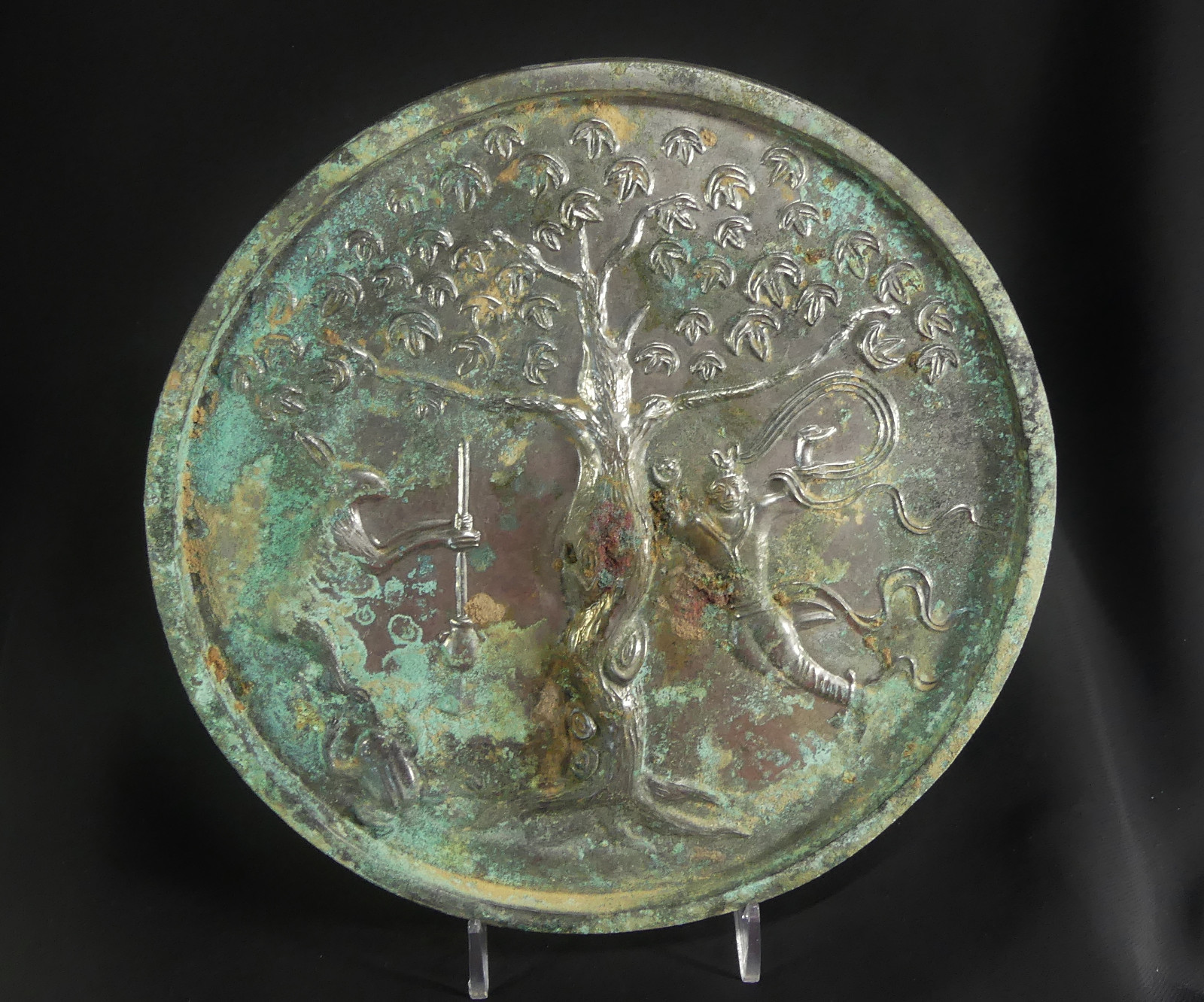
Ancient Chinese Tang Dyn. 7" Bronze Lunar Moon Immortality Mirror "Jade Rabbit"

When you click on links to various merchants on this site and make a purchase, this can result in this site earning a commission. Affiliate programs and affiliations include, but are not limited to, the eBay Partner Network.

Ancient Chinese Tang Dyn. 7" Bronze Lunar Moon Immortality Mirror "Jade Rabbit" :
$8400.00
Ancient Civilizations
Antiques, Artifacts & Fine Collectibles
Chinese Auspicious Silver-PlatedBronze Lunar Mirror:
Self-Healing GuìhuāTree 桂花 on the Moon
With the Chinese MoonGoddess “Chang’e” as
The “Jade Rabbit” Stirs the Elixir of Immortality
c. Tang Dynasty(618—907)
"TheJade Rabbit in the Moon pounds the medicine in vain."
~Li Bai, famous poet of the Tang Dynasty in his poem"The Old Dust"
Condition:
Museum qualitycondition for the discriminating private collector.
The silver-platedcoating on the bronze mirror is heavily encrusted with green oxidation from thebronze and red oxidation from the tin in the bronze. Notable loss of the silver plating on bothsides of the mirror, which has not been tested for thickness or purity. This mirror has a wonderful, old, greenish patina (from the malachite in thesurrounding soil interacting with the bronze) that is typical of bronze thathas been buried for over 1,200 years.
Although the smooth,polished side of mirror on the reverse side is heavily oxidized, it still showstraces of silver-coating and still reflects an image as you can see my handholding the camera in several of these photos.
A similar bronze mirror dated 722, now in theShanghai Museum, presents the earliest dated surviving Tang mirror design knownto us that depicts the lunar landscape.Therefore, this lunar Tang mirror dates to about 725—850 AD.
ChineseLunar Symbolism
Silver-coated bronze mirrors from TangDynasty (618 - 907) that depict the Moon Rabbit and the Gui Tree are seldom unearthedandtherefore considered VERY RARE and Highly Collectible! They arenormally only seen for sale at major sale house or in the world’s finest museums. This is a Museum quality piece that isExtremely RARE!!
ThisChinese figure of rabbit on the lunar surface is a representation of themythical Chinese “Jade Rabbit,” also called the “Gold Rabbit,” who lives on theMoon and creates the elixirs of immortality for the Buddhist Goddess of themoon, called Chang’e.
Thisstunning Bronze Moon Mirror dates approximately to China’s Tang Dynasty, whichlasted from 618-907. That’s right, thisbeautiful, silver-coated mirror is over 1,200-years-old.
TheJade Rabbit and the Moon Goddess “Chang’e”
Theamazing figure to the left of the tree is the Chinese Moon Goddess called“Chang’e.” According the Chinese legend,an immortal Jade Rabbit lives on the Earth’s Moon and makes elixirs of life. InChinese folklore, he is often portrayed as a companion of the Moon GoddessChang'e, constantly pounding the elixir of life for her. In Japanese and Korean versions, the JadeRabbit is just pounding the ingredients for rice cakes.
Anearly historical reference that there is a rabbit on the moon appears in the Chu Ci, a Western Han anthology ofChinese poems from the Warring States period, which notes that along with atoad, there is a rabbit on the Moon who constantly pounds herbs for theimmortals. This notion is supported by later texts, including the ImperialReadings of the Taiping Era encyclopedia of the Song Dynasty. Han Dynasty poetscall the rabbit on the moon the "Jade Rabbit" (玉兔) or the "Gold Rabbit" (金兔), and these phrases were often usedin place of the word for the moon. A famous poet of the Tang Dynasty period, LiBai, relates how: "The rabbit in the moon pounds the medicine invain" in his poem "The Old Dust."
TheMythical Story of Wu Gang & the Chinese Guìhuā Tree(桂花)
WuGang or Wu Kang is a character in Chinese folklore and Taoism who was set thetask of cutting down a self-healing Guìhuā Tree on the Moon. The story of Wu Gang has often been associatedwith the Mid-Autumn Festival, also known as the Moon Festival. The reason forthis connection remains unclear, although different versions of the story offerseveral different explanations.
TheBook of the Master of Huainan, fromthe Han Dynasty, records that when the moon waxes, the foot of an immortalgrows into a laurel. However, Wu Gang isnot mentioned in that book.
Miscellaneousmorsels from Youyang records that the tree on the Moon is over five hundred chihigh, and Wu Gang of Xihe stands under it. It is also recorded that immortalsare sent to the moon to chop down the laurel tree when they make a mistake.
Inthe earliest known version of the story as it exists now, Wu Gang's wife had anaffair with Yandi's grandson and had three sons with him. Wu murdered Yandi'sgrandson in revenge. Consequently, Yandi ordered Wu to be banished to the moon,where he would cut down a laurel tree. However, the tree healed itself aftereach blow. Consequently, Wu was forced to spend eternity trying to perform atask that could never be completed.
Inanother version of the tale, Wu Gang wished to learn to become an immortal, buthe did not try very hard. The Jade Emperor was furious and decided to punishhim. The Emperor created a cherry bay tree on the moon. Wu Gang was asked tochop it down in order to become an immortal. Wu Gang tried to chop down thetree but, because of the tree's self-healing abilities, it was impossible. Theshadows on the moon are said to be created by the cherry bay tree.
Inyet another version, Wu wished to be taught the method of eternal life. Hefound a teacher in the mountains. When his teacher tried to teach him to heal,Wu gave up after three days. When Wu was taught to play Chinese chess, he gaveup learning after two days. When Wu received lessons in the method of eternallife, he lost interest after a day. His teacher sent him to the moon to chopdown a tree of unnamed species.
Fromthe occasion of its blossoming, the sweet osmanthus is closely associated withthe Chinese Mid-Autumn Festival. Osmanthus wine isa traditional choice for the "reunion wine" drunk with one's family,and osmanthus-flavored confections and teas may also be consumed. Chinesemythology held that a sweet osmanthus grows on themoon and was endlessly cut by Wu Gang: some versions held that he was forced tocut it every 1000 years lest its luxuriant growth overshadow the moon itself,others that he was obliged to cut it constantly only to see it regrow an equalamount every day.
Inlate imperial China, the osmanthus was also associated with the imperialexaminations, which were held in the 8th lunar month.
Mirrors& the Moon in 8th Century China
Inancient China, bronze mirrors symbolized good fortune and were thought toprotect their owners against evil spirits.Chinese bronze mirrors are usually circular with one side highlypolished to provide a reflective surface and the other side decorated with aninscription and symbols.
Bronzemirrors were produced in China from Neolithic times until the Qing Dynasty,when Western glass mirrors were brought to China. Bronze mirrors were usuallycircular, with one side polished bright, to give a reflection, and the reverseside with designs. They usually had a knob in the center so that they could beattached to clothing.
Someof the earliest examples of Chinese bronze mirrors belonged to the NeolithicQijia culture from around 2,000 BC.However, until Warring States times (475--221 BC), bronze mirrors werenot common with approximately only twenty having been discovered.
Duringthe Warring States period, mirrors became particularly popular and then werenot produced in any great quantity until a revival during the famous TangDynasty (618--907). During that time,they became the "go-to" gift to present to young, marriedcouples. They vary in size and, ofcourse, style. This 20 cm example is oneof the larger types and the mythical moon motifs are stunning. Please look carefully at the macro photos andyou will see the amazing detail that has been cast in relief.
MIRRORSin China
Simpleundecorated bronze mirrors first appeared during Neolithic times while theearliest decorated mirror, which was discovered in a tomb in Qinghai Province,dates to the Xia Dynasty (2100-1600 BC).
Interms of quality and production, the period from the Warring States (475-221BC) through the Tang Dynasty (618-907 AD) was the heyday of Chinese bronzemirrors. By the middle of the Qing (Ch’ing) Dynasty (1644-1911 AD),bronze mirrors began to be replaced by glass mirrors and the 4,000 year historyof bronze mirror use was nearing its end.
Mirrorswere believed to have strong amulet powers that could ward off evilspirits. An invisible demon would fleewhen it saw its reflection in a mirror. Since it is believed that this mirrorwas used to provide protection, the mirror was probably hung with theinscription side facing outwards.
Mirrorsused for this purpose frequently had concave surfaces on the side with theinscription and decorations. This mirror is concave on its inscriptionside, as the Chinese believed a concave mirror would “invert” the image of aghost, and thus “overturn” or repel any evil influences.
Forthis reason, Daoists often wore these mirrors hanging down the back to protectagainst being blind-sided by a ghost. Thesemirrors were given as wedding and birthday gifts and hung in traditional Chinese houses inorder to scare away evil spirits and to bring good luck and prosperity. Daoist priests also used the concave bronzemirrors to collect dew which, because of its “purity,” was used in rituals.
Visualand Spoken Chinese Auspicious Symbols
Oneof the peculiarities of the Chinese language is that it has a very large numberof written characters, but a much smaller number of spoken sounds. As a result, many Chinese characters sharethe same pronunciation, i.e. are homonyms.
Theimages cast into ancient, bronze mirrors frequently took advantage of thischaracteristic. The mirrors may usedepictions of animals, plants and other objects to substitute for other wordsbecause of their similarity in pronunciation, even though they may not have anyother relationship to what is being expressed.So, the pictures of animals on mirrors usually have hidden or impliedmeaning or a visual pun if you will, and this is what the Chinese refer to as“auspicious or lucky pictures” (jixiangtuan吉祥图 案). A more technical term in English would be arebus.
Objectson mirrors such as mythical animals have become symbols because of theirsimilar pronunciation to auspicious Chinese words. On this elaborately cast mirror there are anumber of such “auspicious symbols.” Listed below is as short explanation of each of these symbols.
TheChinese word for "round" (yuan 圆)is pronounced the same as the word for "first" (yuan 元). Again, the round, bronzemirror suggests that this lovely mirror was a birthday gift and a wish fora long life and a happy marriage.
Mirrorsin China symbolize good fortune and are believed to protect against evilspirits.
Traditionalmarriage gifts included a bronze mirror (tongjing铜镜)and shoes (xie 鞋)because the words combined express "together and in harmony" (tongxie 同谐). The mirror can be included as one of theEight Treasures.
CONDITION
Museums and modern archeological studiesusually use the general term “copper alloy” instead of just the term “bronze”to describe these ancient treasures, as many other elements (such as tin, lead,zinc, iron, and even arsenic) were added to the copper to form differentstrengths of types of bronze items.Ancient bronze artifacts such as this mirror are probably about 80%copper and 20% tin, while modern bronze is closer to 88% copper and 12% tin.
It has a wonderful old, patina that isabsolutely fabulous: a greenish patina from the malachite in the surroundingsoil and some dark red patina from the cuprite and iron in the soil. This combination of colors forms a fantasticpatina that is typical of bronze that has been buried for over 2,000years. Close examination with amicroscope under natural and black light reveal it to be 100% authentic andcast by hand in a sand mold.
One interesting property of bronze is thatonce it has oxidized superficially, a copper oxide layer is formed on thesurface and essentially protects the object from further damagingcorrosion. This protective layer turnsin another compound, called copper carbonate for you scientists out there,which protects most bronze pieces from further corrosion.
I havecarefully examined this mirror under magnification and it shows authentic andoriginal signs of weathering and ground contact that help to furtherauthenticate it as an ancient piece. It shows green oxidation, pitting and erosion on both sides, especially on the mirror side.
You will not be disappointed! It is exceeding rare to find silver platedbronze mirrors for sale. It is a museumquality, ancient Chinese work of art.
It is a wonderful piece and would look greatdisplayed next to your other fine ancient Chinese jade and bronze pieces!
It would also make a fantastic wedding gift for that special couple!
ESTIMATEDVALUE
This extraordinary Tang Dynasty Lunar Mirrorhas a pre-sale estimate of $50,000 to $75,000.
At an sale in NY on March 21-22,2013, a similar although smaller Silver-Plated Bronze Moon Mirror with the MoonGoddess Chang’e and the Jade Rabbit soldfor an eye-popping $93,750!! You can addthis mirror to your collection for a fraction of that price!
At a recent sale, a similar but larger bronze mirror was estimated to sell between $60,000-$80,000,but the mirror actually sold for an eye-popping US$102,500!
It is a wonderful piece and would look great displayed next to your other fine ancient Chinese jade and bronze pieces, or in your Space collection!
Please examine the photos taken indoors carefully as they are part of the description.
The contemporary stand is not included for in this sale.
And please ask any questions before you buy. Thanks!
Ancient Chinese Tang Dyn. 7" Bronze Lunar Moon Immortality Mirror "Jade Rabbit" :
$8400.00
Related Items:
Mermaid Key Stone "Chichén Itzá" From Kukulkan Temple "Ancient Chinese 🪶 🐉"
$1000000.00
Ancient Chinese Tang Dyn. 7" Bronze Lunar Moon Immortality Mirror "Jade Rabbit"
$16800.00
RARE Ancient Chinese Clay Stoneware Tomb Model Cook Stove with Fish Han Dyn.
$9250.00