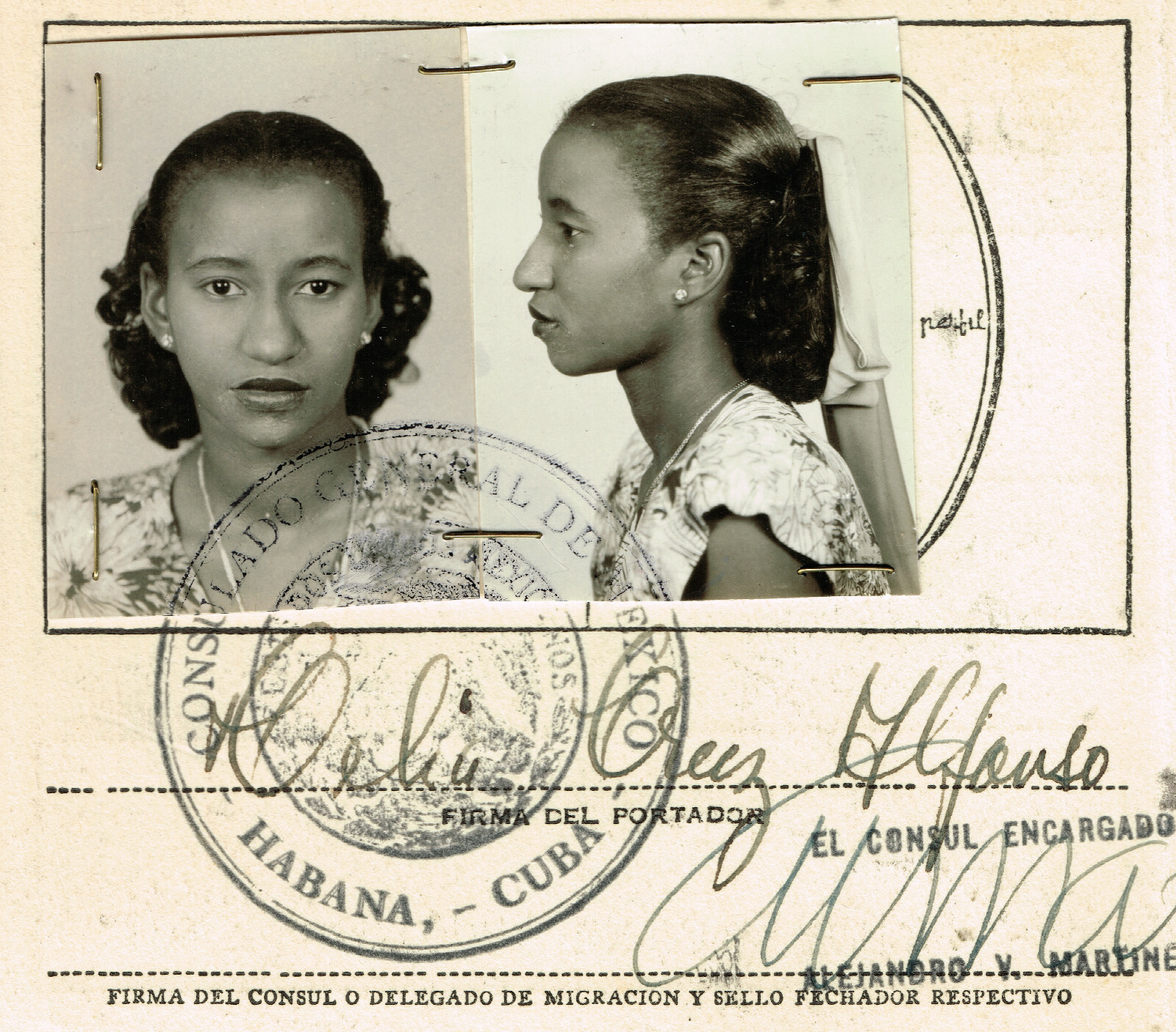
CELIA CRUZ ALFONSO AUTOGRAPH SIGNED DOCUMENT Jul,1948 (Mexico Migration Sheet)

When you click on links to various merchants on this site and make a purchase, this can result in this site earning a commission. Affiliate programs and affiliations include, but are not limited to, the eBay Partner Network.

CELIA CRUZ ALFONSO AUTOGRAPH SIGNED DOCUMENT Jul,1948 (Mexico Migration Sheet):
$10000.02
CELIA CRUZ ALFONSO
SINGER
DOCUMENT SIGNED 07/15/1948
(Ficha migratoria con fotografía de frente y costado, con su firma
de la cantante de "Azucar" a los 22 años, expedida por el Consulado de México en la H)
Autograph of Celia Cruz Alfonso
Signed Migration Sheet: "Celia Cruz Alfonso ",
in iron gall ink. 5.5 x 8.5 (14 x 21cm.) One page. Dated:
Jul 15, 1948
SERVICIO DEMIGRACION FORMA 5,
15 de Julio de1948 NUM. 219330-303
TARJETA DE IDENTIFICACION EXPEDIDA POR MEDIA FILIACION DELINTERESADO
El ConsuladoGeneral de México en la H, C.ESTATURA 1.62 Mtrs. COMPLEXIONdelgada
A CELIA CRUZ YALFONSO COLOR negro PELO negro
CEJAS OJOS negro
CUYO RETRATO YFIRMA CONSTAN EN SEGUIDA NARIZ chata BOCA grande
BIGOTE ------- BARBA ---------
(Fotografía de frente y costado SEÑAS PARTICULARES ninguna
(“SELLO” CONSULADO GENERAL DE MEXICO) DATOS COMPLEMENTARIOS
() AÑO EN QUE NACIO Oct. 21-1925 EDO. CIVIL soltera
PROFESION, OFICIO U OCUPACION Artista
Celia Cruz Alfonso IDIOMA NATIVOcastellano
FIRMA DEL PORTADOR LUGAR DE NACIMIENTO La H, C
NACIONALIDADACTUALC.
ALEJANDRO Y MARTINEZ RELIGIONcatólica
FIRMA DEL CONSUL Y SELLOFECHADOR NOMBRE Y DOMICILIO DE SU PARIENTE MASCERCANO
Simon Cruz,Flores # 511,
ANEXO A LATARJETA F.5 # 219330, EXPEDIDA POR EL CONSULADO GRAL.
DE MEXICO EN LA H. A FAVOR DE LA SRTA. CELIA CARIDAD CRUZ Y ALFONSO,
DE NACIONALIDAD C.
Admitida encalidad de NO INMIGRANTE POR SEIS MESES, en los términos del Art. 50 fracciónIII
De la Ley Gral. DePoblación vigente y de conformidad con el correográma # 20194 del 16 de Junio.
Ppdo. Expediente 4/351.5.48/1867, para el exclusivo objeto de venir a prestar susservicios artísticos
a las Empresas del Teatro “Follies Bergere” y al centro nocturno“Waikiki”,
De esta Ciudad.PAGO LA CANTIDADA DE $ 200.00 (DOSCIENTOS PESOS, M.N.,) en el Consulado
Gral. De Méxicoen la H., C., según Rec. Oficial # 4293419, por concepto de Impuesto
De Migración.Presentó Pasaporte # 30229 con Visa # 2144 del 15 de Julio actual, por
El Consulado Gral. DeMéxico en La H., C.
Puerto CentralAéreo en México, D.F. a 15 de Julio de 1948
EL AGENTE DE MIGRACION.
HECTOR LUJAMBIO G.
ANNEX TO CARD F.5 # 219330,ISSUED BY THE GRAL CONSULATE. FROM MEXICO IN H.,
C. IN FAVOR OF LA SRTA.CELIA CARIDAD CRUZ Y ALFONSO, OF NATIONALITY C.
Admitted as a NON-IMMIGRANTFOR SIX MONTHS,
under the terms of Art. 50 section III
Of the General Law ofPopulation in force and in accordance with the corregraph # 20194 of June 16.
Ppdo. File 4 / 351.5.48 / 1867, for the exclusive purpose of coming to provideartistic services to
the Companies of the “Follies Bergere” Theater and the“Waikiki” Night Center,
Of this Citizen. I PAY THECANTIDATE OF $ 200.00 (TWO HUNDRED PESOS, M.N.,) at General
Consulate of Mexico in H,C, according to Official Rec. # 4293419, for Tax concept
Migration he presentedPassport # 30229 with Visa # 2144 of the current July 15, for
The General Consulate from Mexicoin H, C.
Central Air Port in Mexico,D.F. July 15, 1948
First Migratory document of Celia Cruz to leave
"Usted esta Protegido al hacer su compra en el Pago con PayPal,
además de que cuenta con 60 días en caso de devolución,tiempo suficiente
para realizar un certificado de autenticidad con la empresaque usted guste en USA.
Tal vez después del primer Pasaporte de Celia Cruz en 1947cuando salió por primera vez de su país. hacia Caracas; que su representanteOmer Pardillo pago aun Austriaco en $5,000 dlls hace ya varios años, este es elsegundo Documento oficial de su segundo viaje fuera de su país a México en 1948donde la catapulto a la fama, cuyo documento hasta ahora desconocido que seconozca mas valiosa
de "La Reyna de la Salsa" no deje pasar laOportunidad de hacerse de este Documento"
Biografía
Úrsula Hilaria Celia de la Caridad CruzAlfonso (October 21, 1925 – July 16, 2003), known simply and professionally asCelia Cruz, was a singer and the most popular Latin artist of the 20thcentury. Cruz was renowned internationally as the "Queen of Salsa","La Guarachera de C.", as well as "The Queen of LatinMusic".
Throughout her career, Celia Cruzinterpreted and internationally popularized tropical rhythms such as Son,Guaguancó, Rumba, Guaracha and Bolero. However, the genre that led to stardomwas Salsa.
She began her career in her native ,earning recognition as a vocalist of the popular musical group SonoraMatancera, a musical association that lasted fifteen years (1950-1965). In the1960s, after the triumph of the C. Revolution, Cruz left her native country,becoming one of the symbols and spokespersons of the C. community in exile.Cruz continued her career, first in Mexico, and then in the United States, thecountry that she took as her definitive residence. In the 1970s she was fullyincorporated into the Salsa genre, especially after her musical associationwith other artists of the genre within the Fania All-Stars. During the lastyears of her career, Cruz had already become a myth of Latin American music.Her constant evolution in the world of music, helped her to remain in forcepractically until her death and to conquer new generations of followers. Hercareer formed an invaluable legacy and inescapable reference for futuregenerations who discover in her a powerful and prolific source of inspiration.Some of the songs performed by her are part of the cultural heritage of LatinAmerica. Among the most famous are Quimbara, Burundanga, La Vida Es Un Carnavaland La negra tiene tumbao, among many others. Her musical legacy is made up ofa total of 37 studio albums, in addition to many other special recordings,records in live or associations with other singers. In her career she wasawarded numerous prizes, recognitions and distinctions, including two GrammyAwards and three Latin Grammy Awards. In addition to her prolific career inmusic, Cruz also made some punctual interventions as an actress in movies andtelenovelas.
Celia Cruz also made famous the expression¡Azúcar! (Sugar!) Which she adopted and it remained in the collective memory asher identifying phrase, which she shouted as a carnival ad inciting fun. With aunique style and an iconic image of unsurpassed attractiveness thanks to acharismatic and musical talent that is difficult to replicate, Celia Cruz isconsidered an authentic symbol of Latin culture worldwide.
Contents
Early life
Úrsula Hilaria Celia de la Caridad CruzAlfonso was born in the Santos Suárez neighborhood of . Her father,Simón Cruz, was a railway stoker, and her mother, Catalina Alfonso Ramos, ahousewife. Cruz shared her childhood with her three siblings: Dolores, Gladysand Bárbaro and numerous cousins. Her chores included lullabies for the littleones. So she began to sing. Her father wanted her to be a school teacher, andnot without regret she tried to satisfy him and studied teaching. When she wasabout to finish the career and left to enter the National Conservatory of Music
Meanwhile, Cruz participated in radioprograms for amateurs, such as La Hora del Té or La Suprema Corte del Arte, inwhich she won first prizes such as a cake or a silver chain, until by herperformance of the tango Nostalgia received in payment 15 dollars. She latersang in the orchestras Gloria Matancera and Sonora Caracas.
Celia Cruz in the 1950s with the members ofthe Sonora Matancera in
Career
Beginning
In 1948, Roderico Rodney Neyra founded thegroup of dancers and singers Las Mulatas de Fuego. Cruz was hired with thisgroup as a singer, reaching great success and making presentations in Mexicoand Venezuela. With the Mulatas de Fuego, Cruz recorded some songs. Shortlythereafter, Cruz began to sing on musical programs at Radio Cadena Suaritos,along with a group that performed Yoruba choruses and rhythms and recorded asong with the singer Obdulio Morales. The songs she recorded at that momentwould be incorporated later to one of the first compilations of her work in LPformat.
In 1950, Cruz met the businessman RafaelSotolongo who sought her out because he wanted her to sing with the SonoraMatancera, at that time the most popular and successful music group in .This is because the lead vocalist of the orchestra, the Puerto Rican singerMyrta Silva had decided to leave the group to return to Puerto Rico, leavingthe vacancy for a female voice available. Her income was approved by thedirector of the group, Rogelio Martínez. Upon hearing of this interview, themanagers of the radio where she worked were arbitrarily dismissed.
Sonora Matancera
In her first rehearsal with SonoraMatancera, Cruz met her future husband Pedro Knight, who was the band's secondtrumpeter. Cruz debuted with the group on August 3, 1950. Initially Cruz wasnot received with enthusiasm by the public, but Rogelio Martínez had faith inher. On December 15, 1950, Cruz recorded her first songs with the group, whichwere a resounding success. Her "musical marriage" with the SonoraMatancera lasted fifteen years. That's where the successes of Burundanga, ElYerberito Moderno, Tu voz, Pa 'la pigeon and many others come from. In totalCelia recorded 188 songs with the Matancera. With the group, Celia also madeshort musical interventions in Mexican and C. films.
After C. Revolution
On July 15, 1960, when the Cuban Revolutionled by F. C. began, a contract for the Sonora Matancera in Mexico arose.Cruz never imagined that she would ever step on C. soil again. The new C.regime looked with bad eyes that the group will accept offers to work abroad,specifically in the United States. Thus, the Castro regime arbitrarily forbadeher to return to C. When she completed a month of stay in Mexico, shereceived the news of the death of her father Simón Cruz. In 1961, Cruz and theSonora left for the United States for a contract. Celia began performing soloperformances without the orchestra. She performed at a recital at the HollywoodPalladium in Los Angeles. In 1962, before the refusal of the government of hercountry to allow her to return to C. soil, Celia acquired a house in NewYork. Although she tried to return to Cuba to see her mother sick, the C.government forbade her to return. A fatal day for Celia arrived on April 7 ofthat year. When she was preparing to act, she received the news of the death ofher mother Catalina Alfonso, who had been struggling with terminal bladdercancer. In that same year, on July 14, Cruz was married in civil ceremony withPedro Knight after a romance of several years. Cruz and the Sonora Matanceramade their first tour outside the American continent, visiting Europe andJapan, where they performed with Tito Puente. In 1965, Cruz would culminate avertiginous fifteen years with the Sonora Matancera. Cruz began a solo careerand her husband Pedro Knight decided to leave his position at Sonora Matancerato become her representative, arranger and personal director. In parallel, Cruzhad adopted the American nationality.
In 1966, Cruz was contacted by Tito Puenteto perform with his orchestra. Cruz and Puente started an association thatreleased five albums. She also recorded albums with the Orquesta de MemoSalamanca, Juan Bruno Tarraza and Lino Frías under the TICO Records label. Fromthis time one of her great successes was revealed: Bemba Colorá. EventuallyCruz joined Vaya Records. A musical change made her enter into Salsa music. In1973, Cruz teamed up with the pianist and exclusive artist of the Fania Recordslabel Larry Harlow and led an Afro-C. music concert at Carnegie Hall in NewYork. There Cruz interpreted Divine Grace, her first song of the Salsa genreand the door to this new rhythm. The album resulting from this meeting wasproduced by the now defunct Jerry Masucci, who is considered one of thecreators of the Salsa genre along with the Dominican musician Johnny Pacheco.Later, she participated in a legendary concert recorded live at Yankee Stadiumwith The Fania All-Stars, a group composed of leaders of Latino groups thatrecorded for the Fania label.
Salsa music and The Fania All-Stars
Celia Cruz performing in Paris at theOlympia in 1980
Cruz signed a contract with the recordcompany of Masucci, VAYA (Subsidiary of Fania). In 1974 she released the albumCelia & Johnny, with Johnny Pacheco, who was a great success. Cruzintegrated fully with the Fania All-Stars orchestra, which was a combination ofthe musicians of each orchestra that played for the musical label Fania (likeJohnny Pacheco, Héctor Lavoe, Willie Colón and others) With the FaniaAll-Stars, Cruz had the opportunity to visit the United Kingdom, France andZaire. In 1977, Cruz recorded her first record with the backing of thetrombonist and salsa orchestrator Willie Colón, a fusion that would be repeatedwith great success in 1981 and in 1987.
In 1982, Celia was reunited with the SonoraMatancera, and recorded the album Feliz Encuentro. In that year the singerreceived the first tribute of her career at Madison Square Garden in New York.In 1987, Cruz performed a concert in Santa Cruz de Tenerife. That concert wasrecognized by the publisher of the Guinness Book of Records as the largestoutdoor free entry. 250,000 people attended the concert. In 1989, she won herfirst Grammy Award for the album Ritmo en el corazón. She was also invited tocelebrate the 65th anniversary of the Sonora Matancera in Central Park in NewYork. The decline of Salsa success gradually brought the end of Celia's musicalassociation with the Fania All Stars.
Later years
In 1990 Cruz managed to return to C. Shewas invited to make a presentation at the US base in Guantanamo. When she cameout of this presentation she took in a bag a few grams of earth from C., thesame one she asked to be placed in her coffin when she died.
Although she had previously made musicalpresentations in Mexican and C. films, in 1992 Celia debuted as an actressin the American film Mambo Kings, along with Armand Assante and AntonioBanderas. A year later she made her debut as a television actress in theMexican telenovela Valentina, along with Verónica Castro for the Televisanetwork.
In 1995, Celia has a special participationin the American film The Perez Family, along with Alfred Molina and AngelicaHuston. In 1997 she starred again for Televisa the Mexican telenovela El almano tiene color, a remake of the classic Mexican film Angelitos negros, andwhere Cruz plays the role of a black woman who gives birth to a white daughter.On October 25 of that year the city of San Francisco officially declared thatdate as "Celia Cruz Day".
In 1998 she released the album Mi vida escantar, from which one of her most successful themes is revealed: La Vida Es UnCarnaval. In 1999, she performed with Luciano Pavarotti for the Pavarotti andFriends concert. In 2000, Cruz released a new album under the auspices of SonyMusic: Celia Cruz and Friends: A Night of Salsa, where she recorded again withTito Puente, who died a little later. Thanks to this album, Cruz was awardedwith her first Latin Grammy. In 2001, the album Siempre Viviré makes her thecreditor of her second Latin Grammy. In that same year, she performed with MarcAnthony in a tribute to Aretha Franklin for VH1.
In 2002, Cruz released the album, La NegraTiene Tumbao, where she ventured into modern variants of Caribbean rhythms,influenced by rap and hip hop. For this record she obtains her third LatinGrammy and her second American Grammy.
Dexter Lehtinen, Celia Cruz, Alonso R. delPortillo, Rep. Ros-Lehtinen, and Pedro Knight in May 1992
Death
Celia Cruz's mausoleum in WoodlawnCemetery, The Bronx, New York
During a presentation in Mexico, Cruzsuffered a health mishap. As a result of this, it was discovered that shesuffered from glioma, (a very aggressive brain tumor), and underwent anoperation to remove it at the end of that year, to then try to resume herartistic career. She recorded her last album, entitled Regalo del Alma. InMarch 2003, it was offered a tribute by the US Hispanic network Telemundo,which involved figures such as Gloria Estefan, Marc Anthony, La India, GloriaGaynor and Patti LaBelle among others. This was her last public appearance.
On the afternoon of July 16, 2003, CeliaCruz died at her home in Fort Lee, New Jersey, at the age of 77. At her expresswish, her mortal remains were first transferred to Miami for two days toreceive the homage of her C. exile admirers, returning and finally resting inthe Woodlawn Cemetery in The Bronx, New York. An epilogue in her autobiographynotes that, in accordance with her wishes, C. soil which she had saved froma visit to Guantánamo Bay was used in her entombment
CELIA CRUZ ALFONSO AUTOGRAPH SIGNED DOCUMENT Jul,1948 (Mexico Migration Sheet):
$10000.02
Related Items:
CELIA CRUZ ALFONSO AUTOGRAPH SIGNED DOCUMENT Jul,1948 (Mexico Migration Sheet)
$10000.02
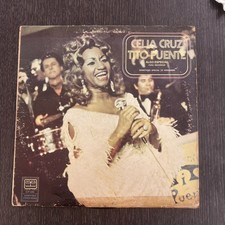
RARE VINTAGE LP VINYL AUTOGRAPH BY CUBAN CELIA CRUZ AND PUERTO RICAN TITO PUENTE
$1195.00
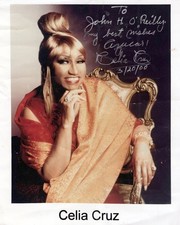
CUBA CUBAN SALSA QUEEN CELIA CRUZ SIGNED INSCRIBED PORTRAIT 2000 ORIG Photo 1100
$874.99