1910 'Passage System of the Great Pyramid of Giza in the Land of Egypt'

When you click on links to various merchants on this site and make a purchase, this can result in this site earning a commission. Affiliate programs and affiliations include, but are not limited to, the eBay Partner Network.

1910 'Passage System of the Great Pyramid of Giza in the Land of Egypt':
$2500.00
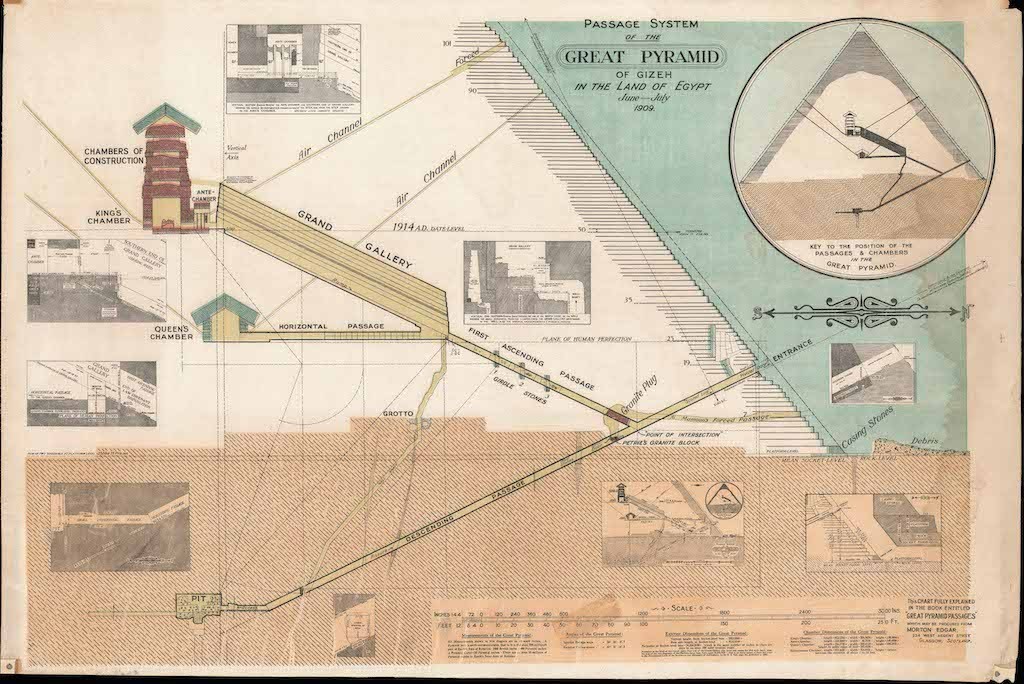
125 x 82 cm (49 x 32.25 in). Very good. Water stain right side. Some edge wear and damage to upper left and right corners where there were formerly grommets.A remarkable muslin banner depicting the internal architecture of the Great Pyramid at Giza and touting a wild theory proposed by the pyramidologist founder of the Jehovah's Witnesses.
This large and striking waxed muslin banner is among the most unique items we have ever encountered. The motif is essentially a cross-section of the great Cheops pyramid at Giza, but the image is far more than an archaeological or architectural drawing. It is also brimming with eccentric ideas characteristic of the age in which it was produced.
The banner was created by two post-Victorian adventurers, John and Morton Edgar. The brothers traveled to Egypt in the summer of 1909 to survey the wondrous structure at Giza. The following year, John died just as a report of their findings was published:The Great Pyramid Passages and Chambers In Which Is Shown How the Great Pyramid of Gizeh Symbolically and By Measurement Corroborates the Philosophy and Prophetic Times and Seasons of the Divine Plan of the Ages, as Contained in the Holy Scriptures(Glasgow: Bone and; Hulley, 1910).
The report included many plans, drawings, and photographs of the pyramid, including a large plate in Chapter 4 labeledPassage System of the Great Pyramid of Gizeh. Our banner is an enlargement of that plate, and a likely explanation of its creation is that Morton Edgar commissioned it as a tool for the lecturing tours he did after his journey to Egypt (two surviving grommets corroborate this in the lower corners).
The Edgars were what we were known at the time as pyramidologists.Pyramidologywas the study of pyramids with the aim of discovering hidden meanings in their existence. Pyramidologists believed an underlying mystical, metaphysical, or even theological purpose was waiting to be uncovered. The premise, of course, hinged on a notion that the burial function, commonly considered the primary purpose of Egyptian pyramids, camouFlages the building's true nature, which can only be discerned through a careful correlation of physical attributes with certain sacred or esoteric texts.
John and Morton Edgar were inspired by their spiritual mentor, Charles Taze Russell (1852 - 1916). Russell was a Pittsburgh minister and founder of theBible Studentmovement, which later developed into the Jehovah's Witnesses. He postulated a theory in which the ancient Hebrews were responsible for building the Great Pyramid. To Russell, the structure was an enormous mystical artifact mapping Biblical events and culminating in the End of Days as predicted in Revelations.
In the introduction to their book, the Edgars claim that Russell's dedicated study of scripture 'enabled [them] to discover symbolic and prophetic features in the Great Pyramid' that others had overlooked. Russell hypothesized that the different passages discovered within the pyramid - and shown clearly on the banner - represent significant Biblical events such as the fall of man, the provision of Mosaic Law, and the death of Christ. These ideas enthralled the Edgar brothers, and their trip to Egypt in the summer of 1909 was mainly about bolstering Russell's interpretations with their empirical observations.
To achieve their goal, the Edgar brothers needed to investigate the internal layout of the pyramid carefully. The central image of the banner is a detailed cross-sectional view of the northern side of the Cheops Pyramid, showing the interior's main passages, galleries, tombs, chambers, and air channels. The illustration is rife with detail, with illustrated features and delineations of the pyramid's courses and distinguishing elements cut directly into the bedrock. Interspersed throughout are insets of specific architectural elements, shown without color and at a significantly closer scale.
In many ways, the view corresponds to the kind of educational illustrations one finds in egyptological textbooks today. Much of what is portrayed here is indeed relatively factual (e.g. the alignment of the air shafts to celestial bodies). However, a closer look reveals various elements that betray the sectarian motivation behind its composition. Among the most revealing features are two axis lines labeled 1914 A.D. Date-LevelandPlane of Human Perfection. Based on Russell's musings, Morton proposed that the Great Pyramid was designed as an allegorical chronograph plotting human history since Creation. Moreover, he believed this 'clock' was still counting down to the Second Coming of Christ and thus Judgement Day.
While most of the explanatory detail is found in the associated book, Morton associates the original base of the Pyramid with the moment of Creation, and the original entrance is seen as marking the Great Flood. The descent of the passage beyond this entrance corresponds to man's descent into selfishness and evil. Halfway into the pyramid, the descending pathway is met by an ascending one, which leads through the great galleries into Pharaoh's tomb chamber. Marked on the banner as thePoint of Intersection,this ascent of humanity symbolizes the formative struggles of Babylonian captivity, the rise of the House of King David, and the compilation of an officially recognized Hebrew Bible.
For its part, thePlane of Human Perfectionrepresents the birth of Christ and corresponds precisely to the position of the Queen's burial chamber. In this way, the large gallery that continues up to Cheop's burial chamber represents the positive growth of a dignified and righteous humanity which, much like the galleries culminating in the main burial chamber, will correspond to the Second Coming and thus the End of Days.Conclusion
In light of the view that the Pharaoh's burial chamber corresponds to the dated Second Coming of Christ and that Morton used his banner specifically to lecture on this matter in the years leading up to 1914, the entire composition is loaded with a sense of ecstatic religious urgency. This banner is not just a unique relic of early pyramidology. It is also a vivid testimony to Ancient Egypt's thrall over European societies following the Napoleonic endeavor to catalog it. Above all, it is an early marker of one of the most eccentric and successful Christian sects created in the 20th century.Census
The banner is undated, but a note in the lower right corner refers to the Edgar book from 1910. As this was the same year John died, we find only Morton's name listed as seller in the imprint. The notion of enlarging one of the book's key plates to become an educational banner makes it likely that it was conceived and commissioned as a lecturing tool by Morton Edgar himself.
The OCLC has a few listings of the Edgars' bookThe Great Pyramid Passages and Chambers,including examples at UCLA and the University of Michigan (no. 987718765). Unsurprisingly, one can also find an example of the Edgar tome in the National Library of Scotland (no. 678879092). The book is not listed in the ESTC.
1910 'Passage System of the Great Pyramid of Giza in the Land of Egypt':
$2500.00
Related Items:
1910 'Passage System of the Great Pyramid of Giza in the Land of Egypt'
$2500.00
PORTRAIT "UNDER THE EQUATOR", PASSAGE DE LA LIGNE / LINER LA FRANCE. 1910.
$69.26
France, View of gunners passing through Paris, vintage print, circa 1910 print v
$114.29