Rare Calvin Wilson Kamoinge Workshop Photo Negatives & Contact Sheet Black Arts

When you click on links to various merchants on this site and make a purchase, this can result in this site earning a commission. Affiliate programs and affiliations include, but are not limited to, the eBay Partner Network.

Rare Calvin Wilson Kamoinge Workshop Photo Negatives & Contact Sheet Black Arts:
$25000.00
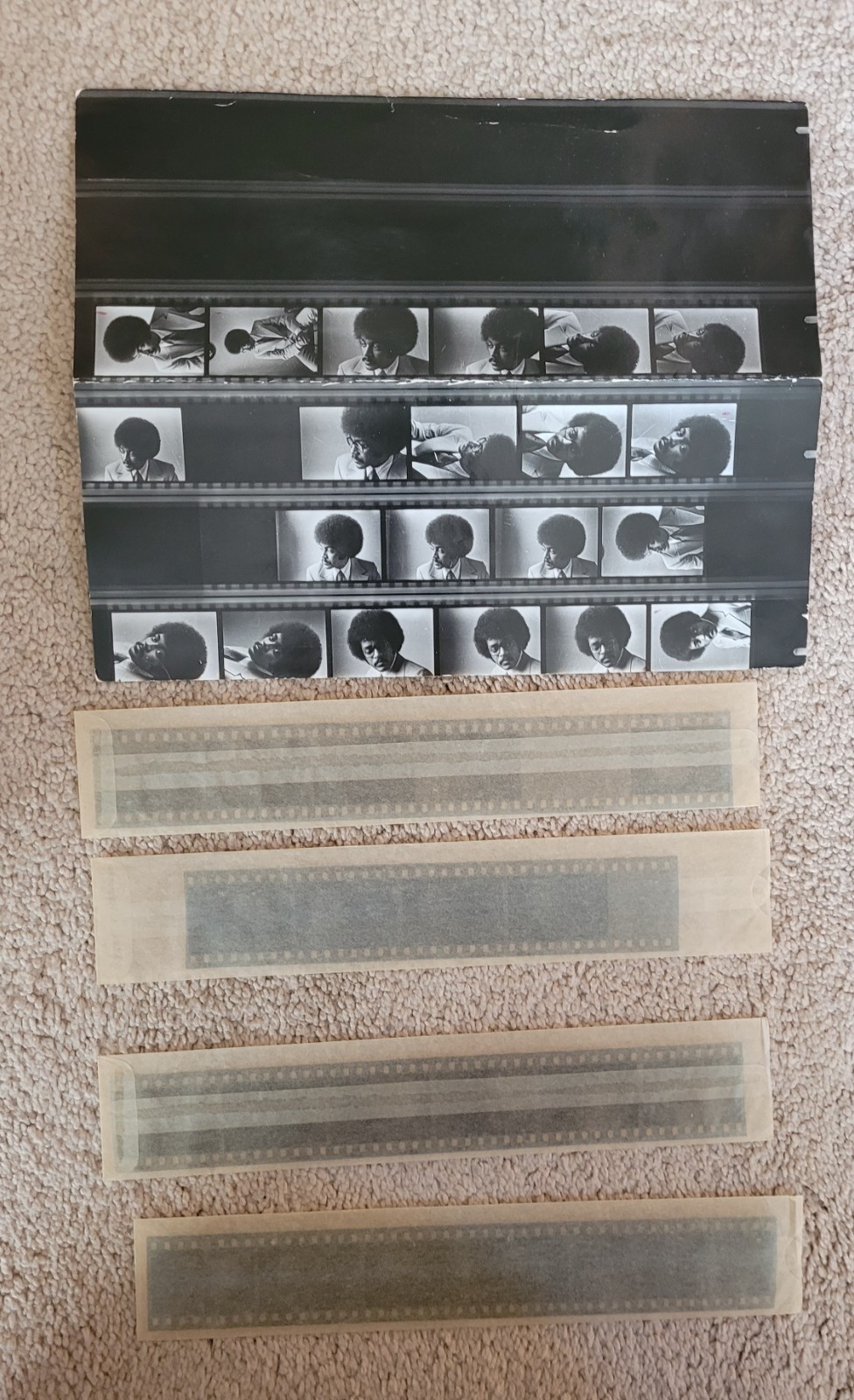
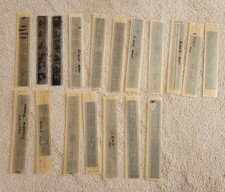
This is an exceptionally rare lot of original 35mm film negatives and a contact sheet by renowned African American photographer Calvin Wilson (1924-1992), a founding member of the influential Kamoinge Workshop.
The lot includes:
One (1) original Contact Sheet showing multiple frames from the film roll.
Four (4) separate strips of 35mm film negatives, housed in protective archival sleeves.
The images feature striking portraiture of an African American man with a large afro and suit, captured in various poses and dramatic lighting. The contact sheet allows for a direct view of the images as positive prints.
The item was obtained directly from the artist's estate/archive, making it a unique piece of photographic history and a significant collector's item.
🏛️ About Calvin Wilson & The Kamoinge WorkshopCalvin Wilson (1924–1992) was a New York-based photographer and a charter member of the Kamoinge Workshop. Though detailed biographical information is scarce, his work is recognized as part of the group's legacy, and his photographs have been exhibited in major shows, including Working Together: The Photographers of the Kamoinge Workshop at institutions like the Whitney Museum of American Art and the Virginia Museum of Fine Arts.
The Kamoinge Workshop (pronounced kəm-WEHN-gee) is a pioneering collective of African American photographers founded in 1963 in New York City. The name comes from the Kikuyu language of Kenya, meaning "a group of people acting and working together," reflecting their spirit of communal critique, support, and a unified vision. Its members, including Wilson, sought to create a positive and truthful counter-narrative of Black life in America and the African diaspora, challenging the negative and stereotypical images prevalent in mainstream media.
✊ Context: The Black Arts MovementThe Kamoinge Workshop was active during and integral to the Black Arts Movement (BAM) of the 1960s and 1970s. This cultural movement, which ran parallel to the Black Power and Civil Rights struggles, was a period of intense artistic and political ferment. Poets, writers, musicians, and visual artists, including the Kamoinge photographers, sought to:
Establish a distinctly Black aesthetic and sense of Black history, identity, and beauty (famously exemplified by the "Black is Beautiful" movement).
Create art for and about the Black community, serving as a powerful form of cultural and political resistance.
These negatives and contact sheet are an artifact from the heart of this pivotal era in African American art and Calvin. (b. New York, NY, 1924; active New York, NY, 1970)Bibliography and Exhibitions
MONOGRAPHS AND SOLO EXHIBITIONS:GENERAL BOOKS AND GROUP EXHIBITIONS:PORTER, ALLAN, ed.
Harlem: A photographic report on Harlem by a group of young negro photographers: their point of view, their people, their daily life.
1966.
In: Camera Issue 7 (July 1966.) Portfolio of images by Kamoinge Workshop photographers; cover image by Lou Draper; photos by Draper, Ernest Dunkley, James Mannas, Herbert Randall, Beuford Smith, Shawn Walker and Calvin Wilson. The project was initiated by then-editor R.E. Martinez, and completed by the subsequent editor Allan Porter who titled the portfolio and wrote the introductory commentary and remarked that the images were noteworthy because the photographers had a racial predisposition to a more sympathetic understanding of their subjects than an "outsider" would have. The title is misleading since the photos were taken in various cites throughout Mississippi, New Jersey, New York, Virginia, and in Bermuda. Unhappy with the positioning of their work by the new editor, Kamoinge wrote a postscript in response: "The Kamoinge Workshop is composed of black photographers whose involvement with their medium has brought them together to communicate the conditions they see and feel around them. The point of view expressed by these photographers is personal and individual, and their treatment of technical and aesthetic problems when dealing with aspects of the human condition is often radically different to the established approach. They come together to exchange ideas, to forge ahead with their contemporaries and to speak the truth as they see it through their work. The Kamoinge Workshop see Harlem as a state of mind, whether it exists in Watts in California, the south side of Chicago, Alabama, or New York." [For important discussion of the aesthetic perspective of the images in this portfolio, see: Erina Duganne, "Transcending the Fixity of Race: The Kamoinge Workshop and the Question of a "Black Aesthetic" in Photography," Chapter 9, New Thoughts on the Black Arts Movement:187-205; illus.]The Kamoinge Workshop is a photography collective that was founded in 1963.[1] In 2013, the group stood as “the longest continuously running non-profit group in the history of photography.”[1] The collective was born when two groups of African-American photographers came together in collaboration.[1] The first group, named Kamoinge was founded by Louis Draper, James "Jimmie" Mannas, Al Fennar, and Herbert Randall. The second group, named Group 35 consisted of photographers Ray Francis, Earl Jones, Louis Draper, Herman Howard, Calvin Mercer, and Mel Dixon.[1] Louis Draper was especially crucial to its founding.[2] The first director of the group was Roy DeCarava, who led the collective from 1963 to 1965.[1][3]
NamingAl Fennar suggested the newly united group of artists to name themselves Kamoinge,[1] after reading Jomo Kenyatta’s book, written in 1962, called Facing Mount Kenya -- Kamoinge can be translated to “a group of people who are working together” from the Kikuyu language, which is spoken in Kenya primarily.[1] The intent of the group is to cultivate a supportive and yet critical artistic community that captures black life in all of the photographers' vast experiences of it. Kamoinge member Deborah Willis is quoted in Timeless: Photographs by Kamoinge as saying “We have seen countless images of black life across the diaspora and I consider these photographs to be a mosaic of the black experience."[1][2] The group as a unit captures photographs of black life in its complexity rather than in a stereotypical or clichéd manner.[2]
MembershipIn late 1963, Kamoinge adopted members Herb Robinson, David Carter, Adger Cowans, and Anthony Barboza into the collective.[1] Beuford Smith became a member in 1965, and the first female member to join the collective was Ming Smith, who joined in 1972—also in that year C. Daniel Dawson became a member.[1]In 2001, Collette V. Fournier, Budd Williams, and Eli Reed were invited by Kamoinge members to join the collective.[1] In 2003, Spencer Burnett, June Truesdale, and Gerald Cyrus joined.[1] In 2004, Mark Blackshear, Jerry Jack, and Russell K. Frederick joined, and in 2005 Salimah Ali and Radcliffe Roye joined.[1] Also in 2004, Anthony Barboza became president of Kamoinge.[1] In 2009 Darryl Sivad and Ronald Herd joined Kamoinge.[1]As of 2014, there had been 30 members of Kamoinge, including: Anthony Barboza (President), Adger W. Cowans (Vice President), Herb Robinson (Treasurer), Ronald Herard, Herbert Randall (founder), Collette V. Fournier, John Pinderhughes, Salimah Ali, Ming Smith, Beuford Smith (President Emeritus), Russell Frederick, Gerald Cyrus, June Truesdale, Mark Blackshear, C. Daniel Dawson, Shawn Walker (Founder), Radcliffe Roye, Albert Fennar (Founder), Darryl Sivad, Budd Williams, Jimmie Mannas, Eli Reed, and Frank Stewart. Deceased members include Louis Draper (Founder and president from 1990 to 1997[1]), James Ray Frances (Founder), Steve Martin, Jerry Jack, Herman Howard, Calvin Wilson, and Toni Parks.[1]
Works, exhibitions, affiliationsFrom 1964 to 1965, Kamoinge members showed their work in two exhibitions titled Theme Black and The Negro Woman in a Harlem brownstone on a street known as Strivers Row.[2][3] Since its founding in 1963,[1] members of the collective have exhibited their works in the International Center of Photography, Countee Cullen Library, Harlem's Studio Museum, as well as a host of other sites.[2] The collective has also hosted lectures and published numerous portfolios.[2]Kamoinge produced fifteen portfolios in its first year, ten of which were sent to institutions including The University of Ghana, Howard University, and Atlanta University, as well as to the Museum of Modern Art, Schomburg Library, and the Museum of Negro History.[1]In 1965, Roy DeCarava put on a solo show, titled US, at the Countee Cullen Library in Harlem.[3] In 1969, he had a survey exhibition at the Studio Museum in Harlem titled Through Black Eyes, where he addressed the black experience in America and its relation to black aesthetic.[3]In 1972, Joe Walker, Joe Crawford, and Beuford Smith began to publish Kamoinge's work in the Black Photographers Annual.[1] This work came out to make up four volumes and included artists from across the United States.[4]In 1974, Some of the photographs taken by members of Kamoinge were displayed at a gallery exhibit for the International Center of Photography, which caused the group to gain publicity.[1]In Harlem, NY, from 1998 to 1999, through the efforts of Kamoinge member Shawn Walkers, the collective became affiliated with the Institute for Youth Entrepreneurship (IYE).[1]In 2001, Kamoinge members Anthony Barboza and Beuford Smith were consultants to the Brooklyn Museum Exhibit, “Committed to the Image: A Half Century of Black Photography in America."[1]In 2004, Kamoinge Inc. published their first book, titled The Sweet Breath of Life. In 2006 Kamoinge's Mark Blackshear alongside artist Daniel Simmons curated “Black Music,” an exhibit for the Brooklyn Academy of Music (BAM).[1]In 2007, the first showing of “Revealing the Face of Katrina” at the HP Gallery at Calumet Photo, NY opened.[1] The exhibition was curated by Kamoinge members Radcliffe Roye, C. Daniel Dawson, Russel Frederick, and John Pinderhughes.[1] A second showing opened at the Gordon Parks Gallery at the College of New Rochelle at the Bronx Campus in 2009.[1]In 2013,Timeless: Photographs of Kamoinge by Anthony Barboza, Herb Robinson, Quincy Troupe, and Vincent Alabiso was published.[1] The group had been collectively working on putting the book together since 2010.[1]“Working Together: The Photographers of the Kamoinge Workshop” exhibition will take place at the Whitney Museum of American Art from July until October 2020. The exhibition “chronicles the formative years of the Kamoinge Workshop” and “focuses on influential works of founding Kamoinge members during the first two decades of the collective."[5] The exhibition will also be shown at the Virginia Museum of Fine Arts from February 1, 2020 - June 14, 2020.[6]
ReceptionIn July 1966, Swiss editor and photographer Allan Portei published a Kamoinge portfolio in an issue of Camera titled “Harlem,” despite the majority of pictures being taken outside of Harlem.[7] Deborah Willis says in Timeless: Photographs by Kamoinge, “We have seen countless images of black life across the diaspora and I consider these photographs to be a mosaic of the black experience."[2]In 1972, Roy Gibson described the foundations of Kamoinge as deriving from “a common need to form black esthetic.”[7] In 1996, Peter Gelassi said “The Harlem neighborhood was both its [Kamoinge’s] essential subject and intended principle audience,”[7] despite few Kamoinge photographers living in or photographing Harlem exclusively.[7] Beuford Smith, in a 2001 interview, reflected on the misconceptions of black aesthetic, noting, “I think black aesthetic is different for everyone… I think it is based on how you live as a black person."[7]With a name derived from the Kikuyu word for “a group of people acting together,” a photography collective founded in 1963 as a shared political and artistic space for self-determination among a group of Black American photographers living and working in New York City. The group gathered weekly to exchange, review, and critique each other’s work. They produced two portfolios in 1964 and 1965, and were the driving force behind the publication of the Black Photographers Annual (1973–80). Key group members included Anthony Barboza, Adger Cowans, Roy DeCarava, Louis Draper, C. Daniel Dawson, Herman Howard, Larry Stewart, Ming Smith, and Shawn W. Walker.
Progressive soulReferencesFoster, Hannah (2014-03-21). "The Black Arts Movement (1965-1975)". Black Past. Retrieved 9 February 2019.
Salaam, Kaluma. "Historical Overviews of The Black Arts Movement". Department of English, University of Illinois. Archived from the original on 22 July 2018. Retrieved 9 February 2019.
Finkelman, Paul, ed. (2009). Encyclopedia of African American History. Vol. 1. Oxford: Oxford University Press. p. 187. ISBN 9780195167795.
Bracey, John H.; Sonia Sanchez; James Edward Smethurst, eds. (2014). SOS – Calling All Black People: A Black Arts Movement Reader. University of Massachusetts Press. p. 7. ISBN 9781625340306. OCLC 960887586.
Neal, Larry (Summer 1968). "The Black Arts Movement". The Drama Review. 12 (4): 29–39. doi:10.2307/1144377. JSTOR 1144377.
Iton, Richard. In Search of the Black Fantastic: Politics and Popular Culture in the Post Civil Rights Era.
Hassan, Salah M. (2011). "Remembering the Black Arts Movement". Nka: Journal of Contemporary African Art. 29 (1): 4–7. doi:10.1215/10757163-1496309. ISSN 2152-7792. S2CID 193193496.
Woodard, Komozi (1999). A Nation within a Nation. Chapel Hill and London: The University Of North Carolina Press. doi:10.5149/uncp/9780807847619 (inactive 11 July 2025). ISBN 9780807847619.
Jeyifous, Abiodun (Winter 1974). "Black Critics on Black Theatre in America: An Introduction". The Drama Review. 18 (3): 34–45. doi:10.2307/1144922. JSTOR 1144922.
Muhammad, Khalil Gibran (2010). The condemnation of blackness : race, crime, and the making of modern urban America (1st Harvard University Press paperback ed.). Cambridge, Mass.: Harvard University Press. pp. 1–14. ISBN 9780674054325. OCLC 809539202.
Kuenz, Jane (2007). "Modernism, Mass Culture, and the Harlem Renaissance: The Case of Countee Cullen". Modernism/Modernity. 14 (3): 507–515. doi:10.1353/mod.2007.0064. S2CID 146484827.
Nash, William R. (2017). "Black Arts Movement". Oxford Research Encyclopedia of Literature. ISBN 978-0-19-020109-8.
Rae, Brianna (19 February 2016). "From the Harlem Renaissance to the Black Arts Movement, Writers Who Changed the World". The Madison Times.
"The Harlem Renaissance". Encyclopaedia Britannica. 1999. OCLC 40923010.
Fortune, Angela Joy (2012). "Keeping the communal tradition of the Umbra Poets: creating space for writing". Black History Bulletin. 75 (1): 20–25. JSTOR 24759716. Gale A291497077.
Gipson, Ferren (2022). Women's Work: From Feminine Arts to Feminist Art. London: Frances Lincoln. ISBN 978-0-7112-6465-6.
Smethurst, James E. The Black Arts Movement: Nationalism in the 1960s and 1970s (The John Hope Franklin Series in African American History and Culture), NC: The University of North Carolina Press, 2005.[page needed]
Salaam, Kalamu ya (2000). "Historical Background of the Black Arts Movement (BAM) — Part II". The Black Collegian. Archived from the original on April 20, 2000.
"A Brief Guide to the Black Arts Movement". poets.org. February 19, 2014. Retrieved March 6, 2016.
Douglas, Robert L. Resistance, Insurgence, and Identity: The Art of Mari Evans, Nelson Stevens, and the Black Arts Movement. NJ: Africa World Press, 2008.[page needed]
Bracey, John H. (2014). SOS – Calling All Black People: A Black Arts Movement Reader. Massachusetts: University of Massachusetts Press. p. 18. ISBN 978-1-62534-031-3.
"A Gathering of the Tribes" (includes biography of Steve Cannon). Archived 2016-04-15 at the Wayback Machine (Place Matters, January 2012).
Morgan, Jo-Ann (December 17, 2018). The Black Arts Movement and the Black Panther Party in American Visual Culture. New York: Routledge. ISBN 9780429467851.
Tribune, Chicago (July 29, 2017). "Chicago's 'Wall of Respect' inspired neighborhood murals across U.S." Tribune Publishing."Historical Overview of the Black Arts Movement". Department of English, University of Illinois at Urbana-Champaign. Archived from the original on 2008-12-02. Retrieved 2008-12-01.
Smith, David Lionel (1991). "The Black Arts Movement and Its Critics". American Literary History. 3 (1): 93–110. doi:10.1093/alh/3.1.93.
Pollard, Cherise A. (2006). "Sexual Subversions, Political Inversions: Women's Poetry and the Politics of the Black Arts Movement". In Collins, Lisa Gail; Crawford, Margo Natalie (eds.). New Thoughts on the Black Arts Movement. Rutgers University Press. pp. 173–186. ISBN 9780813536941. JSTOR j.ctt5hj474.12.
Neal, Larry (1968). "The Black Arts Movement". The Drama Review. 12 (4): 28–39. doi:10.2307/1144377. JSTOR 1144377.
Neal, Larry. "The Black Arts Movement", Floyd W. Hayes III (ed.), A Turbulent Voyage: Readings in African American Studies, San Diego, California: Collegiate Press, 2000 (3rd edition), pp. 236–246.
"Black Arts Movement". Encyclopædia Britannica article
Smalls, James (2001). "Black aesthetic in America". Grove Music Online (8th ed.). Oxford University Press. ISBN 978-1-56159-263-0.
Duncan, John; Gayle, Addison (1972). "Review of The Black Aesthetic, Addison Gayle, Jr". Journal of Research in Music Education. 20 (1): 195–197. doi:10.2307/3344341. JSTOR 3344341. S2CID 220628543.
Karenga, Ron (Maulana) (2014). "Black Cultural Nationalism". In Bracey, John H.; Sanchez, Sonia; Smethurst, James (eds.). SOS – Calling All Black People: A Black Arts Movement Reader. University of Massachusetts Press. pp. 51–54. ISBN 9781625340306. JSTOR j.ctt5vk2mr.10.
Kuryla, Peter (2005), "Black Arts Movement", Encyclopedia of African American Society, SAGE Publications, Inc., doi:10.4135/9781412952507.n79, ISBN 9780761927648
MacKey, Nathaniel (1978). "Ishmael Reed and the Black Aesthetic". CLA Journal. 21 (3): 355–366. JSTOR 44329383.
Ellis, Trey (1989). "The New Black Aesthetic". Callaloo (38): 233–243. doi:10.2307/2931157. JSTOR 2931157.
Mitchell, Verner D., and Cynthia Davis, Encyclopedia of the Black Arts Movement, 2019.
Young, Kevin, ed. (2020). Black Poem, African American Poetry: 250 Years of Struggle & Song. Library of America. pp. 396–398. ISBN 9781598536669."Amiri Baraka". Poetry Foundation. October 31, 2016. Retrieved October 31, 2016.
Nielson, Erik (2014). "White Surveillance of the Black Arts". African American Review. 47 (1): 161–177. doi:10.1353/afa.2014.0005. JSTOR 24589802. S2CID 141987673. Project MUSE 561902.
Rojas, Fabio (2006). "Social Movement Tactics, Organizational Change and the Spread of African-American Studies". Social Forces. 84 (4): 2147–2166. doi:10.1353/sof.2006.0107. JSTOR 3844493. S2CID 145777569. Project MUSE 200998.
Higashida, Cheryl (2011). Black Internationalist Feminism: Women Writers of the Black Left, 1945-1995. University of Illinois Press. pp. 52–53.
Nelson, Emmanuel S., The Greenwood Encyclopedia of Multiethnic American Literature: A — C, Westport, CT: Greenwood Press, 2005, p. 387.
"The Black Arts Movement (BAM)". African American Literature Book Club. Retrieved March 6, 2016. Crawford, Margo (2017). Black Post-Blackness: The Black Arts Movement and Twenty-First-Century Aesthetics. University of Illinois Press.Works cited Avilez, GerShun. Radical Aesthetics and Modern Black Nationalism. Urbana: University of Illinois Press, 2016.
Baraka, Amiri. The LeRoi Jones/Amiri Baraka Reader. Edited by William J. Harris. New York: Basic Books, 2009.
Bracey, John H., Sonia Sanchez, and James Smethurst, eds. SOS – Calling All Black People: A Black Arts Movement Reader. University of Massachusetts Press, 2014.
Clarke, Cheryl. "After Mecca": Women Poets and the Black Arts Movement. New Brunswick, N.J.: Rutgers University Press, 2005.
Crawford, Margo Natalie. Black Post-Blackness: The Black Arts Movement and Twenty-First-Century Aesthetics. Urbana, Ill.: University of Illinois Press, 2017.
Fenderson, Jonathan. Building the Black Arts Movement: Hoyt Fuller and the Cultural Politics of the 1960s. Urbana, Ill.: University of Illinois Press, 2019.
Lubiano, Wahneema. "Black Nationalism and Black Common Sense: Policing Ourselves and Others." In The House That Race Built: Black Americans, U.S. Terrain, edited by Wahneema Lubiano, 232–52. New York: Pantheon Books, 1997.
Salaam, Kalamu ya. "Black Arts Movement". In The Oxford Companion to African American Literature, edited by William L. Andrews, Frances Smith Foster, and Trudier Harris, 70–74. New York: Oxford University Press, 1997.
Smethurst, James Edward. The Black Arts Movement: Literary Nationalism in the 1960s and 1970s. Chapel Hill: University of North Carolina Press, 2005.External links Black Arts Repertory Theatre/School
Black Arts Movement Page at University of Michigan
Amazing Street arts, Black street Arts West: Culture and Struggle in Postwar Los Angeles vteSchools of poetryicon vteAfrican Americans
Flag vteCounterculture of the 1960s (timeline)
vtePremodern, Modern and Contemporary art movements
Categories: Black Arts Movement1964 introductions20th-century American literature20th-century art movementsAfrican and Black nationalismAfrican-American poetsAmerican art movementsAmerican literary movementsAmerican poetsBlack PowerCultural organizations based in the United StatesPost–civil rights era in African-American historyArt exhibitions in the United StatesAfrican-American literature This page was last edited on 11 July 2025, at 21:09
Rare Calvin Wilson Kamoinge Workshop Photo Negatives & Contact Sheet Black Arts:
$25000.00
Related Items:
1st App Calvin & Hobbes 1985 Rare Newspaper Strips Bill Waterson MAKE OFFER
$250000.00
Rare Calvin Wilson Kamoinge Workshop Photo HUGE LOT OF Negatives Black Arts
$50000.00

Rare Calvin Wilson Kamoinge Workshop Photo Negatives & Contact Sheet Black Arts
$25000.00