SALEM WITCH TRIALS DEFENDANT JOB TOOKIE PRIOR MARITIME LEGAL MA 1677 WITCHCRAFT

When you click on links to various merchants on this site and make a purchase, this can result in this site earning a commission. Affiliate programs and affiliations include, but are not limited to, the eBay Partner Network.

SALEM WITCH TRIALS DEFENDANT JOB TOOKIE PRIOR MARITIME LEGAL MA 1677 WITCHCRAFT:
$34999.99
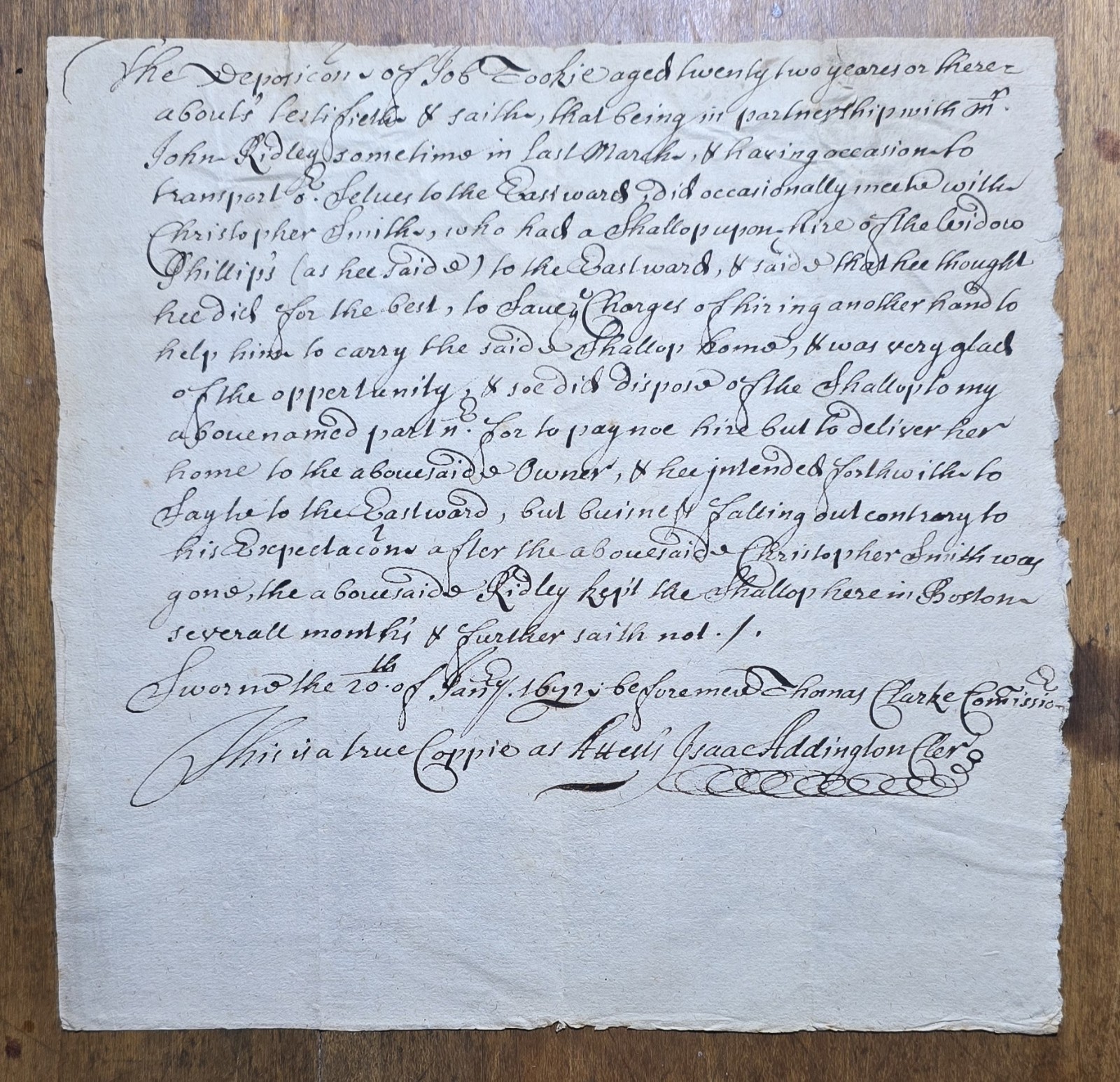
An exceedingly rare 17th century deposition from Salem Witch Trial defendant Job Tookie/Tookey, a laborer and sailor, related to a previous maritime legal matter described as the "Tookie Oath" with this copy authorized by Isaac Addington and Major Thomas Clarke on January 20, 1677. Tookie was imprisoned for witchcraft for approximately 7 months and released. Although some accounts have him as a younger man, he was mid 30s at the time of the trial and likely appeared younger. From a Massachusetts estate. See research below. Thanks for looking.
Arrest & Imprisonment: He was arrested and jailed on June 4, 1692, after several of the "afflicted girls" accused his specter of multiple torments and maritime murders.
The Indictment: He was formally indicted by a Grand Jury a few months later on September 15, 1692, but his case was not brought before the deadly Court of Oyer and Terminer before it was dissolved in October.
Trial & Acquittal: He remained in jail through the freezing winter until the newly formed Superior Court of Judicature sat to clear the remaining cases. He was tried on January 5, 1693, and found not guilty.
Release: Following the custom of the time, he was officially discharged shortly thereafter, once he paid his mandatory jailer's fees for his room and board.
Transcription: (The Deposicon of Job Tookey aged twenty two yeares or there= abouts testifieth & saith, that being in partnership with Mr. John Ridley sometime in Last March, & having occasion to transport o.r Selves to the Eastward did occasionally meet with Christopher Smith, who had a Shallop upon Hire of the Widow Phillips (as hee Said) to the Eastward, & said that hee thought hee did for the best, to Save Charges of hiring another hand to help him to carry the said Shallop Home, & was very glad of the oppertunity, & soe did dispose of the Shallop to my abovenamed partn.r for to pay noe hire but to deliver her home to the abovesaid Owner, & hee intended forthwith to sayle to the Eastward, but businesse falling out contrary to his Expectacon after the abovesaid Christopher Smith was gone, the abovesaid Ridley kept the Shallop here in Boston ~ severall months & further saith not. / Sworne the 20.th of Jany. 1677 before me Thomas Clarke Comissio.r This is a true Coppie as Attests Isaac Addington Cler:
Summary of What Happened
- Who: Job Tookey (22 years old) and his business partner John Ridley.
- The Situation: In March, Tookey and Ridley needed to travel "Eastward" (likely towards Maine/the Massachusetts coast). They met Christopher Smith.
- The Deal: Smith had rented a small boat called a shallop from a widow named Mrs. Phillips. To save money on hiring a crew hand to sail it back to her, Smith let Ridley take the boat. The agreement was that Ridley would pay no rental fee, but would sail it directly back home to the widow.
- The Broken Promise: Instead of sailing it back right away as promised, Ridley kept the boat parked in Boston for several months.
- The Official Record: This statement was sworn on January 20, 1677, before Commissioner Thomas Clarke. This document is an official true copy certified by Clerk Isaac Addington.
Isaac Addington signed documents as "Clerk" in January 1692 (written as 1691/92 at the time) until the spring of 1692. Though King William and Queen Mary had already approved the new royal charter in London, it had not yet physically arrived in Boston. Consequently, the provisional colonial government continued operating under its transitional rules. The official copy of the new provincial charter did not arrive in Boston until February 8, 1692. Royal Governor Sir William Phips did not arrive to formally establish the new government until May 14, 1692. Because the interim government remained active through the winter, official letters and records from January 1692—such as administrative correspondence sent to John Pynchon—show Addington still validating papers as Clerk of the Council. He did not fully transition to signing exclusively as "Secretary" until Phips' arrival in the spring.
Job Tookey (often spelled Tookie) was a laborer from Beverly, Massachusetts, who became a notable target during the height of the Salem witch trials in 1692. While he is not as widely discussed today as figures like John Proctor or Rebecca Nurse, his case is a fascinating example of how "spectral evidence" and rumors of past misconduct could instantly upend a person's life. In September 1692, a grand jury issued his formal Witchcraft Indictment. The legal language shifted from his civil business to pure colonial panic.
The Charge: The indictment stated that Tookey had used "Wicked Mallitios and Fellonious Witchcraftise and Sorceries" against Mary Warren.
The Evidence: The prosecution officially bundled the civil deposition regarding the shallop into his case packet. They used it to trace his physical movements at sea to try and corroborate Mary Warren's claims that he used poppets to sink ships and murder sailors like Andrew Woodbury and Gamaliel Hawkins.
Jail Conditions and Survival: The Imprisonment: Tookey spent the late summer and grueling winter of 1692 bound in heavy irons in a freezing, disease-ridden Massachusetts jail.
The Cost of Freedom: When the Court of Oyer and Terminer dissolved and spectral evidence was finally banned, the new Superior Court of Judicature found him not guilty in January 1693. However, colonial law required prisoners to personally pay for their daily food, straw bedding, and the jailers fees accumulated over those seven months before they could walk free.
What Happened to Job Tookie?Because he survived the trials, court records show he returned to his life as a laborer. He eventually married a woman named Mary Thomas in April 1696. Biography & Background Very few details survive regarding Tookeys early life, but historical court records indicate he was a working-class man living in Essex County. He was known in the community for having a sharp tongue and making loose statements. Crucially, Tookey had a history of traveling; he had spent time in Barbados. In the highly paranoid atmosphere of 17th-century New England, anyone with connections to foreign, tropical colonies which Puritans associated with indigenous rituals and exotic "magic"was viewed with deep suspicion.
Involvement in the Salem Witch Trials Tookey's legal troubles began in late spring as the witchcraft hysteria expanded from Salem Village into neighboring towns.
The Accusation: On June 4, 1692, a formal complaint was filed against Tookey. He was arrested and brought before the Salem magistrates for examination.
The Courtroom Hysteria: During his examination on June 7, 1692, several of the infamous "afflicted girls"including Mary Warren, Susanna Sheldon, Mary Walcott, and Elizabeth Booth experienced violent fits in his presence. They claimed that Tookey's "specter" was torturing them. The court administered the "touch test," and the girls pseudo-recovered only after Tookey was forced to touch their wrists.
Spectral Ghosts and Murders: The accusations against Tookey quickly escalated from simple affliction to multiple counts of supernatural murder. Mary Warren claimed that while in a trance, she saw the ghost of a man named Gamaliel Hawkins. She alleged Tookey had murdered Hawkins in Barbados by sticking pins into a puppet. Susanna Sheldon and Elizabeth Booth backed this up, claiming they saw a swarm of ghosts in the courtroomincluding Hawkins, a man named Andrew Woodbury, and a young childall draped in burial shrouds, crying out for vengeance against Tookey.
Tookey's Defense: When the magistrates aggressively questioned Tookey about whether he had covenanted with or seen the Devil, Tookey did not confess. He maintained his innocence, deflecting the trap questions by stating he could not recall ever making remarks about seeing the Devil. Several neighbors, like John Louder and Samuel King, testified about his odd behavior and past statements to damage his character.
Fate and Aftermath: Despite the dramatic ghost stories brought against him, Tookey survived the trials. Because he refused to offer a false confession, he was held in prison under heavy financial and physical toll while awaiting a formal trial by the Court of Oyer and Terminer. By the autumn of 1692, public opposition to the use of spectral evidence grew, and Governor William Phips dissolved the biased court. When the Superior Court of Judicature met in early 1693 to clear out the remaining backlog of cases, the evidence against Tookey was deemed insufficient. The charges against him were dismissed, and he was released from jail along with the remaining survivors.
Isaac Addington was a prominent colonial magistrate and long-serving politician who served as the Secretary of the Massachusetts Bay Colony during the notorious Salem Witch Trials of 1692. Rather than acting as a judge on the front lines, Addington functioned as the central administrative hub of the crisis, managing critical legal paperwork, coordinating arrests, and serving on the Grand Jury that formally indicted the defendants.
Biography Overview
Early Life: Born on January 22, 1644, in Boston, Massachusetts, to Isaac Addington Sr. and Anne Leverett. Through his mother, he was the nephew of Massachusetts Governor John Leverett. Early Career: Initially trained as a surgeon, he quickly shifted his focus to public administration, civic leadership, and law.
Political Rise: He became a member of the House of Deputies in 1685 and speaker the following year. Following the 1689 overthrow of Governor Edmund Andros, Addington was chosen as the Clerk of the Council of Safety.
The Secretariat: When the new provincial charter arrived in 1692, he was appointed the first official Secretary of the Province of Massachusetts Bay, a powerful lifetime administrative post he held until his death.
Judicial Peak: Later in life, he was appointed a Justice of the Peace and briefly served as the Chief Justice of the Superior Court of Judicature from 1702 to 1703. Death: He died in Boston on March 19, 1715, and is buried in the Granary Burying Ground.
Involvement in the Salem Witch Trials:
While names like John Hathorne and William Stoughton dominate the dark history of the trials, Addington played an indispensable structural role behind the scenes.
1. Pre-Trial Examination Participant Before the official Court of Oyer and Terminer was formed, Addington was part of the elite magistrate group that observed the initial, chaotic examinations of the accused. On April 11, 1692, he sat alongside Deputy Governor Thomas Danforth and Samuel Sewall to witness the interrogation of Sarah Cloyce and Elizabeth Proctor. He bore firsthand witness to the "afflicted" children throwing fits in the courtroom.
2. Member of the Grand Jury Addington served directly on the Grand Jury convened in May 1692. His responsibility was evaluating whether the initial complaints and spectral evidence gathered by local officials carried enough weight to formally charge the defendants with the capital crime of witchcraft. The grand jury approved the indictments, clearing the path for the deadly trials to proceed.
3. Administrative Architect of the Court As the Colony's Secretary, Addington was the legal gatekeeper. All official documentation regarding the trials flowed through his Boston office. He processed: Mittimus Warrants: He received orders to commit major figures like Bridget Bishop, Sarah Good, John Proctor, and Tituba to prison while they awaited trial. Official Correspondence: He managed communication with the prosecution, including letters from Attorney General Thomas Newton regarding the preparation of the Court of Oyer and Terminer. The New Charter: He was responsible for recording and issuing the very legal framework that established the courts handling the crisis.
Legacy and Historical Impact:
Because Addington's signature is pressed into dozens of surviving 1692 legal documents, his paperwork remains central to modern historical preservation. In fact, his historical footprint made headlines in 2000 when stolen 17th-century legal papers bearing his and Chief Justice William Stoughtons signatures were discovered being illegally saleed off online. Addington did not publicly repent for his role in the hysteria, unlike his contemporary Samuel Sewall. Instead, he retained his high-standing political reputation as a meticulous bureaucrat who kept the legal machinery of Massachusetts running even when that machinery was executing the innocent.
Major Thomas Clarke of Boston (c. 1607–1683)
This Thomas Clarke was a highly prominent merchant, politician, and military leader in the Massachusetts Bay Colony.
Colonial Role: He was a wealthy merchant who co-owned a massive trading post at Arrowsic, Maine. He served as the Speaker of the House of the Massachusetts Bay Colony for five years.
Military & History: He commanded the Suffolk Regiment starting in 1651. In 1664, he was chosen to represent Massachusetts during the historic transfer of New Amsterdam (New York City) from Dutch rule to the English.
Sources: Selected AI overviews and numerous related sources such as the Colonial Society of Massachusetts.
SALEM WITCH TRIALS DEFENDANT JOB TOOKIE PRIOR MARITIME LEGAL MA 1677 WITCHCRAFT:
$34999.99
Related Items:
SALEM WITCH TRIALS DEFENDANT JOB TOOKIE PRIOR MARITIME LEGAL MA 1677 WITCHCRAFT
$34999.99
🔥RARE Antique Ephraim Provo Salem MA Witch City Bottling Works 8oz Blue Bottle
$1750.00

😍 Antique 🌌 Halloween Wood Witch 🧹 Roadside Souvenir 🌌 Salem MA 💀 20"
$1600.00