Holocaust Hero WWII RAOUL WALLENBERG document scarce


When you click on links to various merchants on this site and make a purchase, this can result in this site earning a commission. Affiliate programs and affiliations include, but are not limited to, the eBay Partner Network.

Holocaust Hero WWII RAOUL WALLENBERG document scarce:
$3000.00
A letter of protection (Schutzpass), issued by the Swedish legation in Budapest, to the Hungarian Jew Föld Auril
The last image is a translation from HungarianRaoul Gustaf Wallenberg
Born: August 4, 1912, Lidingö Municipality, Sweden
Died: July 17, 1947 (age 34 years), Moscow, Russia
was a Swedish architect, businessman, diplomat, and humanitarian. He saved thousands of Jews in German-occupied Hungary during the Holocaust from German Nazis and Hungarian fascists during the later stages of World War II.
Raoul Wallenberg, a Swedish diplomat, issued "Schutz-Passes" (protective passports) to Hungarian Jews in 1944, granting them temporary Swedish citizenship and protection from deportation to Nazi concentration camps, saving thousands of lives.
Raoul Wallenberg did frequently use stamped signatures. Given the urgent nature of his mission in Budapest, he had to issue thousands of documents quickly, and a rubber stamp was often the only way to keep up with the demand.
Based on historical records and sale data, here is how his signatures generally appeared on these documents:
1. The Stamped SignatureMany surviving Schutz-passes and supplementary documents bear a stamped ink signature. This was standard for the bulk of the passports issued to thousands of people simultaneously. Collectors often look for the specific ink bleed and "pressure marks" characteristic of a 1944 rubber stamp.
2. The "Ink Scribble" (Hand-Signed)Wallenberg also frequently hand-signed documents with a very quick, stylized "ink scribble"—often just an abbreviated "R" or a fast "Wallenberg." These were done in person, sometimes while he was physically pulling people out of deportation lines or visiting the railway stations.
3. Full Hand-SignaturesFull, formal hand-signatures are considered the rarest. These were typically reserved for:
Letters of Protection: Specific appeals to the "National Central Authority Supervising Foreigners."
The date (October 28, 1944) is highly significant. This was shortly after the Arrow Cross Party took power in Hungary, a period when Wallenberg was working feverishly to re-verify existing passes to ensure they were still respected by the new, more radical regime.
Early life
Former location of the summer villa where Wallenberg was born in 1912 (pictured in 2009)Wallenberg was born in 1912 in Lidingö Municipality, near Stockholm, where his maternal grandparents, Per Johan Wising and his wife Sophie Wising (née Benedicks), had built a summer house in 1882. His paternal grandfather, Gustaf Wallenberg, was a diplomat and envoy to Tokyo, Istanbul, and Sofia.His parents, who married in 1911, were Raoul Oscar Wallenberg (1888–1912), a Swedish naval officer, and Maria "Maj" Sofia Wising (1891–1979). His father died of cancer three months before he was born, and his maternal grandfather died of pneumonia three months after his birth. His mother and grandmother, now both suddenly widows, raised him together.[16] In 1918, his mother married Fredric von Dardel;[17] they had a son, Guy von Dardel,[18] and a daughter, Nina Lagergren.[19]After high school and his compulsory eight months in the Swedish military, Wallenberg's paternal grandfather sent him to study in Paris. He spent one year there, and then in 1931 he studied architecture at the University of Michigan in the United States.[16] Although the Wallenberg family was rich, he worked at odd jobs in his free time and joined other young male students as a passenger rickshaw handler at Chicago's Century of Progress.[20] He used his vacations to explore the United States, with hitchhiking being his preferred method of travel. About his experiences, he wrote to his grandfather saying, "When you travel like a hobo, everything's different. You have to be on the alert the whole time. You're in close contact with new people every day. Hitchhiking gives you training in diplomacy and tact."[21]Wallenberg was aware of his one-sixteenth Jewish ancestry and proud of it. It came from his great-great-grandfather (his maternal grandmother's grandfather) Michael Benedicks, who immigrated to Stockholm in 1780 and converted to Christianity.[22][23] Ingemar Hedenius (one of the leading Swedish philosophers) recalls a conversation with Raoul dating back to 1930 when they were together in an army hospital during military service: We had many long and intimate conversations. He was full of ideas and plans for the future. Although I was a good deal older – you could choose when to do your service – I was enormously impressed by him. He was proud of his partial Jewish ancestry and, as I recall, must have exaggerated it somewhat. I remember him saying, 'A person like me, who is both a Wallenberg and half-Jewish, can never be defeated'.[24]Raoul Wallenberg's Jewish ancestry is supported by Sweden researcher Paul A. Levine, who wrote in his monograph about Wallenberg: There is general agreement that around the end of the eighteen[th] century, a German Jew named Benedicts emigrated to Sweden, establishing the material line of [Raoul's] Wallenberg’s family.[25]Wallenberg as a youthWallenberg graduated from the University of Michigan in 1935 with a degree in architecture. Upon his return to Sweden, he found that his American degree did not qualify him to practice as an architect. Later that year, his grandfather arranged a job for him in Cape Town, South Africa, in the office of a Swedish company that sold construction material. After six months in South Africa, he took a new job at a branch office of the Holland Bank in Haifa,[26] where he met and befriended Jewish refugees from Nazi Germany. He returned to Sweden in 1936, securing a job in Stockholm with the help of his father's cousin and godfather, Jacob Wallenberg, at the Central European Trading Company,[27] an export-import company trading between Stockholm and central Europe, owned by Kálmán Lauer, a Hungarian Jew.[citation needed]
World War II
See also: Hungary in World War IIBeginning in 1938, the Kingdom of Hungary, under the regency of Miklós Horthy, passed a series of anti-Jewish measures modeled on the so-called Nuremberg Race Laws enacted in Germany by the Nazis in 1935. Like their German counterparts, the Hungarian laws focused heavily on restricting Jews from certain professions, reducing the number of Jews in government and public service jobs, and prohibiting intermarriage. Because of this, Wallenberg's business associate, Kálmán Lauer, found it increasingly difficult to travel to his native Hungary, which was moving still deeper into the German orbit. Hungary became a member of the Axis powers in November 1940 and later joined the Nazi-led invasion of the Soviet Union in June 1941. Out of necessity, Wallenberg became Lauer's personal representative. He traveled to Hungary to conduct business on Lauer's behalf and to look in on members of Lauer's extended family who remained in Budapest. He soon learned to speak Hungarian and, from 1941, made increasingly frequent travels to Budapest.[28] Within a year, Wallenberg was a joint owner and the International Director of the company.[26] In this capacity, Wallenberg also made several business trips to Germany and German-occupied France during the early years of World War II. It was during these trips that Wallenberg was able to closely observe the Nazis' bureaucratic and administrative methods—knowledge which proved valuable to him later.[26]Meanwhile, the situation in Hungary had begun to deteriorate as the tide of the war began to turn decisively against Germany and its allies. Following the catastrophic Axis defeat at the Battle of Stalingrad (in which Hungarian troops fighting alongside German forces suffered a staggering 84% casualty rate), the Horthy regime began secretly pursuing peace talks with the United States and the United Kingdom. Upon learning of Horthy's duplicity, Adolf Hitler ordered the occupation of Hungary by German troops in March 1944. The Wehrmacht quickly took control of the country and placed Horthy under house arrest. A pro-German puppet government was installed in Budapest; actual power rested with the German military governor, SS-Brigadeführer Edmund Veesenmayer. With the Nazis now in control, the relative security from the Holocaust enjoyed by the Jews of Hungary came to an end. In April and May 1944, the Nazi regime and its accomplices began the mass deportation of Hungary's Jews to extermination camps in German-occupied Poland. Under the personal leadership of SS-Obersturmbannführer Adolf Eichmann, who was later tried and hanged in Israel for his role in the implementation of the Nazis' Final Solution, deportations took place at a rate of 12,000 people per day.[29]
"Pimpernel" Smith screeningWallenberg was directly inspired by "Pimpernel" Smith, a 1941 British anti-Nazi propaganda thriller.[30] The film had been banned in Sweden, but Wallenberg and his sister, Nina, were invited to a private screening at the British Embassy in Stockholm. Enthralled by Professor Smith (played by Leslie Howard), who saved twenty-eight Jews from the Nazis, Nina stated, "We thought the film was amazing. When we got up from our seats, Raoul said, ‘that is the kind of thing I would like to do’".[31]
Recruitment by the War Refugee BoardOn 21 June, 1944, George Mantello received and immediately publicized two important reports given to him by Romanian diplomat Florian Manilou, who had returned from a fact-finding trip to Romania and Budapest at Mantello's request. Manilou received material from Miklos "Moshe" Krausz in Budapest, who worked with Carl Lutz to rescue Jews. One of the reports was probably Rabbi Chaim Michael Dov Weissmandl's abridged version of the 33-page Auschwitz Protocols (i.e., the Vrba-Wetzler and Rosin-Mordowicz reports). The reports described in detail the operations of the Auschwitz-Birkenau extermination camp.[32] The second was a six-page Hungarian report that detailed the ghettoization and deportation of 435,000 Hungarian Jews, as updated to 19 June 1944, by towns, to Auschwitz.[33]Mantello publicized the reports' findings immediately upon receipt. This resulted in large-scale grassroots protest in Switzerland against the unprecedented barbarism against Jews and led to Horthy being threatened by US President Franklin D. Roosevelt and UK Prime Minister Winston Churchill. In a letter, Churchill wrote, "There is no doubt that this persecution of Jews in Hungary and their expulsion from enemy territory is probably the greatest and most horrible crime ever committed in the whole history of the world...."[34]Following the report's publication, the Roosevelt administration turned to the newly created War Refugee Board (WRB) in search of a solution to the genocide against Jews. US Treasury Department official Iver C. Olsen was dispatched to Stockholm as a representative of the WRB and tasked with putting together a plan to rescue the Jews of Hungary. In addition to his duties with the WRB, Olsen was also secretly employed as the chief of "Currency Operations" for the Stockholm station of the Office of Strategic Services (OSS), the United States' wartime espionage service.[35]In search of someone willing and able to go to Budapest to organize a rescue program for the nation's Jews, Olsen established contact with a relief committee composed of many prominent Swedish Jews led by the Swedish Chief Rabbi Marcus Ehrenpreis to locate an appropriate person to travel to Budapest under diplomatic cover and lead the rescue operation.[26] One member of the committee was Wallenberg's business associate Kálmán Lauer.The committee's first choice to lead the mission was Count Folke Bernadotte, the vice-chairman of the Swedish Red Cross and a member of the Swedish Royal Family. When Bernadotte's proposed appointment was rejected by the Hungarians, Lauer suggested Wallenberg as a potential replacement.[26] Olsen was introduced to Wallenberg by Lauer in June 1944 and came away from the meeting impressed and, shortly thereafter, appointed Wallenberg to lead the mission.[21] Olsen's selection of Wallenberg met with objections from some US officials who doubted his reliability, in light of existing commercial relationships between businesses owned by the Wallenberg family and the German government. These differences were eventually overcome and the Swedish Ministry for Foreign Affairs agreed to the American request to assign Wallenberg to its legation in Budapest as part of an arrangement in which Wallenberg's appointment was granted in exchange for a lessening of American diplomatic pressure on neutral Sweden to curtail the nation's free-trade policies toward Germany.[35]
Mission to BudapestWhen Wallenberg reached the Swedish legation in Budapest on 9 July 1944, the intense Nazi campaign to deport the Jews of Hungary to Auschwitz had already been underway for several months. The transports from Hungary were halted with few exceptions by Miklós Horthy two days earlier in large part because he was warned by Roosevelt, Churchill, the King of Sweden and even the Pope after the very vocal Swiss grass roots protests against the mass murder in Auschwitz.[33] Between May and early July 1944, Eichmann and his associates deported more than 400,000 Jews by freight train. All but 15,000 were sent directly to the Auschwitz-Birkenau concentration camp in southern Poland.[26] By the time of Wallenberg's arrival, there were only around 230,000 Jews remaining in Hungary. With fellow Swedish diplomat Per Anger,[36] and Miklos "Moshe" Krausz,[37] they issued "protective passports" (German: Schutz-Pass), which identified the bearers as Swedish subjects awaiting repatriation and thus prevented their deportation. Although not legal, these documents looked official and were generally accepted by German and Hungarian authorities, who sometimes were also bribed.[28] The Swedish legation in Budapest also succeeded in negotiating with the German authorities so that the bearers of the protective passes would be treated as Swedish citizens and be exempt from having to wear the yellow badge required for Jews.[26] When the German government said the travel passes were invalid, Wallenberg appealed for help from Baroness Elisabeth Kemény, wife of Baron Gábor Kemény, Hungarian Minister for Foreign Affairs in Budapest. She convinced her husband to have 9,000 passes honoured.[38]With the money mostly raised for the War Refugee Board by American Jews, Wallenberg rented 32 buildings in Budapest and declared them to be extraterritorial, protected by diplomatic immunity. He put up signs such as "The Swedish Library" and "The Swedish Research Institute" on their doors and hung oversized Swedish Flags on the front of the buildings to bolster the deception. The buildings eventually housed almost 10,000 people.[21]Sandor Ardai, one of the drivers working for Wallenberg, recounted what Wallenberg did when he intercepted a trainload of Jews about to leave for Auschwitz: ... he climbed up on the roof of the train and began handing in protective passes through the doors which were not yet sealed. He ignored orders from the Germans for him to get down, then the Arrow Cross men began shooting and shouting at him to go away. He ignored them and calmly continued handing out passports to the hands that were reaching out for them. I believe the Arrow Cross men deliberately aimed over his head, as not one shot hit him, which would have been impossible otherwise. I think this is what they did because they were so impressed by his courage. After Wallenberg had handed over the last of the passports he ordered all those who had one to leave the train and walk to the caravan of cars parked nearby, all marked in Swedish colours. I don't remember exactly how many, but he saved dozens off that train, and the Germans and Arrow Cross were so dumbfounded they let him get away with it.[39]At the height of the program, more than 350 people were involved in the rescue of Jews in Budapest.[40] Sister Sára Salkaházi was caught sheltering Jewish women and was killed by members of the Arrow Cross Party.Tibor Baranski was a 22-year-old religious student who was recruited by Papal Nuncio Monsignor Angelo Rotta to help save Jews. Baranski, who posed as a Vatican representative, saved about 3,000 Jews. He collaborated with diplomats, including Wallenberg. He met with and talked with Wallenberg on the phone several times. Baranski described Wallenberg's motivation as "divinely human love." "We knew in a second we shared the same opinion … the same recklessness, the same determination, all through," said Baránszki.[41]Swiss diplomat Carl Lutz also issued protective passports from the Swiss embassy in the spring of 1944; and Italian businessman Giorgio Perlasca posed as a Spanish diplomat and issued forged visas.[42] Portuguese diplomats Sampaio Garrido and Carlos de Liz-Texeira Branquinho rented houses and apartments to shelter and protect refugees from deportation and murder and issued safe conducts to approximately 1,000 Hungarian Jews.[43][44] Berber Smit (Barbara Hogg), the daughter of Lolle Smit (1892–1961), director of N.V. Philips Budapest and a Dutch spy working for the British MI6, later claimed to have been his girlfriend, also assisted Wallenberg, as did her son.[45][46] However, she was temporarily engaged to Wallenberg's colleague Lars Berg, and later married a Scottish officer;[47] which has not dispelled claims that Wallenberg was homosexual.[48][49]Wallenberg started sleeping in a different house each night, to guard against being captured or killed by Arrow Cross Party members or by Adolf Eichmann's men.[50] Two days before the Soviet Army occupied Budapest, Wallenberg negotiated with Eichmann and with Major-General Gerhard Schmidthuber, the supreme commander of German forces in Hungary. Wallenberg bribed Arrow Cross Party member Pál Szalai to deliver a note in which Wallenberg persuaded the occupying Germans to prevent a Fascist plan to blow up the Budapest ghetto and murder an estimated 70,000 Jews. The note also persuaded the Germans to cancel a final effort to organize a death march of the remaining Jews in Budapest by threatening to have them prosecuted for war crimes once the war was over.[26][28]According to Giorgio Perlasca, who posed as the Spanish consul-general to Hungary in the winter of 1944 and saved 5,218 Jews, Pál Szalai lied to save his life during his criminal trial, and the history of the saving is different.[51][52][53][54] Wallenberg (who was already dead at the time of Szalai's deposition) saved hundreds of people but was not directly involved in the plan to save the ghetto. While Perlasca was posing as the Spanish consul-general, he learned of the intention to burn down the ghetto. Shocked and incredulous, he asked for a direct hearing with the Hungarian interior minister Gábor Vajna, in the basement of the Budapest City Hall where he had his headquarters, and threatened legal and economic measures against the "3000 Hungarian citizens" (in fact, a much smaller number) declared by Perlasca as residents of Spain, and similar treatment to Hungarian residents in two Latin American republics, to force the minister to withdraw the project. This actually happened in the following days.[51][52][53][54]People saved by Wallenberg include biochemist Lars Ernster, who was housed in the Swedish embassy, and Tom Lantos, later a member of the United States House of Representatives, who lived in one of the Swedish protective houses.[55]The Swedish consulate building still exists as of 2025, on the hill behind the Hotel Gellért, with a reference to Wallenberg at the front.
Disappearance
Bronze statue of Raoul Wallenberg in Tel AvivOn 29 October 1944, elements of the 2nd Ukrainian Front under Marshal Rodion Malinovsky launched an offensive against Budapest. By late December, the city had been encircled by Soviet forces. Despite this, the German commander of Budapest, SS Lieutenant General Karl Pfeffer-Wildenbruch, refused all offers to surrender, setting in motion a protracted and bloody siege of Budapest. At the height of the fighting, on 17 January 1945, Wallenberg was called to General Malinovsky's headquarters in Debrecen to answer allegations that he was engaged in espionage.[56][57][58] According to the wife of Géza Soós, a ringleader of the Hungarian resistance who worked with Wallenberg, he used the opportunity to try to transport copies of the Auschwitz Report to the interim Hungarian government in Debrecen.[59] Wallenberg's last recorded words were, "I'm going to Malinovsky's ... whether as a guest or prisoner I do not know yet."[60]Documents recovered in 1993 from previously secret Soviet military archives and published in the Swedish newspaper Svenska Dagbladet show that an order for Wallenberg's arrest was issued by Deputy Commissar for Defence (and future Soviet Premier) Nikolai Bulganin and transmitted to Malinovsky's headquarters on the day of Wallenberg's disappearance.[61] In 2003, a review of Soviet wartime correspondences indicated that Vilmos Böhm, a Hungarian politician who was also a Soviet intelligence agent, may have provided Wallenberg's name to SMERSH as a person to detain for possible involvement in espionage.[62]Information about Wallenberg after his detention is mostly speculative; there were many who claimed to have met him during his imprisonment.[63] Wallenberg was transported by train from Debrecen, through Romania, to Moscow.[58] The Soviet authorities may have moved him to Moscow in the hope of exchanging him for defectors in Sweden.[64] Vladimir Dekanozov notified the Swedish government on 16 January 1945 that Wallenberg was under the protection of Soviet authorities. On 21 January 1945, Wallenberg was transferred to Lubyanka prison and held in cell 123 with fellow prisoner Gustav Richter, who had been a police attaché at the German embassy in Romania. Richter testified in Sweden in 1955 that Wallenberg was interrogated once for about an hour and a half, in early February 1945. On 1 March 1945, Richter was moved from his cell and never saw Wallenberg again.[16][65]On 8 March 1945, Soviet-controlled Hungarian radio announced that Wallenberg and his driver had been murdered on their way to Debrecen, suggesting that they had been killed by the Arrow Cross Party or the Gestapo. Sweden's foreign minister, Östen Undén, and its ambassador to the Soviet Union, Staffan Söderblom, wrongly assumed that they were dead.[26] In April 1945, W. Averell Harriman, then of the US State Department, offered the Swedish government help in inquiring about Wallenberg's fate, but the offer was declined.[21] Söderblom met with Vyacheslav Molotov and Stalin in Moscow on 15 June 1946. Söderblom, still believing Wallenberg to be dead, ignored talk of an exchange for Russian defectors in Sweden.[66][67]
DeathOn 6 February 1957, the Soviet government released a document dated 17 July 1947 that stated: "I report that the prisoner Wallenberg who is well-known to you, died suddenly in his cell this night, probably as a result of a heart attack or heart failure. Pursuant to the instructions given by you that I personally have Wallenberg under my care, I request approval to make an autopsy with a view to establishing cause of death.... I have personally notified the minister and it has been ordered that the body be cremated without autopsy."[68] The document was signed by Smoltsov, then the head of the Lubyanka prison infirmary, and addressed to Viktor Abakumov, the Soviet minister of state security.[16][69] In 1989, Wallenberg's personal belongings were returned to his family, including his passport and cigarette case. Soviet officials said they found the materials when they were upgrading the shelves in a store room.[70][71]In 1991, Vyacheslav Nikonov was charged by the Russian government with investigating Wallenberg's fate. He concluded that Wallenberg died in 1947, executed while a prisoner in Lubyanka.[72] He may have been a victim of the C-2 poison (carbylamine-choline-chloride) tested at the poison laboratory of the Soviet secret services.[73]In Moscow in 2000, Alexander Nikolaevich Yakovlev announced that Wallenberg had been executed in 1947 in Lubyanka prison. He claimed that Vladimir Kryuchkov, the former Soviet secret police chief, told him about the shooting in a private conversation. The statement did not explain why Wallenberg was killed or why the government had lied about it.[56][74] General Pavel Sudoplatov claimed that Wallenberg died after being poisoned by Grigory Mairanovsky, an NKVD chemist and torturer.[75] In 2000, Russian prosecutor Vladimir Ustinov signed a verdict posthumously rehabilitating Wallenberg and his driver, Langfelder, as "victims of political repression".[76] Files pertinent to Wallenberg were turned over to the chief rabbi of Russia by the Russian government in September 2007.[77] The items were slated to be housed at the Jewish Museum and Tolerance Center in Moscow,[77] which opened in 2012.[78]In August 2016, new information about Wallenberg's death came to light when the diary of KGB head Ivan Serov surfaced after Serov's granddaughter found the diary hidden in a wall of her house. "I have no doubts that Wallenberg was liquidated in 1947," Serov wrote.[79][80]
Disputes about his death
A plaque in Wallenberg's honour in Woollahra, New South Wales that claims that, as of 1985, he was "still behind prison bars in the U.S.S.R."Several former prisoners have claimed to have seen Wallenberg after his reported death in 1947.[81] In February 1949, former German Colonel Theodor von Dufving, a prisoner of war, provided statements concerning Wallenberg. In the transit camp of Kirov, while being moved to Vorkuta, Dufving encountered a prisoner dressed in civilian clothes with his own special guard. The prisoner claimed that he was a Swedish diplomat and said he was there "through a great error".[68]Nazi hunter Simon Wiesenthal searched for Wallenberg and collected several testimonies. For example, British businessman Greville Wynne, who was imprisoned in the Lubyanka prison in 1962 for his connection to KGB defector Oleg Penkovsky, stated that he had talked to, but could not see the face of, a man who claimed to be a Swedish diplomat.[82] Efim (or Yefim) Moshinsky claims to have seen Wallenberg on Wrangel Island in 1962.[83][84] An eyewitness asserted that she had seen Wallenberg in the 1960s in a Soviet prison where she worked.[85]During a private conversation about the conditions of detention in Soviet prisons at a Communist Party reception in the mid-1970s, a KGB general is reported to have said that "conditions could not be that harsh, given that in Lubyanka prison there is some foreign prisoner who had been there now for almost three decades."[82]The last reported sightings of Wallenberg were by two independent witnesses who said they had evidence that he was in prison in November 1987.[86] John Farkas was a resistance fighter during World War II and was the last man claiming to have seen Wallenberg alive. Farkas' son has stated that there have been sightings of Wallenberg "up into the 1980s in Soviet prisons and psychiatric hospitals."[87]
Attempts to find WallenbergIn the late 1970s, Annette Lantos, one of the people rescued by Wallenberg, established the International Free Wallenberg Committee to pressure the Soviet Union into providing answers about his disappearance. She later tried to enlist US President Jimmy Carter to seek further information by sending in a postcard to the Ask President Carter radio show and by working with Simon Wiesenthal and Jack Anderson to tell Wallenberg's story through a Washington Post column.Noticing these efforts and angry that Sweden had not gone far enough in their efforts to find Wallenberg, Nina Lagergren, Wallenberg's half-sister, traveled to the United States to campaign with Lantos. The efforts of Lantos and Lagergren eventually led to the creation of the Free Wallenberg Committee in Congress, led by Senator Daniel Patrick Moynihan, whose goal was to determine what happened to Wallenberg. Lantos' husband and fellow Holocaust survivor, Tom, later continued the congressional push for answers regarding Wallenberg after being elected to the House of Representatives in 1980.[88]
Honorary citizenshipOne of Tom Lantos' first acts as a representative in Congress was to recognize Wallenberg as an honorary American citizen. After being told by President Carter that the Soviet Union would not answer questions to America about a non-American citizen, Lantos worked with Senator Moynihan to pass a bill recognizing Wallenberg as such. The effort grew as 60 Minutes aired a piece on Wallenberg while the resolution was moving through Congress. Newly elected President Ronald Reagan watched the program and joined Lantos and Moynihan in pushing for the resolution to pass. It eventually passed by a 396–2 vote and was quickly signed into law by Reagan, making Wallenberg the second person in history (Winston Churchill being the first) to be made an honorary American citizen by an act of Congress.[88]With his citizenship now granted, the Wallenberg family successfully sued the Soviet Union in 1984 in an American Federal District Court over his disappearance for $39 million, or $1 million per year that Wallenberg's fate has been unknown.[89] However, the Soviet Union ignored the suit and did not pay any of the damages awarded by the judge. They also did not offer any information into his disappearance.[88]
Efforts outside AmericaRaoul Wallenberg's half-brother, Guy von Dardel,[90] a well-known physicist, retired from CERN and dedicated the rest of his life to finding out his half-brother's fate.[91] He traveled to the Soviet Union about fifty times for discussions and research, including an examination of the Vladimir prison records.[92] Over the years, von Dardel compiled a 50,000-page archive of interviews, journal articles, letters, and other documents related to his quest.[93] In 1991, Dardel initiated a Swedish-Russian working group[94] to search eleven separate military and government archives from the former Soviet Union for information about Wallenberg's fate, but the group was not able to find useful information.[95][96][97] Many, including von Dardel and his daughters, Louise and Marie, do not accept the various versions of Wallenberg's death. They continue to request that the archives in Russia, Sweden, and Hungary become available to impartial researchers.[citation needed]
Present-day attemptsIn 2012, Russian lieutenant general Vasily Khristoforov, head of the registration branch of the Russian Federal Security Service, said that the Wallenberg case was still open. He also dismissed any allegation of a continuing cover-up, saying that "this is another state and a different special service" from the Soviet Union and the services in charge of holding Wallenberg.[98]
Declared dead in absentiaOn 29 March 2016, an announcement was made by the Swedish Tax Agency that a petition to have Wallenberg declared dead in absentia was submitted. It stated that if he did not report to the Tax Agency before 14 October 2016, he would be legally declared dead.[99][100]Wallenberg was declared dead legally in October 2016, as announced through the petition. Consistent with the approach used in other cases where the circumstances of death were not known, the Swedish tax agency recorded the date of his death as 31 July 1952, five years after he went missing.[101][102]
Intelligence connectionsIn May 1996, the Central Intelligence Agency (CIA) released thousands of previously classified documents regarding Raoul Wallenberg, in response to requests filed under the Freedom of Information Act.[35] The documents, along with an investigation conducted by the news magazine U.S. News & World Report, seemingly confirmed the long-held suspicion that Wallenberg had served as an American intelligence asset during his time in Hungary. Wallenberg's name appeared on a roster found in the National Archives[35] which listed the names of operatives associated with the CIA's wartime predecessor, the Office of Strategic Services (OSS). The documents also included a 1954 memo from an anonymous CIA source that identified a Hungarian-exile living in Stockholm who, according to the author: "assisted in inserting Wallenberg into Hungary during WWII as an agent of OSS".[35] Another declassified memorandum written in 1990 by the curator of the CIA's Historical Intelligence Collection, William Henhoeffer, characterized the conclusion that Wallenberg was working for the OSS while in Budapest as being "essentially correct".[35]More telling was a communique transmitted by the OSS Secret Intelligence Branch in Bari, Italy on 7 November 1944. This message apparently acknowledged that Wallenberg was acting as a liaison between the OSS and Magyar Fuggetlensegi Mozgalom (the Hungarian Independence Movement or MFM), an underground anti-Nazi resistance organization operating in Budapest.[103] The OSS message noted Wallenberg's contacts with Géza Soós, a high-ranking MFM member. The communique further explained that Soós "may only be contacted" through the Swedish legation in Budapest, which was Wallenberg's workplace and also served as the operational center for his attempts to aid the Hungarian Jews. The same message's assertion that Wallenberg "will know if he (Soós) is not in Budapest" is also curious, in that by November 1944 Soós was in hiding and knowledge of his whereabouts would have been available only to persons closely involved with the MFM.[35] This conclusion is given further weight by additional evidence[35] suggesting that secret communications between the MFM and US intelligence were being transmitted to Washington by the Stockholm office of Iver C. Olsen, the American OSS operative who initially recruited Wallenberg to go to Budapest in June 1944.This particular disclosure gave rise to speculation that, in addition to his attempts to rescue the Hungarian Jews, Wallenberg may have also been engaged in a separate effort intended to undermine Hungary's pro-Nazi government on behalf of the OSS.[35] If true, this would seem to add some credence to the potential explanation that it was his association with Western intelligence that led to Wallenberg being targeted by Soviet authorities in January 1945.[35]Several other humanitarians who had helped refugees during World War II accordingly disappeared behind the Iron Curtain in the period 1949–50, several years after Wallenberg's disappearance. OSS ties may have been of interest to the Soviets, but are not a complete explanation because some of those detained, i.e. Hermann Field and Herta Field, had not worked for the OSS. All of these humanitarians, however, like Wallenberg, had interacted with many anti-fascist and socialist refugees during the War, and this experience was used in the Stalin regime's factional politics and show trials.[104]
Family
Main article: Wallenberg familyIn 2009, reporter Joshua Prager wrote an article in the Wall Street Journal profiling the long-term toll that Raoul Wallenberg's disappearance had on his family. His mother Maj and his stepfather Fredrik von Dardel spent the rest of their lives searching for their son. They both died by suicide, overdosing on pills two days apart in 1979. Their daughter, Nina Lagergren, Raoul's half-sister, attributed their suicide to their despair about never finding their son. Lagergren and Raoul's half-brother Guy von Dardel established organizations and worked to find their brother or confirmation of his death. At the request of their parents, they were to assume he was alive until the year 2000.[93]During the war, the Wallenberg bank, Stockholms Enskilda Bank, collaborated with the German government. United States Secretary of the Treasury Henry Morgenthau Jr. considered Jacob Wallenberg strongly pro-German, and in 1945, the Federal Bureau of Investigation subjected the Bank to a blockade from engaging in business in the United States that was only lifted in 1947.[105][106] Author Alan Lelchuk who interviewed, amongst others, Wallenberg's KGB interrogator, wrote a novel that imagines the more powerful of the family may have chosen not to use their influence to locate Raoul as it could have drawn attention to their misdeeds, and they may have considered him an embarrassment, not only for being a man of morality, but his possible homosexuality.[107]
Legacy
Bronze statue of Raoul Wallenberg at London near Marble Arch
Honours
Main article: List of honours dedicated to Raoul WallenbergA considerable number of honours, memorials and statues have been dedicated to the memory of Wallenberg. Among them, the International Raoul Wallenberg Foundation, a non-governmental organization which researches Holocaust rescuers and advocates for their recognition, was named in his honor.
Wallenberg mythIn a 2004 paper, Hungarian historian and Holocaust survivor Randolph L. Braham discussed the mythologizing of Wallenberg's rescue activities. Braham notes that Wallenberg's rescue activities did not start in earnest until the Arrow Cross coup in October 1944, and reached their greatest proportions during the siege. He found that through personal heroism and diplomatic support, Wallenberg managed to save about 7,000 to 9,000 Jews. However, during the Cold War, his death was exploited in Western anti-Soviet propaganda; in order to make the "Soviet crime" seem worse, his rescue operations were greatly exaggerated. Wallenberg was incorrectly identified as the savior of all Jews in Budapest, or at least 100,000 of them, in official statements as well as many popular books and documentaries. As a result, the rescue efforts of other agents in Budapest have been marginalized or ignored.[108]Israeli historian Yehuda Bauer, who puts the number of lives saved by Wallenberg at 4,500, states Lutz and other neutral emissaries saved more Jews, but Wallenberg was the only one who frequently confronted the Nazis and their Arrow Cross accomplices. Although "fact and fiction mixed" in the testimony of Jewish survivors about Wallenberg after the war, Bauer writes, Wallenberg's "fame was certainly justified by his extraordinary exploits". Bauer also points out that the focus on heroic actions taken by Wallenberg and other non-Jewish rescuers obscures the heroism of Jews who also carried out rescue actions in Budapest in the final months and were forgotten after liberation. According to Bauer, Wallenberg had a modest personality and would have rejected fictionalized anecdotes and exaggerated totals.[109]After studying in the United States in the 1930s and establishing himself in a business career in Sweden, Wallenberg was recruited by the US War Refugee Board (WRB) in June 1944 to travel to Hungary. Given status as a diplomat by the Swedish legation, Wallenberg's task was to do what he could to assist and save Hungarian Jews.
Wallenberg Arrives in BudapestAssigned as first secretary to the Swedish legation in Hungary, Wallenberg arrived in Budapest on July 9, 1944. Despite a complete lack of experience in diplomacy and clandestine operations, he led one of the most extensive and successful rescue efforts during the Holocaust. His work with the WRB prevented the deportation of thousands of Hungarian Jews.Hungary had been an ally of Germany, but German defeats and mounting Hungarian losses led Hungary to seek an armistice with the western Allies. To forestall these peace feelers, German forces occupied Hungary on March 19, 1944, and forced the Hungarian head of state, Miklos Horthy, to appoint a pro-German government under Dome Sztojay. The Sztojay government was prepared not only to continue the war but also to deport Hungarian Jews to German-occupied Poland. Shortly after the occupation, Hungarian officials began to round up Hungarian Jews and to transfer them into German custody.By July 1944, the Hungarians and the Germans had deported nearly 440,000 Jews from Hungary, almost all of them to Auschwitz-Birkenau, where the SS killed approximately 320,000 of them upon arrival and deployed the rest at forced labor in Auschwitz and other camps. Nearly 200,000 Jews remained in Budapest; the Hungarian authorities intended to deport them as well, in compliance with German requests.
Rescue ActivitiesWith authorization from the Swedish government, Wallenberg began distributing certificates of protection issued by the Swedish legation to Jews in Budapest shortly after his arrival in the Hungarian capital. He used WRB and Swedish funds to establish hospitals, nurseries and a soup kitchen, and to designate more than 30 “safe” houses that together formed the core of the "international ghetto" in Budapest. The international ghetto was reserved for Jews and their families holding certificates of protection from a neutral country.After the Hungarian fascist Arrow Cross movement seized power with the help of the Germans on October 15, 1944, the Arrow Cross government resumed the deportation of Hungarian Jews, which Horthy had halted in July before the Budapest Jews could be deported. As Soviet troops had already cut off rail transport routes to Auschwitz, Hungarian authorities forced tens of thousands of Budapest Jews to march west to the Hungarian border with Austria. During the autumn of 1944, Wallenberg repeatedly—and often personally—intervened to secure the release of those with certificates of protection or forged papers, saving as many people as he could from the marching columns.Wallenberg's colleagues in the Swedish legation and diplomats from other neutral countries also participated in rescue operations. Carl Lutz, the consul general in the Swiss legation, issued certificates of emigration, placing nearly 50,000 Jews in Budapest under Swiss protection as potential emigrants to Palestine. Italian businessman Giorgio Perlasca posed as a Spanish diplomat. Closely assisted by Laszlo and Eugenia Szamosi, Perlasca issued to many Jews in Budapest certificates of protection for nations whose interests neutral Spain represented and established safe houses, including one for Jewish children.
Oral History
Agnes Mandl Adachi describes Raoul Wallenberg's efforts to save Jews from deportation (Oral History)Agnes was in Switzerland in 1939 to study French. She returned to Budapest in 1940. After the Germans occupied Hungary in 1944, Agnes was given refuge in the Swedish embassy. She then began to work for Swedish diplomat Raoul Wallenberg in his efforts to save the Jews of Budapest, including the distribution of protective passes (Schutzpaesse). When the Soviets entered Budapest, Agnes decided to go to Romania. After the war, she went to Sweden and Australia before moving to the United States.
Credits: US Holocaust Memorial Museum Collection View Archival Details (External website)After the Liberation of BudapestWhen Soviet forces liberated Budapest in February 1945, more than 100,000 Jews remained, mostly because of the efforts of Wallenberg and his colleagues.Wallenberg was last seen in the company of Soviet officials on January 17, 1945, as the Red Army
besieged Budapest. He was presumably detained on suspicion of espionage and subsequently disappeared. A Soviet government report in 1956 suggested that Wallenberg had died on July 17, 1947, while imprisoned by Soviet authorities at the infamous Lubyanka Prison in Moscow. Subsequent eyewitness sightings of Wallenberg in the Soviet penal system after 1947 have called this statement into question. The exact date and circumstances of Wallenberg’s death are unknown and may never be clarified. In October 2016, 71 years after his disappearance, Swedish officials formally declared Wallenberg legally dead.About Raoul Wallenberg
Saved Thousands During The Second World WarRaoul Wallenberg was a man of outstanding individual courage, humanity and decisiveness. By the end of the Second World War, the young architect and businessman Raoul Wallenberg saved the lives of tens and thousands Hungarian Jews. Some estimates suggest that he saved as many as 100 000 people.From the moment he arrived Budapest in July 1944 as Secretary to the Swedish Legation, Wallenberg became an unusually successful diplomat. He is said to have had a strong effect on his opponents; particularly able as negotiator with a natural authority that made people listen. He also had a remarkable linguistic talent.Raoul Wallenberg made tireless negotiation efforts and actions of various neutral diplomatic missions. The Papal Nunciature and the International and Swedish Red Cross saved as many as 100,000 Hungarian Jews from Nazi persecution. It is well-known that it is thanks to Wallenberg leading the negotiations directly with Adolf Eichmann and the Hungarian Nazi Arrow Cross, that made this possible.
Handing out ‘Schutzpass’Among other measures Wallenberg took to save people’s lives – and one of the first things he did – was to hand out protective passports, ‘Schutzpass’, and set up safe houses for Jews. The blue passports with the three yellow cronors, symbolising the Swedish State, were provisional passports giving Jews the status of Swedish citizens.Thanks to these passports, at least some Jews could escape the fate of being brought to different labour camps, mainly at the Austrian border, by trains or in “death-marches”. 450,000 were deported in Hungary, and all of them perished.Another thing Wallenberg did, was to draw up a post-war plan on reconstruction and employment opportunities for deportees. It was this plan which Wallenberg brought with him on the day he left the Swedish Legation on 17 January 1945, to visit the Soviet military headquarters in Debrecen in the Eastern part of Hungary.
Raoul Wallenberg was an unusually brave and tireless diplomat.
Disappearance on January 17, 1945Wallenberg was on his way to visit the Soviet military headquarters, with the reconstruction plan in his briefcase. However, the plan could never be put into action because that day Wallenberg met his fate. He was captured and detained by Soviet forces – no-one still knows why. It has been said that some suspected that he was a spy on behalf of the Americans. His connections with high-level German politicians have also been brought forward as motifs for his detention.According to Soviet sources and the so-called Smoltsov Report, which was document carried out by the Lubyanka prison Doctor’s son, Smoltsov, Wallenberg died in the Lubyanka prison in July 1947 from infarction. At the time, it was not uncommon to use cardiac infarction as a cause of death used to conceal unnatural death, i.e., death by execution or ill-treatment. The accuracy and authenticity of the report is disputed. During confidential talks between Swedish and Russian diplomats during the last decade, the Russians stated that Wallenberg in reality was executed.While this story has also been brought forward during interviews undertaken in connection to a recent report on the fate of Raoul Wallenberg undertaken by a Swedish-Russian working group, no proof or evidence has been found to confirm this theory.In the preface of the report, the Swedish Secretary of State, Hans Dahlgren, makes the following remark of Raoul Wallenberg: He did not ask what needed to be done. He did not need a decision-making process in the face of evil. His unerring moral compass indicated the path that he should take… Raoul Wallenberg thus set an example. He knew that we need not always be prepared to do what is right. He showed that we are all able to meet a challenge.Overview: Wallenberg’s Work and LifeThe Early Years 1912. Raoul Wallenberg was born into the renowned Swedish Wallenberg family of bankers, politicians and diplomats. He later graduated with honors in architecture at the University of Michigan in the United States. During the early years of Wallenberg’s career, his paternal grandfather, Gustav Wallenberg a respected diplomat, is crucial to Raoul.
The elder Wallenberg takes on the education of Raoul, and raises him as a ‘citizen of the world’. He makes sure that Raoul learns languages, travels abroad and takes on various commercial positions. After high school and completing the Swedish military service, Wallenberg spends a year in Paris. Thereafter, he goes the US, to study architecture at the University of Michigan. He is a top student, and graduates in 1935.Working Life and Diplomatic Efforts 1936. After graduation, Raoul Wallenberg returns to Sweden. Shortly thereafter he leaves again to work commercially in South Africa and Haifa, Palestine. During his time working at a Dutch bank in Haifa, he becomes acquainted with anti-semitism.
In 1941, Raoul Wallenberg is appointed foreign trade representative of the Central European Trading Company whose director was Kálmán Lauer. Through Lauer, a Hungarian Jew, and his family, Wallenberg makes his first acquaintance with Budapest and Hungary through visits in the country between 1941 and 1943.
March 19, 1944, Hitler invades Hungary. The new leadership turns over the Hungarian Jews in the countryside to the Nazi’s. 450 000 people are deported and almost all of them die. Hitler sends Eichmann to Hungary as a Nazi official responsible for overseeing the extradition of Jews to death camps. Eichmann’s mission is to make sure all Hungarian Jews are liquidated. In the summer of 1944, it becomes apparent that the more than 200,000 strong Jewish Community in Budapest, which had been untouched so far, comes into direct life-threatening danger.
July 1944. At the Swedish legation, in similarity to other neutral legations, provisional passports are being issued. This is by no means enough. More passports and other measures of protection are needed. Sweden needs to help accelerate the procedure of protection.
Negotiations between the Swedish Foreign Ministry, the American War Refugee Board and the World Jewish Congress, result in the decision that a Swede would be appointed in order to lead a mission to rescue the Jews of Budapest. Wallenberg is recommended by his former manager, Kálmán Lauer, who says that “Wallenberg is “right man for the job”, possessing all qualities needed.
July 9, 1944. Raoul Wallenberg arrives in Budapest as secretary to the Swedish Legation. He had no prior background in diplomacy. At that time, the Nazis had scrapped the deportation trains, after an intervention by King Gustav V of Sweden. But, instead the Jews were brought to different labour camps, mainly at the Austrian border, by other trains or in “death-marches”.
Wallenberg launches the “protective” passports, Schutzpass. At first, he can only make a thousand copies, but manages to raise the quota to 4,500 passports, while others estimate it was triple that amount. Wallenberg operates from a special department within the Swedish Legation and is assisted by more than 300 volunteers. Wallenberg’s relief work also involves the establishment of thirty two so-called “safe houses” under the protection of the Swedish Legation. 15-20,000 Jews are said to have been rescued in this way.Sebastián de Romero Radigales was a Spanish diplomat, who helped Jews in Greece during the Holocaust. He was born in Graus in the east of Aragon in Spain on 20 January 1884 and died in Madrid, Spain on 31 July 1970. He studied law and during WWII he served as the Spanish consul in Athens. After he died, in 2014 he was awarded the title of Righteous Among the Nations by Yad Vashem.
Righteous
Among the Nations The Holocaust Rescuers of Jews Righteousness Seven Laws of Noah Yad VashemBy country Austrian Croatian Czech German Hungarian Lithuanian Norwegian Polish (list) Romanian Serbian Ukrainian vteEarly lifeRomero came from a Spanish bourgeois family with a political vocation. His brother was a secretary of state for agriculture and minister in the 1930s with the government of the CEDA. Romero's father was a senator for life.Romero studied law, but unlike his father and brother Jose and on their recommendation, he chose a diplomatic career and started a journey through different consulates: New York, Tangier, Santiago de Cuba, Belgrade, until 1924. During the dictatorship of General Primo de Rivera, he was appointed consul in Bulgaria. On 23 February 1927, three years later, Sebastián Romero was appointed consul of Spain in Galati, Moldavia (Romania), by King Ferdinand the first of Romania. In Galati he would meet his wife, Elena Cutavá Anino. On 26 August 1929 he was appointed consul in San Francisco by King Alfonso XIII, remaining in this position until 1933. On 12 October 1934 Romero was appointed consul of Chicago.[1]Romero was a consul in Athens 3 times. The first time was between 1937 and 1938, the second was between 1939 and 1940 and the third time started in April 1943, in the middle of the German occupation of Greece.
Activity during WWIIAs he was Spain's consul in Greece, Romero felt responsibility toward the Sephardi Jews of Greece, and specifically toward the Spanish Sephardi Jews, who are those who held a Spanish passport. He asked for an approval to give those Jews an entry permit to Spain before the Nazis would deal with them themselves. To his surprise the Spanish government was not fond of this idea, but luckily the Germans also preferred for the Spanish Jews to return to Spain, and thanks to Romero's actions the Spanish Jews were assigned to be the last ones to go to Bergen - Belsen's concentration camp.[2]On 18 March Romero obtained from the Spanish government a list of strict requirements Spanish Jews had to fall into in order to return to Spain. The meaning of these strict requirements was that a very small number of Jews would actually be able to get the entry permit. At this point it was clear to Romero that his views regarding Spanish Jews of Greece were very different from the rest of the Spanish government. Regardless, Romero now had to sign the visas of the Jews who did meet the requirements, and after that the question of how they would actually get to Spain, which proved to be quite complicated.[3]At first the Spanish government wanted to transport them by sea with Spanish ships, Romero didn't believe this was feasible and suggested that the Spanish Jews would get to Spain with the Swedish's Red cross ships that delivered food to Greece. Sweden agreed but before Spain could carry out this operation, the Germans denied it.Following negotiations between the Spanish and German governments it was initially decided that the Jews will return to Spain via a train Spain would have to pay for, after Spain didn't agree to that it was decided that the Spanish Jew returning with this train would pay it themselves. A day after Germany officially agreed for this the Spanish government suddenly stepped back from this plan and refused to accept any of its Jewish citizens back.On 22 July 1943 Romero was informed that the Spanish Jews will be deported to Bergen - Belsen for at least two months, and if Spain will keep not showing any interest in their fate, they will be exterminated. Romero spoke about how terrified and panicked those Jews, who had family in Athens which they now had to leave, were. Romero begged mercy for them and that at least the women, the children, and the ill would be spared. Unfortunately his begging did not yield any results.[3]without notifying the Spanish government, Romero started to organize with the Italian forces a plan to send Jews from Salonika to Italy or an Italian occupied zone. This infuriated the Spanish government and when Altenberg discovered this plan he immediately ordered Romero to stop and told Germany to not let the Jews go to Athens under any circumstances, even if they won't end up in the camps.Although he was told not to, Romero continued to attempt to move the Jews to Athens, and thanked Ezra (Spanish Jewish diplomatic representative) Romero made sure that a large amount of Jews will get on a military train to Italy with Italian soldiers that are coming home, so that they will be safe in an Italian occupied zone.[4]On 2 August 1943 the Salonika Jews with a Spanish nationality were moved to Bergen - Belsen. Romero kept the belongings of the Jews and promised to take care of them. Since not all the Jews that were supposed to be in Salonika were present (because some of them were in Italy illegally) Germany got furious but decided to stay quiet about it to avoid confrontation with Italy.Italy surrendered to Germany and the Jews of Athena were obligated to register to the Germans and they started a lock-down on the Jews, Romero protested against this but to no avail.In March 1944 the Germans arrested 3000 Jews out of which 150 had a Spanish citizenship, they were put in Hidary camp next to Athena.On 11 April 1944 155 Jews with Spanish nationalities and 19 Jews with Portuguese citizenship were sent to Bergen - Belsen concentration camp. Thanks to Romero's efforts and the agreement between Germany and Spain they were moved to a neutral zone. In that area they didn't need to work, thy could wear shoes and had better conditions in general.[5] When The Allies of WW2 got close the Bergen Belsen, the camp got closed following that they sent out 3 trains, the second train had 2700 Jews and was sent out on 6 April 1945, there were Greek Jews,Jews with Spanish nationalities and Jews with Portuguese nationality.On 30 September 1944 Romero reported that he took upon himself to aid the Jews in Athena that escaped deportation, he sheltered the Jews in a hotel that a Greek Jew that got deported owned, it was enough for a number of families.Romero was also in touch with Jews that were hiding, and after 6 of them were found by Germans he debated with the German forces so they wouldn't get deported, eventually they gave up and agreed that the Jews will not get deported but will need to report to a nearby police station on a weekly basis.On 17 August 1944 the Spanish government informed Romero that he can start planning the moving of 25 Jews at a time to Spain, where another 25 Jews can move only when the previous 25 are not in the country. On 31 August 1944 Romero wrote a letter to the minister of foreign affairs explaining that it is not reasonable to let only 25 Jews get into Spain at a time because that would take 2 years to complete, he then requested to increase the number of Jews at a time, he also requested that the Jews will immediately get a visa upon arrival, both requests were denied.On 30 September 1944 Spain asked Romero to give them a list of 25 Jews so that they can accept.In June 1944 Romero tried to move 155 Jews from Bergen Belsen camp to Spain to no avail.
Spanish passport issued in Athens by diplomat Sebastián de Romero Radigales for a Jewish couple in 1943.
Honors After WWII Romero continued serving General Franco in Athens. On 12 April 1945 he was appointed to different diplomatic roles until he became ambassador in December 1950. He was awarded a diploma by the Greek Red Cross for his service in Greece during the war.
Romero finished his diplomatic career in Greece, being elected Honorary member of the Parnassus Greek Cultural Association.
On 18 July 1954 he was awarded the Grand Cross of the Order of Civil Merit.[1] After that he spent his time in the family home “Villa Elena” in Graus (Huesca).
After his death Romero got awarded the title of Righteous among the Nations. The award was received by his granddaughter in a ceremony which took place at Yad Vashem on 30 September 2014.Romero Radigales, Sebastián. Graus (Huesca) 20. I. 1884 - Madrid, 31. VII. 1970. Diplomático.
Hijo de una familia burguesa y con vocación política. Su padre, Evaristo Romero Juseu, fue
senador vitalicio, y el hermano de Sebastián, José, abogado y diputado en numerosas
ocasiones durante el reinado de Alfonso XIII, y secretario de Estado de Agricultura y ministro
interino en el régimen republicano con el gobierno de la CEDA. Un tercer hermano, Ignacio, fue
jesuita. Su madre, Elena Radigales y Radigales, también era hija de familia burguesa.
Sebastián Romero Radigales estudió Leyes pero, a diferencia de su padre y de su hermano
José y por recomendación de ellos, optó por la carrera diplomática. Inicia pronto un periplo por
distintos consulados: Nueva York, Tánger, Santiago de Cuba, Belgrado, hasta que en 1924,
durante la dictadura del general Primo de Rivera, se le nombra cónsul en Bulgaria. Tres años
después, el 23 de febrero de 1927, Sebastián Romero fue acreditado cónsul de España en
Galati, Modalvia (Rumanía), por el rey Fernando I de Rumanía. En Galati conocería a la que
luego sería su esposa Elena Cutavá Anino. El 26 de agosto de 1929 sería nombrado cónsul en
San Francisco por el rey Alfonso XIII, permaneciendo en este cargo hasta 1933.
Durante su estancia en San Francisco cabe destacar la labor de Radigales a favor del buen
nombre de España, con ocasión de la aparición de un libro del geógrafo Russel-Smith de la
Universidad de Columbia, en el que el autor describía y presentaba a los españoles de forma
ofensiva. El libro incluía una foto que representaba una caverna de gitanos trogloditas,
queriendo vender la imagen a la juventud norteamericana de que en España los españoles
vivían así, pues dicho libro era de texto en las escuelas oficiales de muchos Estados de
América. El cónsul Radigales, indignado por esta publicación reunió a todos los cónsules
españoles para denunciar la aparición de dicho libro. Poco después, el Estado de California
retiraba el libro y rogaba a cada lector que pidiera al embajador de España en EE.UU. una
condecoración más para Radigales como recompensa por haber defendido la reputación de
España contra sus detractores oficiales.
En julio de 1933 se le nombra comisario oficial del pabellón español de la Exposición
Internacional de Chicago. El 12 de octubre de 1934, durante el gobierno radical de la CEDA, el
presidente de la Segunda República, Alcalá Zamora, designa a Radigales cónsul en Chicago, y
el 17 de diciembre del mismo año Radigales presentaba sus Cartas Credenciales al mandatario
norteamericano Franklin D. Roosevelt. Su último destino sería Grecia. En vacaciones pasaba
temporadas en la capital griega, donde había destacado como conferenciante entre 1932-1933
en la Liga Hispano-Helénica.
En Grecia su labor como diplomático se desarrolló en distintos periodos. El primero, como
cónsul del gobierno nacional de Franco en Atenas durante la guerra civil española, entre 1937
y 1938, y el segundo, de 1939 a 1940, como agente oficial de la Dictadura. Tras el Alzamiento
en España en julio de 1936, casi al mismo tiempo (4 de agosto) en Atenas estallaba también
una guerra, pero de signo diplomático entre los dos agentes de España en Grecia: Radigales
representaba al gobierno de hecho de Franco en Atenas, y Máximo José Khan al gobierno de
iure de la República en Salónica. Radigales no cesó de denunciar a Franco la salida de barcos
griegos cargados con armas y municiones con destino a la España republicana sin poderlo
evitar ante la atenta mirada de Metaxás, que casi justificaba el contrabando existente por los
sustanciosos beneficios que proporcionaba. Máximo José Khan, por su parte, llamaba la
atención sobre la presencia de Radigales en la legación de Atenas durante la guerra civil
española, mientras el gobierno republicano carecía de representación oficial en la capital
griega.
El tercer periodo, en abril de 1943, sucedió en plena ocupación alemana, como cónsul general
de Atenas, sustituyendo al anterior cónsul Eduardo Gasset. La situación era muy distinta a las
anteriores. El cónsul Radigales se tuvo que enfrentar con el problema de la repatriación a
España de los sefardíes españoles de Salónica. La repatriación fue muy difícil por las trabas
burocráticas del gobierno español, pero, al final, consiguió repatriar a España 365 sefardíes de
Salónica, tras pasar varios meses en el campo de concentración de Bergen-Belsen en
Alemania.Terminada la Segunda Guerra Mundial, Romero Radigales seguiría en Atenas al servicio del
general Franco. El 12 de abril de 1945 fue nombrado Enviado Extraordinario y Ministro
Plenipotenciario de España en Grecia, y el 29 de octubre de 1946, Encargado de Negocios.
Este mismo año se le designa presidente de la Comisión, creada en la capital griega, para
atender las reclamaciones de los sefardíes españoles que dejaron sus bienes antes de ser
deportados. El 10 de diciembre de 1950 fue nombrado a Sebastián de Romero Radigales
embajador de España en Atenas, y el 21 de mayo de 1951 el presidente de la Cruz Roja
griega le entregaba un diploma por los servicios prestados a la nación durante la ocupación.
Sebastián de Romero Radigales finalizó su carrera diplomática en Grecia, siendo elegido
miembro honorario de la Asociación cultural griega Parnasos, distinción que solo había
obtenido hasta aquel momento otro representante extranjero.
El 18 de julio de 1954 se le concede la Gran Cruz de la Orden del Mérito Civil. Tras su
jubilación, el cónsul Radigales pasaría largas temporadas en la casa familiar “Villa Elena”, en
Graus (Huesca).estimony of Isaac Revah, on the action of the Spanish Consul in Athens in 1943, Sebastian de Romero Radigales, who obtained the release from Bergen Belsen of a group of Spanish JewsVersion en español >>My name is Isaac Revah, born September 8, 1934 in Thessaloniki, Greece, son of Benico Revah and Suzanne Revah (née Aruch). I also have a sister Léla Sadai born August 3, 1939 also in Thessaloniki. My family was of Spanish nationality by my father, the nationality of origin of my mother being Greek. The Revah family had Spanish passports even before the decree of December 20th 1924 of Primo de Ribera.Our family was part of a group of 367 Jews of Thessaloniki, having a Spanish passport, deported to Bergen-Belsen on August 2, 1943 and released before the end of the war (February 13, 1944), and eventually sent to Spain, thanks to their nationality. However a person was instrumental in the negotiations with the German authorities which started on April 1943 and lasted until December 1943. He undertook the diplomatic steps in order to prevent our deportation and, after our transfer to Bergen-Belsen, to obtain our liberation: this person is Sebastian de Romero Radigales, General Consul of Spain in Athens. He had a difficult task since his action was restrained by the Spanish government which was ambiguous in its official position: hesitating between a refusal and an agreement for repatriation. In the beginning the Spanish authorities are unfavourable to the repatriation recommended by Sebastian Romero Radigales and state that Spain “was unable to integrate such a great number of Jews, Spanish nationals”. This did not discourage the Consul in his efforts aiming to save us from extermination.
shows page 1 of our passportI was 9 years old at the time of our deportation to Bergen-Belsen in August 1943 so that my personal knowledge about the efforts of Sebastian de Romero Radigales, to avoid our deportation and afterwards obtain our liberation from Bergen-Belsen, results partly from what I was told after the war by my parents or, in 1963, by Rachel Ezratty Revah a first cousin of my father. Rachel was the wife of Solomon Ezratty, the Vice Consul from Spain in Thessaloniki in 1943, who assisted Romero Radigales in his efforts. My testimony is based on this information that I gathered from my family.As will be shown below, Sebastian de Romero Radigales acted continuously in order to convince the Spanish authority above him to “repatriate” to Spain the Jews with Spanish nationality from Greece. He communicated through the Spanish Embassy in Berlin either to pass his demands to the ambassador Ginès Vidal or to transmit his messages to the Minister of Foreign Relations, Jordana, in Madrid. As will be seen he very often went well beyond what he was allowed to as a Consul. His interventions were crucial since he had to convince the Spanish authorities that the accumulation of continuous hesitations on the decision to “repatriate” the Jews with Spanish nationality from Greece, would certainly lead to their extermination by the Germans.
On page 2 one can read: « Paises para los cuales este pasaporte es valido: EN TRANSITO POR: Bulagaria, Hungaria, Alemania, Francia, Italia, Egipto,Turquia y Grecia. 28 de Mayo 1943 » This mentions thus the Countries through which we should have travelled to go to Spain.The deportation of the Jews with Spanish nationality of Thessaloniki
The Germans invade the North of Greece in April 1941 and reach Thessaloniki in three days. They apply the racial laws and measures against the Jews since 1942: obligatory forced labour, expropriations, destruction of the historical Jewish cemetery. 45.000 Jews of Thessaloniki are deported (that is to say 95% of the Jewish population) to Birkenau during the period March to August 1943. The last convoy leaves Thessaloniki in August 1943. From the Jewish population a group of 520 people is preserved miraculously until July 1943, because of their Spanish nationality, and my family is part of them. We did not have to leave our home but I remember the change of atmosphere at home and, for example, the German soldiers searching our apartment and showing us how well they played piano….I do remember also the events related to the notification by the Germans to the heads of the Spanish families to assemble at Beth Saul and the gathering of the families in the Baron Hirsch camp.
During this period Spain did not give a real support for its nationals. It showed hesitation, passivity and often delayed action, whereas, for example, the Italian government provided support and protection to its Jewish nationals. In spite of the hostile and negative official position, the General consul of Spain in Athens Sebastian de Romero Radigales, who arrived in April 1943, as well as the Vice consul of Spain in Thessaloniki, Solomon Ezratty, whose wife was a first cousin of my father, do not spare their efforts to try to avoid the deportation of the Spanish nationals. In vain Sebastian Romero Radigales and Solomon Ezratty ask the German authorities to allow the “repatriation” in Spain. The Ministry for Foreign Affairs in Madrid hesitates, is unfavourable with these steps and does not plan indeed to open its borders to the Spanish Jews. It declares that Spain “was unable to integrate such a great number of them”. However in the middle of 1943, Franco and his foreign minister Jordana, take into account the evolution of the military situation becoming more favourable to the Allies, decide to treat them with more consideration on the long run and consider a possible solution of repatriation subject to obtaining substantial financial counterparts of the Americans. On their side the Germans agree to preserve the nationals of a friendly state: they decide not to deport us immediately. They fix to Spain the end of June 1943 as a deadline to take the decision on our repatriation. However the Spanish Ministry for Foreign Affairs although having his back to the wall, does not react and no decision is taken.
Page 5 is marked ” BUENO PARA: Espana por una sola vez por la frontera de Irun. 6 Julio 1943.” Signed by Sebastian de Romero Radigales. What also seems to confirm our Spanish destination.Several rumours circulated then in Thessaloniki on the intentions of the Germans concerning the Jewish Spanish nationals: repatriation to Spain via Germany or transfer to Athens with the agreement of Italy, and, then repatriation. The 4 figures that appear at the end of the testimony, show indeed that these rumours were plausible. The figures correspond to pictures of pages 1 to 9 of our family passport issued on March 28, 1943, a few months before our deportation, and signed by Sebastian de Romero Radigales.In spite of our hopes, in July 1943, the Germans make the decision to send the Spanish nationals to Bergen-Belsen and transfer them to an extermination camp in Poland if Spain would not claim them within a two months period.On July 29, 1943 the heads of family are gathered in the temple Beth Saul in order to take the instructions relative to their “journey”: repatriation to Spain after a short stay in Germany. The Germans tell them that they are authorized to carry with them food, personal effects and even their valuables.
They are interned in the camp “Baron Hirsch” where their families join them carrying in particular light clothing for the announced destination, Spain. I remember well the small houses of the camp (all the Revah stayed in the same house, including the Vice-Consul Salomon Ezratty).
Page 9 is marked: VISA DE TRANSIT SANS ARRET N° AUT INTERIEUR 7e BUREAU DU 13/4. BON POUR VISA DE SORTIE DE FRANCE PAR CERBERE. RECU 20 FRANCS.CERBERE LE 13/2/44. It is the date of our arrival to Port Bou.I remember the railway station, opposite to the camp, from where the trains left for the concentration camps, and also the faces of a group of Jewish collaborators watching us and stealing our belongings, explaining that these will be given back to us before the departure of the train for Germany. This did not happen.We left Thessaloniki on August 2 in cattle wagons, without water or food: we are 441 persons (367 Spanish nationals and 74 Greeks). Naturally we were beforehand deprived of all our personal belongings and the valuables which we carried. Our travelling condition were the usual ones for deported Jews: herded together like cattle in wagons without any opening, the families laying down on the ground on mattresses of straw without any blankets, the toilet being a barrel with a hole for the flow outside, practically no food or drink. The convoy stopped close to Nuremberg while this city was bombarded by the allies.While we were travelling, Berlin is informed that the Spanish government was finally ready to repatriate our group in Spain in transit, for three months. The move of Madrid from an uncompromising position to a repatriation solution was not guided by any humanitarian concern. It is mainly due to the continuous pressure exerted, since April 1943, by Sebastian de Romero Radigales on the Ministry of Foreign Affairs and by the decision of the American Joint Distribution Committee, agreeing to take responsibility for all transport and life costs in Spain as well as the expenses to obtaining the visas for a later destination out of Spain. However an additional condition is imposed by the authorities of Madrid: a new group of refugees could be sent to Spain from the concentration camp, only if the preceding group had left the country. The agreement of Spain to repatriate us arrives too late since we are already on our way to Bergen-Belsen where we arrive 12 days after our departure from Thessaloniki. Spain then requires of the Germans “to treat us well”…In Bergen-Belsen, we are separated from the Greek nationals and occupy 2 or 4 huts I do not remember (the French word for it is “baraque”), in a special camp “of Jews to exchange», also named the “neutral’ section. To exchange against who? Against Germans residing in Palestine???. Women and men are separated. If our group is isolated from the other parts of the camp it is to avoid, in the event of our release, testimonies on the exactions, tortures and massacres to which were subjected the other Jewish deportees, Russian or Polish prisoners.
Our living conditions were less cruel than those of the other prisoners: we were not imposed to “work”, we did not have a number tattooed on the arm, we did not carry the striped dress and we could wear our shoes whereas the other prisoners did not.
I was 9 years old and the memories that I preserve are those of a child who is not aware of the threat which weighs on him and of his privileged statute. I suspected the hostility of the medium but it did not seem to me that I was concerned. I went through events certainly unexplainable, with resignation: calls, lasting for ever (3 or 4 times systematically), in the cold, in row four by four, very early in the morning, perhaps also in midday and then in the afternoon; over-populated dormitories (I slept with my father, my uncles and my cousin, in the dormitory for men), infested with lice; the diseases (typhus); the total absence of hygiene. The only drink available was a black liquid which was described as “coffee” because water was not drinkable; lack of food and the permanent feeling of hunger; parents having still cigarettes, exchanging them against “a soup » bowl or depriving themselves of the little bread distributed to give it to their children. Disinfection of clothing and shower, every three days: we stayed on line during hours in front of the building in an extreme cold before being able to wash ourselves, without understanding well why the Germans cut off the water at the time when, covered with soap, we wanted to rinse ourselves. It was their game. After the shower, still wet, new call in the cold. However, during the day, I was never separated from my parents and sister who was 4 years old at the time.
I also remember that the children followed a course of bible and mathematics given by fellows-prisoners and that we played ”train” sometimes, with Polish children of Argentinean nationality interned with us.
It is clear that the children, of whom I was, did not perceive the gravity of the situation which they lived and that the adults endeavoured to occult to them.Our living conditions were degrading and generating suffering, but we were treated better than the other deportees. They endured a cruelty without common measure compared to that which we underwent. That explains my feelings of humility with regard to those which did not have a Spanish nationality to protect them.
In November 1943 Madrid requires our repatriation officially, while imposing two conditions there:
– a new group of refugees could proceed to Spain provided the preceding group left it,
– that the American Joint Distribution Committee agrees to cover all the life and transport expenses in Spain as well as the expenses of a later departure out of Spain.
Following this decision, the Germans start to prepare our departure. Two groups are formed to leave at one week interval. The Revah as well as the Vice-Consul Solomon Ezratty belong to the second group. Naturally the families of the second group are desperate and very worried, persuaded that after the departure of the first group the Germans would reconsider their decision. It was not thus, and we are released on February 7, 1944 and directed, by train, to Spain. Travelling on board third class coaches, we cross in full war, Germany (we saw Mannheim burnt down), then France. We arrive in the early morning, February 13, 1944, at the Port Bou frontier post in Spanish territory, close to Perpignan. We are welcomed there by Dr. SEKERA President of the Joint Distribution Committee in Spain.Finally free in Spain, that liberated us from a Nazi camp and welcomed us indeed. We were given as of our arrival, by the Joint Committee the essential items, correct clothing and financial support. Port Boo remained in my memory of child as the place of a second birth with the return of normality in my life. Normality which was not any more an abstract concept but a fact. The symbol of freedom which my memory held for Port Bou included the banana offered to me on the station platform. It was the first healthy food which I had tasted for several months.
Spain kept us only 4 months in Barcelona: just like Primo de Ribera, Franco refused to authorize the Jews of Spanish nationality to establish in Spain. The reason given for that was that” it was necessary to make place for other Spanish deportees who waited to be released «.We all leave Barcelona, except for our cousin Vice Consul Solomon Ezratty authorized by a special measure of Franco to reside in Spain. Our travel is placed under the responsibility of the Joint Committee. We leave on June 14, 1944 for Cadiz and from there, under the potential threat of the German submarines, we are transferred to Casablanca on board an American ship transporting troops.
We lived under tent until the end of October 1944, in a camp bearing the name «Marshal Lyautey «, of the UNRRA (United Nations Relief and Rehabilitation Agency) managed by the Americans, and close to the city. The director of the camp, an American officer M.N. Beckelman made any possible effort so that our stay proceeds under good material and moral conditions: pleasant atmosphere, possibility of sending the children to school, work proposed to the adults in the camp or downtown, training in different activities for a later reintegration in the working world, artistic activities.
It is by boat in December 1944 that we were transferred to Port Said via Naples in Italy, and then by bus from Port Said to Gaza in Palestine under British Mandate. After one period of quarantine under the very difficult and deplorable conditions imposed by the British troops, we settle in Tel-Aviv. Some among us chose to return to Greece as from August 9, 1945; my family decides to establish in Paris in April 1948.The humanitarian and decisive action of Sebastian de Romero Radigales in favour of our repatriation to Spain.a) It is not surprising that the course of events between our deportation from Thessaloniki to our liberation from Bergen-Belsen stays present in my mind permanently. However the happiness to live that I withdrew from our release of the Nazi camp, was always close in my conscience to a feeling of discomfort. That was particularly true during my adolescence in Paris when I realized that, eventually, the person who had the full authority and position to save us from the Germans, was Franco. After many hesitations and successive postponements of an official diplomatic statement, Franco required officially our liberation from Bergen-Belsen at the end of 1943. Franco has thus been our saviour.
This was difficult to explain that, in the years 1950, to:
– my class fellows who focused themselves on the acts of criminal dictators such as Franco and Salazar,
– my friends, children of exiled Spanish republicans, whose families had fought against Franco and had suffered from it.
But, this discomfort, progressively disappeared as I found out that the instrumental person for our liberation was the General Consul of Spain in Athens: Sebastian de Romero Radigales. He was the person who tried during months to convince the Ministry of Foreign Affairs in Madrid hostile to his interventions, to reach an agreement with the German government. The act to save is multiform and results from a series of interventions: Sebastian de Romero Radigales tried them all. He never gave up in the face of failures of his successive attempts or the blames of Madrid. Without him, without the diplomatic protection he provided to us, our lives would not have been preserved. To be released during the war from a concentration camp by the Nazis is an unbelievable event. This became a reality for 367 persons thanks to the exceptionally courageous and human Sebastian de Romero Radigales who merits obviously the title of Righteous among the nations.b) One must stress the difficult conditions under which Sebastian de Romero Radigales undertook to convince the Spanish Ministry of Foreign Affairs to intervene. The Ministry had to rise with the German Ministry for Foreign Affairs, the issue of the protection and repatriation to Spain of the group of Spanish Jews of Thessaloniki. The ambiguity of the Spanish policy on the matter lead to an absence of a clear position and will of the Spanish government. So that the Germans decide to plan in detail the deportation of the 367 Spanish Jews who were still in Thessaloniki then. The reaction of Spain is twofold: on the one hand it wishes to save our lives and, on the other hand, it is reluctant to repatriate us. Its policy is hesitant and unstable. Thus one day Spain emits an official statement declaring «we are willing to repatriate them and preserve their goods «. Then, later on: » we agree on the principle of repatriation but it is suspended, and we need the list of the people concerned «. These tergiversations persuade the Germans that Spain has no further interest in the Jews of Spanish nationality of Thessaloniki. Moreover it continuously raises objections on details of the repatriation such as the number of people concerned.It is within this complicated context that Sebastian de Romero Radigales, fully aware of the critical situation of the Spanish Jews, undertakes actions aiming to save this group from deportation. He warns his authorities on the consequences of a delay in or a refusal of repatriation: there is a risk of death in a concentration camp, moreover a passive attitude of Spain would not be understood by the Allied Countries, especially since at the same time, the Italian authorities repatriate their Jewish nationals. Sebastian Romero Radigales proposes even solutions of replacement: instead of Spain transfer to Turkey (refusal of Turkey), repatriation by sea on a boat of the Red Cross, transfer to Athens (refusal of the Germans).How exceptionally courageous was this person! Guided by humanitarian convictions, he permanently acted to obtain our repatriation and, later, our liberation from Bergen-Belsen, and this often without orders of his Ministry of Foreign Affairs. As a consequence, Madrid asked him on several occasions to cease any action related to our repatriation and to avoid being too zealous. His interventions in order to obtain our release became even more urgent when we were deported to Bergen-Belsen. He then convinces Madrid to inform Berlin that the Spanish government agrees to repatriate us and that the Germans should organize as soon as possible our liberation and repatriation. I owe my survival to an out of the ordinary person who showed strong solidarity with persecuted individuals.Yad Vashem (Hebrew: יָד וַשֵׁם; lit. 'a memorial and a name') is Israel's official memorial to the victims of the Holocaust. It is dedicated to preserving the memory of the Jews who were murdered; echoing the stories of the survivors; honoring Jews who fought against their Nazi oppressors and gentiles who selflessly aided Jews in need; and researching the phenomenon of the Holocaust in particular and genocide in general, with the aim of avoiding such events in the future.[4] Yad Vashem's vision, as stated on its website, is: "To lead the documentation, research, education and commemoration of the Holocaust, and to convey the chronicles of this singular Jewish and human event to every person in Israel, to the Jewish people, and to every significant and relevant audience worldwide."[5]Established in 1953, Yad Vashem is located on the Mount of Remembrance, on the western slope of Mount Herzl, a height in western Jerusalem, 804 meters (2,638 ft) above sea level and adjacent to the Jerusalem Forest. The memorial consists of a 180-dunam (18.0 ha; 44.5-acre) complex containing two types of facilities: some dedicated to the scientific study of the Holocaust, and memorials and museums catering to the needs of the larger public. Among the former there are an International Research Institute for Holocaust Research, an archives, a library, a publishing house and the International School for Holocaust Studies; the latter include the Holocaust History Museum, memorial sites such as the Children's Memorial and the Hall of Remembrance, the Museum of Holocaust Art, sculptures, outdoor commemorative sites such as the Valley of the Communities, as well as a synagogue.A core goal of Yad Vashem's founders was to recognize non-Jews who, at personal risk and without financial or evangelistic motives, chose to save Jews from the ongoing genocide during the Holocaust. Those recognized by Israel as Righteous Among the Nations are honored in a section of Yad Vashem known as the Garden of the Righteous Among the Nations.Yad Vashem is the second-most-visited Israeli tourist site, after the Western Wall, with approximately one million visitors each year. It charges no admission fee.
EtymologyThe name "Yad Vashem" is taken from a verse in the Book of Isaiah (56:5): "[To] them will I give in my house and within my walls a [memorial] and a [name], better than sons and daughters; I will give them an everlasting [name], that shall not be cut off [from memory]." [6][7] Hebrew: וְנָתַתִּי לָהֶם בְּבֵיתִי וּבְחוֹמֹתַי יָד וָשֵׁם, טוֹב מִבָּנִים וּמִבָּנוֹת; שֵׁם עוֹלָם אֶתֶּן לוֹ, אֲשֶׁר לֹא יִכָּרֵת.). Naming the Holocaust memorial "yad vashem" (Hebrew: יָד וָשֵׁם, yād wā-šêm, literally "a memorial and a name") conveys the idea of establishing a national depository for the names of Jewish victims who have no one to carry their name after death. The original verse referred to eunuchs who, although they could not have children, could still live for eternity with the Lord.[8]
History
The wagon (or cattle car) monument in memory of those deported by railThe desire to establish a memorial in the historical Jewish homeland for Jewish victims of the Nazi Holocaust originated during World War II, in response to emerging accounts of the mass murder of Jews in Nazi-occupied countries. Yad Vashem was first proposed in September 1942, at a board meeting of the Jewish National Fund, by Mordecai Shenhavi, a member of Kibbutz Mishmar Ha'emek.[8] In August 1945, the plan was discussed in greater detail at a Zionist meeting in London. A provisional board of Zionist leaders was established that included David Remez as chairman, Shlomo Zalman Shragai, Baruch Zuckerman, and Shenhavi. In February 1946, Yad Vashem opened an office in Jerusalem and a branch office in Tel Aviv, and in June that year convened its first plenary session. In July 1947, the First Conference on Holocaust Research was held at the Hebrew University of Jerusalem. However, the outbreak of the 1947–1949 Palestine war brought operations to a standstill for two years.On 19 August 1953, the Knesset, Israel's Parliament, unanimously passed the Yad Vashem Law, establishing the Holocaust Martyrs' and Heroes' Remembrance Authority, the aim of which was "the commemoration in the Homeland of all those members of the Jewish people who gave their lives, or rose up and fought the Nazi enemy and its collaborators," and to set up "a memorial to them, and to the communities, organizations and institutions that were destroyed because they belonged to the Jewish people."[9]
Valley of the (Destroyed) CommunitiesOn 29 July 1954, the cornerstone for the Yad Vashem building was laid on a hill in western Jerusalem, to be known as the Mount of Remembrance (Hebrew: Har HaZikaron); the organization had already begun projects to collect the names of individuals killed in the Holocaust; acquire Holocaust documentation and personal testimonies of survivors for the Archives and Library; and develop research and publications. The memorial and museum opened to the public in 1957.[10][11]The location of Yad Vashem on the western side of Mount Herzl – an area devoid of weighty historical associations, distinct from the Chamber of the Holocaust, founded in 1948 on Mount Zion[12][13] – was chosen because it was far from the Jerusalem city center, and the founders of the memorial site did not want to erect a grim, sorrowful memorial, amidst population concentration. The conceptual connection of "From Holocaust to Rebirth" was made only with hindsight: Only in 2003 the Connecting Path between Yad Vashem and the National Cemetery in Mount Herzl was created and paved.[14][15] The "Valley of the Communities" monument at Yad Vashem commemorates over 5,000 Jewish communities destroyed or damaged during the Holocaust, the names of which are engraved on its towering walls. The position of Yad Vashem is that the Holocaust is incomparable to any other calamity previously inflicted on the Jewish people, and therefore the Holocaust cannot be regarded as a continuation of the death and destruction that plagued Jewish communities over the centuries, but rather as a unique phase in history, an unprecedented endeavor to totally annihilate the Jewish people.[16][17][18][19]In 1982, Yad Vashem sponsored the International Conference on Holocaust and Genocide, which included six presentations on the Armenian genocide. It later withdrew from the conference after threats by the Turkish government that Jewish lives would be put in danger if the conference went ahead.[20][21][22]On 15 March 2005, a new Museum complex four times larger than the old one opened at Yad Vashem.[23] It included the Holocaust History Museum with a new Hall of Names, a Museum of Holocaust Art, an Exhibitions Pavilion, a Learning Center and a Visual Center.[24][25] The new Yad Vashem museum was designed by Israeli-Canadian architect Moshe Safdie, replacing the previous 30-year-old exhibition.[26] It was the culmination of a $100 million decade-long expansion project.[27]
AdministrationIn November 2008, Rabbi Yisrael Meir Lau was appointed chairman of Yad Vashem's council, replacing Tommy Lapid.[28] The vice chairman of the council is Moshe Kantor.[29] Yitzhak Arad was vice chairman until his death on May 6, 2021.[30] Elie Wiesel was vice chairman of the council until his death on 2 July 2016.[31]Yitzhak Arad served as the chairman of the directorate from 1972 to 1993. He was succeeded by Avner Shalev, who served as chairman until February 2021.[32] Shalev was succeeded as chairman by Dani Dayan in August 2021.[33]The members of the Yad Vashem directorate are Yossi Ahimeir, Daniel Atar, Michal Cohen, Avraham Duvdevani, Boleslaw (Bolek) Goldman, Vera H. Golovensky, Shlomit Kasirer, Yossi Katribas, Yehiel Leket, Dalit Stauber, Zehava Tanne, Shoshana Weinshall, and Dudi Zilbershlag.[34] Former deceased members were Matityahu Drobles, Moshe Ha-Elion and Baruch Shub.The CEO is Tzvika Fayirizen.[35] The Director of the International Institute for Holocaust Research is Iael Nidam-Orvieto.[36] The chair for Holocaust studies is Dan Michman. and Prof. Dina Porat is Senior Academic Advisor.[37] She also served as Chief Historian between the years 2011-2022.[34] Prior to that Prof. Yehuda Bauer[38] had that position.
Objectives
The eternal flameThe aims of Yad Vashem are education, research and documentation, and commemoration.[39] Yad Vashem organizes professional development courses for educators both in Israel and throughout the world; develops age-appropriate study programs, curricula, and educational materials for Israeli and foreign schools in order to teach students of all ages about the Holocaust; holds exhibitions about the Holocaust; collects the names of Holocaust victims;[40] collects photos, documents, and personal artifacts; and collects Pages of Testimony memorializing victims of the Holocaust.[41] Yad Vashem seeks to preserve the memory and names of the six million Jews murdered during the Holocaust, and the numerous Jewish communities destroyed during that time. It holds ceremonies of remembrance and commemoration; supports Holocaust research projects; develops and coordinates symposia, workshops, and international conferences; and publishes research, memoirs, documents, albums, and diaries related to the Holocaust.[42] Yad Vashem also honors non-Jews who risked their lives to save Jews during the Holocaust.The International Institute for Holocaust Studies at Yad Vashem, founded in 1993, offers guides and seminars for students, teachers, and educators, and develops pedagogic tools for use in the classroom. Yad Vashem trains thousands of domestic and foreign teachers every year.[43][44][45]Yad Vashem operates a web site in several languages, including English,[46] German,[47] Hebrew,[48] Persian,[49] French,[50] Russian,[51] Spanish[52] and Arabic.[53] In 2013 Yad Vashem launched an online campaign in Arabic, promoting Yad Vashem's website. The campaign reached over 2.4 million Arabic speakers from around the globe, and the traffic to Yad Vashem's website was tripled.[54]The institution's policy is that the Holocaust "cannot be compared to any other event". In 2009 Yad Vashem fired a docent for comparing the trauma Jews suffered in the Holocaust to the trauma Palestinians suffered during 1947–1949 Palestine war, including the Deir Yassin massacre.[55]
Yad Vashem StudiesYad Vashem Studies is a peer-reviewed semi-annual scholarly journal on the Holocaust. Published since 1957, it appears in both English and Hebrew editions.[56]
Museum
View of Yad Vashem
Yad Vashem Holocaust Museum
Exterior of the new Holocaust History MuseumYad Vashem building on the Mount of Remembrance was inaugurated in 1957. Its first exhibits, opened on 1958, focused on documentation of the Holocaust. The second exhibition, opened in 1959, presented paintings from the Holocaust Ghettos and camps.[57][58]In 1993, planning began for a larger, more technologically advanced museum to replace the old one. The new building, designed by Canadian-Israeli architect Moshe Safdie, consists of a long corridor connected to 10 exhibition halls, each dedicated to a different chapter of the Holocaust. The museum combines the personal stories of 90 Holocaust victims and survivors and presents approximately 2,500 personal items including artwork and letters donated by survivors and others. The old historical displays revolving around anti-Semitism and the rise of Nazism have been replaced by exhibits that focus on the personal stories of Jews killed in the Holocaust. According to Avner Shalev, the museum's curator and chairman, a visit to the new museum revolves around "looking into the eyes of the individuals. There weren't six million victims, there were six million individual murders."[58]The new museum was dedicated on 15 March 2005 in the presence of leaders from 40 states and then Secretary General of the UN Kofi Annan. President of Israel Moshe Katzav said that Yad Vashem serves as "an important signpost to all of humankind, a signpost that warns how short the distance is between hatred and murder, between racism and genocide".[59]In April 2019, Yad Vashem started a new collection center to house and conserve millions of artifacts from the skylightThe first architect involved in the design of Yad Vashem was Munio Weinraub, who worked on the project from 1943 till the 1960s, together with his architectural partner Al Mansfield.[62] He was approached for this purpose by Mordechai Shenhavi, the initiator and first director of the institution.[62] Weinraub's plans were not realised as a whole, but some of his ideas are visible in Yad Vashem today.[62]The new Holocaust History Museum, designed by Moshe Safdie, is shaped like a triangular concrete prism that cuts through the landscape, illuminated by a 200-meter-long (656 ft) skylight. Visitors follow a preset route that takes them through underground galleries that branch off from the main hall.[27] Safdie is also the architect behind the Children's Memorial and the Deportees (cattle-car) Memorial.The gates are the work of the sculptor David Palombo (1920–1966).
Hall of Names
Main article: Hall of Names
The Hall of Names containing Pages of Testimony commemorating the millions of Jews who were murdered during the HolocaustThe Hall of Names is a memorial to the six million Jews who were murdered in the Holocaust. The main hall is composed of two cones: one ten meters high, with a reciprocal well-like cone excavated into the underground rock, its base filled with water. On the upper cone is a display featuring 600 photographs of Holocaust victims and fragments of Pages of Testimony. These are reflected in the water at the bottom of the lower cone, commemorating those victims whose names remain unknown. Surrounding the platform is the circular repository, housing the approximately 2.7 million Pages of Testimony collected to date,[63] with empty spaces for those yet to be submitted.Since the 1950s, Yad Vashem has collected approximately 110,000 audio, video, and written testimonies by Holocaust survivors. As the survivors age, the program has expanded to visiting survivors in their homes, to tape interviews. Adjoining the hall is a study area with a computerized data bank where visitors can do online searches for the names of Holocaust victims.
ArchivesThe Archive is the oldest department of Yad Vashem. Before presenting an exhibition, Yad Vashem collects items. The best known of these are the historical photographs, as well as the Pages of Testimonies collected from survivors. The latter is a database of personal information about those who survived and those who were murdered in the Holocaust. Yad Vashem has also acquired access to the database of the International Tracing Service of Bad Arolsen of the International Committee of the Red Cross, and these two databases complement each other for research purposes.
Righteous Among the Nations
Main article: Righteous Among the Nations
Tree, memorial honoring Irena Sendler (Polish social worker who smuggled more than 2,500 Jewish children out of the Warsaw Ghetto)[64]
Janusz Korczak and the children, memorial
Memorial to the Jewish children murdered by the NazisOne of Yad Vashem's tasks is to honor non-Jews who risked their lives, liberty, or positions to save Jews during the Holocaust. To this end, a special independent commission, headed by a retired Supreme Court justice, was established. The commission members, including historians, public figures, lawyers, and Holocaust survivors, examine and evaluate each case according to a well-defined set of criteria and regulations. The Righteous receive a certificate of honor and a medal, and their names are commemorated in the Garden of the Righteous Among the Nations,[65] on the Mount of Remembrance, Yad Vashem. This is an ongoing project that will continue for as long as there are valid requests, substantiated by testimonies or documentation. Five hundred and fifty-five individuals were recognized during 2011, and as of 2021, more than 27,921 individuals have been recognized as Righteous Among the Nations.[66]Yad Vashem's declared policy is not to provide meaningful recognition, even in a possible new category, to Jews who rescued Jews, regardless of the number of people their activism saved. The stated reason is that Jews had an obligation to save fellow Jews and do not deserve GroupIn April 2019 the Yad Vashem granted the title of Righteous Among the Nations to Konstanty Rokicki and offered "appreciation" to Aleksander Ładoś and Stefan Ryniewicz arguing that Rokicki headed the Ładoś Group. The document erroneously called Ładoś and Ryniewicz "consuls".[69] The decision sparked outrage and frustration among the family members of the two other late Polish diplomats, and among survivors.[70][71] Thirty one of them signed an open letter to Yad Vashem.[72] Rokicki's cousin refused to accept the medal until two other Polish diplomats, Rokicki's superior are recognized as Righteous Among The Nations, too. Polish Ambassador to Switzerland Jakub Kumoch who contributed to the discovery of Rokicki also refuted the Yad Vashem's interpretation stating that Rokicki worked under Ładoś and Ryniewicz.[73] Eldad Beck of Israel Hayom suggested that this decision was politically inspired and related to the worsening of Israel-Poland relations due to the controversy over the Amendment to the Act on the Institute of National Remembrance.[71]
Political interference and leadershipIn 2018, Yad Vashem chief historian Dina Porat participated in developing a compromise agreement between the Israeli and Polish governments about Poland’s record during the Holocaust, and moderating a Polish law criminalizing any assertion of any Polish complicity in the Holocaust or other Nazi crimes. By agreement between the Israeli and Polish governments, the law was reworded to acknowledge some Polish misconduct, in exchange for a joint declaration by Polish government and Israeli Knesset that many Poles committed "heroic" efforts "to save Jewish people." However, the museum, itself, argued the declaration "contains highly problematic wording that contradicts existing and accepted historical knowledge in this field," and harshly disparaged the deal, saying the agreement would stifle free research about the subject.[74]In February 2020, Yad Vashem apologized for “inaccuracies” and “partial” facts that had been presented in Jerusalem at the previous month’s World Holocaust Forum (attended by Russian president Vladimir Putin and other world leaders). The criticism alleged the program excessively emphasized Russia’s role in ending World War II, and suppressed information unpalatable to Russia's government.[75]In 2020 plans to appoint Effi Eitam to head the institutions have been criticized, due to alleged racist remarks made by the appointee.[76][77]In summer 2023, a number of scholars, politicians and media figures have criticized Israeli Prime Minister Benjamin Netanyahu and Education Minister Yoav Kisch for an attempt to remove Yad Vashem Chairman Dani Dayan from his position, noting that this reduces the independence and hence, credibility, of the institution.[78][79]
Art galleryYad Vashem houses the world's largest collection of artwork produced by Jews and other victims of Nazi occupation in 1933–1945. The Yad Vashem Art Department supervises a 10,000-piece collection, adding 300 pieces a year, most of them donated by survivors' families or discovered in attics.[80] Included in the collection are works by Alexander Bogen, Alice Lok Cahana, Samuel Bak, and Felix Nussbaum.Righteous Among the Nations (Hebrew: חֲסִידֵי אֻמּוֹת הָעוֹלָם ḥasidei ummot ha'olam) is a title used by Yad Vashem to describe people who, for various reasons, made an effort to assist victims, mostly Jews, who were being persecuted and exterminated by Nazi Germany, Fascist Romania, Fascist Italy, and other local close allies and collaborators, during the Holocaust. The term originates from the concept of ger toshav, a legal term used to refer to non-Jewish observers of the Seven Laws of Noah.
Endowment
Criteria of the KnessetWhen Yad Vashem, the Shoah Martyrs' and Heroes' Remembrance Authority, was established in 1953 by the Knesset, one of its tasks was to commemorate the "Righteous Among the Nations". The Righteous were defined as non-Jews who risked their lives to save Jews during the Holocaust.Since 1963, a commission headed by a justice of the Supreme Court of Israel has been charged with the duty of awarding the honorary title "Righteous Among the Nations". Guided in its work by certain criteria, the commission meticulously studies all documentation including evidence by survivors and other eyewitnesses, evaluates the historical circumstances and the element of risk to the rescuer, and then decides if the case meets the criteria. Those criteria are:[1] Only a Jewish party can put forward a nomination.
Helping a family member or helping a Jew who converted to Christianity is not ground for recognition.
Assistance has to be repeated or substantial.
Assistance has to be given without any financial gain expected in return (although covering expenses such as food is acceptable).The award has been given without regard to the social rank of the helper. It has been given to royalty such as Princess Alice of Battenberg, Queen Mother Helen of Romania and Queen Elisabeth of Belgium but also to others like the philosopher Jacques Ellul, Salvadoran diplomat José Castellanos Contreras and to Amsterdam department store employee Hendrika Gerritsen.[2][3]
Reception in Jerusalem
Memorial tree in Jerusalem, Israel honoring Irena Sendler, a Polish Roman Catholic nurse who saved 2,500 Jews
Obverse (left) and reverse (right) of the Righteous MedalA person who is recognized as Righteous for having taken risks to help Jews during the Holocaust is awarded a medal in their name, a certificate of honor, and the privilege of having the name added to those on the Wall of Honor in the Garden of the Righteous at Yad Vashem in Jerusalem (the last is in lieu of a tree planting, which was discontinued for lack of space). The awards are distributed to the rescuers or their next of kin during ceremonies in Israel, or in their countries of residence through the offices of Israel's diplomatic representatives. These ceremonies are attended by local government representatives and are given wide media coverage.[citation needed]
Israeli citizenship and legal benefitsThe Yad Vashem Law authorizes Yad Vashem "to confer honorary citizenship upon the Righteous Among the Nations, and if they have died, the commemorative citizenship of the State of Israel, in recognition of their actions". Anyone who has been recognized as "Righteous" is entitled to apply to Yad Vashem for the certificate. If the person is no longer alive, their next of kin is entitled to request that commemorative citizenship be conferred on the Righteous who has died.[4]
The Righteous Diploma of Maria KotarbaIn total, 28,217 (as of 1 January 2022)[5] men and women from 51 countries have been recognized,[5] amounting to more than 10,000 authenticated rescue stories. Yad Vashem's policy is to pursue the program for as long as petitions for this title are received and are supported by evidence that meets the criteria.[6]Recipients who choose to live in the State of Israel are entitled to a pension equal to the average national wage and free health care, as well as assistance with housing and nursing care.[7][8]
Recipients settled in IsraelAt least 130 Righteous non-Jews have settled in Israel. They were welcomed by Israeli authorities, and were granted citizenship. In the mid-1980s, they became entitled to special pensions. Some of them had settled in British Mandatory Palestine before Israel's establishment shortly after World War II, or in the early years of Israel, while others came later. Those who came earlier often spoke fluent Hebrew and have integrated into Israeli society.[9] Children and grandchildren of Righteous Gentiles are entitled to a temporary residence visa in Israel, but not Israeli citizenship.[10]
Non-Jewish initiatives for the Righteous
A Righteous Among the Nations award ceremony in the Polish Senate, 2012
Christian honoursOne Righteous Among the Nations, Saint Elizabeth Hesselblad of Sweden, has been canonized a saint in the Catholic Church.[11] Seven others have been beatified: Giuseppe Girotti and Odoardo Focherini of Italy,[12][13] Klymentiy Sheptytsky of Ukraine,[14] Bernhard Lichtenberg of Germany,[15] Sára Salkaházi of Hungary, and Józef and Wiktoria Ulma of Poland (together with their children).Maria Skobtsova of Paris and her companions are recognised as martyrs in the Eastern Orthodox Church. Her feast day is 20 July.Giuseppina De Muro, an Italian Catholic nun who saved over 500 people from deportation to concentration camps, was announced in 2024.[16]
Secular honours
1940 issued visa by Consul Chiune Sugihara in Lithuania
Polish passport extended in 1941 by Righteous Among the Nations Chilean diplomat Samuel del Campo
University study booklet issued to Polish Righteous Among the Nations Wladyslaw Smolski in 1938In 2015, Lithuania's first street sign honoring a Righteous Among the Nations was unveiled in Vilnius.[17] The street is named Onos Šimaitės gatvė, after Ona Šimaitė, a Vilnius University librarian who helped and rescued Jewish people in the Vilna Ghetto.[17]In Zvolen, Slovakia, the Park of Generous Souls commemorates the Righteous Among the Nations from Slovakia.[18]Beginning in 2018, China's most significant World War II museum, the War of Resistance Museum, features China's Righteous Among the Nations and other Chinese figures who helped Jews escape Europe.[19]
Number of awards by countryAs of 10 August 2023, the award has been made to 28,217 people. Yad Vashem emphasises that the table is not representative of the effort or proportion of Jews saved per country, and notes that these numbers "are not necessarily an indication of the actual number of rescuers in each country, but reflect the cases that were made available to Yad Vashem."[5]
Country Number of awards Notable recipients 1939 population Recipients per 100,000 inhabitants
Poland 7,232 Jan Karski, Maria Kotarba, Irena Sendler, Irena Adamowicz, Benedykt Kraskowski 34,849,000 20.59
Netherlands 5,910 Willem Arondéus, Corrie ten Boom, Miep Gies, Frits Philips, Gerrit van der Veen, Bep Voskuijl, Henk Zanoli, Jan Zwartendijk 8,729,000 67.70
France 4,150 Anne Beaumanoir, Jeanne Brousse, André and Magda Trocmé 42,000,000 9.88
Ukraine 2,673 Klymentiy Sheptytsky 32,425,000 8.24
Belgium 1,774 Queen Elisabeth of Belgium 8,387,000 21.15
Lithuania 924 Ona Šimaitė, Kazys Binkis, Sofija Kymantaitė-Čiurlionienė, Kazys Grinius 2,575,000 35.88
Hungary 876 Endre Szervánszky, Sára Salkaházi 9,129,000 9.60
Italy 744 Carlo Angela, Gino Bartali, Giuseppina De Muro, Giuseppe Girotti, Odoardo Focherini, Giorgio Perlasca, Lorenzo Perrone 43,400,000 1.71
Belarus 676 5,568,994 12.14
Germany 641 Oskar Schindler, Wilm Hosenfeld, Hans von Dohnanyi, Bernhard Lichtenberg, Gustav Schröder, Karl Plagge 69,314,000 0.92
Slovakia 621 Pavel Peter Gojdič 2,655,000 23.39
Greece 362 Queen Helen, Queen Mother of Romania,
Princess Alice of Battenberg, Damaskinos of Athens 7,222,000 5.01
Russia 215 108,377,000 0.20
Serbia 139 5,174,000[20] 2.69
Latvia 138 Jānis Lipke 1,994,500 6.97
Croatia 130 Ivan Vranetić 4,235,000[21]: 120 3.07
Czech Republic 119 Victor Kugler 11,200,000 1.06
Austria 115 Ella Lingens, Kurt Lingens, Karl Motesiczky 6,658,000 1.73
Moldova 79 2,468,000 3.20
Albania 75 Arslan Rezniqi 1,073,000 6.99
Romania 69 Queen Helen, Queen Mother of Romania 19,933,800 0.35
Norway 67 2,945,000 2.27
Switzerland 49 Paul Grüninger, Carl Lutz 4,200,000 1.17
Bosnia and Herzegovina 49 Nurija Pozderac
Armenia 24
United Kingdom 22 Frank Foley, Sofka Skipwith, Jane Haining
Denmark[a] 22 Danish resistance movement 3,795,000 0.58
Bulgaria 20 Dimitar Peshev, Stefan I of Bulgaria, Cyril of Bulgaria 6,458,000 0.31
Slovenia 15
North Macedonia 10
Sweden 10 Raoul Wallenberg, Elizabeth Hesselblad
Spain 9 Ángel Sanz Briz, Eduardo Propper de Callejón
United States 5 Varian Fry, Martha Sharp, Waitstill Sharp, Roddie Edmonds, Lois Gunden
Estonia 3 Uku Masing 1,134,000 0.26
Indonesia 3 Tole Madna, Mima Saina
Peru 3 José Maria Barreto
Portugal 3 Aristides de Sousa Mendes, Carlos Sampaio Garrido
Brazil 2 Luis Martins de Souza Dantas, Aracy de Carvalho
Chile 2 Samuel del Campo
Republic of China 2 Ho Feng-Shan, Pan Junshun
Cuba 1 Ámparo Otero Pappo
Egypt 1 Mohammed Helmy
Turkey 1 Selahattin Ülkümen
Montenegro 1 Petar Zanković
Ecuador 1 Manuel Muñoz Borrero
Japan 1 Chiune Sugihara
Luxembourg 1 Victor Bodson
Vietnam 1 Paul Nguyễn Công Anh
Ireland 1 Mary Elmes
El Salvador 1 José Castellanos Contreras
Georgia 1 Sergei Metreveli
Raoul Wallenberg (4 August 1912 – disappeared 17 January 1945)[note 1][1] was a Swedish architect, businessman, diplomat, and humanitarian. He saved thousands of Jews in German-occupied Hungary during the Holocaust from German Nazis and Hungarian fascists during the later stages of World War II. While serving as Sweden's special envoy in Budapest between July and December 1944, Wallenberg issued protective passports and sheltered Jews in buildings which he declared as Swedish territory.[2]On 17 January 1945, during the Siege of Budapest by the Red Army, agents of SMERSH detained Wallenberg on suspicion of espionage, and he subsequently disappeared.[3] In 1957, 12 years after his disappearance, he was reported by Soviet authorities to have died of a suspected myocardial infarction on 17 July 1947 while imprisoned in the Lubyanka, the prison at the headquarters of the NKVD secret police in Moscow. A document released in 2023 as part of the President John F. Kennedy Assassination Records Collection indicates that Vyacheslav Nikonov, then an assistant to the head of the KGB, determined as part of a 1991 inquiry into the circumstances surrounding his disappearance that Wallenberg had likely been executed by Soviet authorities in late 1947 as a result of claims that he may have been associated with people helping not only Jews but also Nazi war criminals escape prosecution.[4] However, there is no conclusive proof of this theory of Wallenberg's death, and his cause and date of death have been disputed ever since, with some people claiming to have encountered men matching Wallenberg's description until the 1980s in Soviet prisons and psychiatric hospitals. The motives behind Wallenberg's arrest and imprisonment by the Soviet government, along with questions surrounding the circumstances of his death and his ties to US intelligence, remain shrouded in mystery and are the subject of continued speculation.[5] In 2016, the Swedish Tax Agency declared him dead in absentia, with the pro forma date of death noted as 31 July 1952.As a result of his successful efforts to rescue Hungarian Jews, Wallenberg has been the subject of numerous humanitarian honours in the decades following his presumed death. In 1981, US Congressman Tom Lantos, one of those saved by Wallenberg, sponsored a bill making Wallenberg an honorary citizen of the United States, the second person ever to receive this honour, after Sir Winston Churchill. Wallenberg also became an honorary citizen of Canada, Hungary, Australia, the United Kingdom and Israel.[6] In 1963, Yad Vashem designated Raoul Wallenberg as one of the Righteous Among the Nations.[7] Numerous monuments have been dedicated to him, and streets have been named after him throughout the world. The Raoul Wallenberg Committee of the United States was founded in 1981 to "perpetuate the humanitarian ideals and the nonviolent courage of Raoul Wallenberg."[8] It gives the Raoul Wallenberg Award annually to recognize persons who take action to further these ideals. In 2012, Wallenberg was awarded a Congressional Gold Medal by the United States Congress "in recognition of his achievements and heroic actions during the Holocaust."[9] Declassified documents have confirmed that Raoul Wallenberg worked with the Office of Strategic Services (OSS), the predecessor of the CIA.[10][11]Although some have claimed that Wallenberg was responsible for rescuing 100,000 Jews who survived the Holocaust in Hungary, historians regard that figure as an exaggeration;[12][13][14] Yad Vashem estimates the number of people granted protective paperwork as about 4,500 individuals.[15]
Early life
Former location of the summer villa where Wallenberg was born in 1912 (pictured in 2009)Wallenberg was born in 1912 in Lidingö Municipality, near Stockholm, where his maternal grandparents, Per Johan Wising and his wife Sophie Wising (née Benedicks), had built a summer house in 1882. His paternal grandfather, Gustaf Wallenberg, was a diplomat and envoy to Tokyo, Istanbul, and Sofia.His parents, who married in 1911, were Raoul Oscar Wallenberg (1888–1912), a Swedish naval officer, and Maria "Maj" Sofia Wising (1891–1979). His father died of cancer three months before he was born, and his maternal grandfather died of pneumonia three months after his birth. His mother and grandmother, now both suddenly widows, raised him together.[16] In 1918, his mother married Fredric von Dardel;[17] they had a son, Guy von Dardel,[18] and a daughter, Nina Lagergren.[19]After high school and his compulsory eight months in the Swedish military, Wallenberg's paternal grandfather sent him to study in Paris. He spent one year there, and then in 1931 he studied architecture at the University of Michigan in the United States.[16] Although the Wallenberg family was rich, he worked at odd jobs in his free time and joined other young male students as a passenger rickshaw handler at Chicago's Century of Progress.[20] He used his vacations to explore the United States, with hitchhiking being his preferred method of travel. About his experiences, he wrote to his grandfather saying, "When you travel like a hobo, everything's different. You have to be on the alert the whole time. You're in close contact with new people every day. Hitchhiking gives you training in diplomacy and tact."[21]Wallenberg was aware of his one-sixteenth Jewish ancestry and proud of it. It came from his great-great-grandfather (his maternal grandmother's grandfather) Michael Benedicks, who immigrated to Stockholm in 1780 and converted to Christianity.[22] Ingemar Hedenius (one of the leading Swedish philosophers) recalls a conversation with Wallenberg dating back to 1930 when they were together in an army hospital during military service: We had many long and intimate conversations. He was full of ideas and plans for the future. Although I was a good deal older – you could choose when to do your service – I was enormously impressed by him. He was proud of his partial Jewish ancestry and, as I recall, must have exaggerated it somewhat. I remember him saying, 'A person like me, who is both a Wallenberg and half-Jewish, can never be defeated'.[23]Raoul Wallenberg's Jewish ancestry is supported by Sweden researcher Paul A. Levine, who wrote in his monograph about Wallenberg: There is general agreement that around the end of the eighteen[th] century, a German Jew named Benedicts emigrated to Sweden, establishing the material line of [Raoul's] Wallenberg’s family.[24]Wallenberg as a youthWallenberg graduated from the University of Michigan in 1935 with a degree in architecture. Upon his return to Sweden, he found that his American degree did not qualify him to practice as an architect. Later that year, his grandfather arranged a job for him in Cape Town, South Africa, in the office of a Swedish company that sold construction material. After six months in South Africa, he took a new job at a branch office of the Holland Bank in Haifa,[25][26] where he met and befriended Jewish refugees from Nazi Germany.[27][28] He returned to Sweden in 1936, securing a job in Stockholm with the help of his father's cousin and godfather, Jacob Wallenberg, at the Central European Trading Company,[29] an export-import company trading between Stockholm and central Europe, owned by Kálmán Lauer, a Hungarian Jew.[citation needed]
World War II
See also: Hungary in World War IIBeginning in 1938, the Kingdom of Hungary, under the regency of Miklós Horthy, passed a series of anti-Jewish measures modeled on the so-called Nuremberg Race Laws enacted in Germany by the Nazis in 1935. Like their German counterparts, the Hungarian laws focused heavily on restricting Jews from certain professions, reducing the number of Jews in government and public service jobs, and prohibiting intermarriage. Because of this, Wallenberg's business associate, Kálmán Lauer, found it increasingly difficult to travel to his native Hungary, which was moving still deeper into the German orbit. Hungary became a member of the Axis powers in November 1940 and later joined the Nazi-led invasion of the Soviet Union in June 1941. Out of necessity, Wallenberg became Lauer's personal representative. He traveled to Hungary to conduct business on Lauer's behalf and to look in on members of Lauer's extended family who remained in Budapest. He soon learned to speak Hungarian and, from 1941, made increasingly frequent travels to Budapest.[30] Within a year, Wallenberg was a joint owner and the International Director of the company.[25] In this capacity, Wallenberg also made several business trips to Germany and German-occupied France during the early years of World War II. It was during these trips that Wallenberg was able to closely observe the Nazis' bureaucratic and administrative methods—knowledge which proved valuable to him later.[25]Meanwhile, the situation in Hungary had begun to deteriorate as the tide of the war began to turn decisively against Germany and its allies. Following the catastrophic Axis defeat at the Battle of Stalingrad (in which Hungarian troops fighting alongside German forces suffered a staggering 84% casualty rate), the Horthy regime began secretly pursuing peace talks with the United States and the United Kingdom. Upon learning of Horthy's duplicity, Adolf Hitler ordered the occupation of Hungary by German troops in March 1944. The Wehrmacht quickly took control of the country and placed Horthy under house arrest. A pro-German puppet government was installed in Budapest; actual power rested with the German military governor, SS-Brigadeführer Edmund Veesenmayer. With the Nazis now in control, the relative security from the Holocaust enjoyed by the Jews of Hungary came to an end. In April and May 1944, the Nazi regime and its accomplices began the mass deportation of Hungary's Jews to extermination camps in German-occupied Poland. Under the personal leadership of SS-Obersturmbannführer Adolf Eichmann, who was later tried and hanged in Israel for his role in the implementation of the Nazis' Final Solution, deportations took place at a rate of 12,000 people per day.[31]
"Pimpernel" Smith screeningWallenberg was directly inspired by "Pimpernel" Smith, a 1941 British anti-Nazi propaganda thriller.[32] The film had been banned in Sweden, but Wallenberg and his sister, Nina, were invited to a private screening at the British Embassy in Stockholm. Enthralled by Professor Smith (played by Leslie Howard), who saved twenty-eight Jews from the Nazis, Nina stated, "We thought the film was amazing. When we got up from our seats, Raoul said, ‘that is the kind of thing I would like to do’".[33]
Recruitment by the War Refugee BoardOn 21 June 1944, George Mantello received and immediately publicized two important reports given to him by Romanian diplomat Florian Manilou, who had returned from a fact-finding trip to Romania and Budapest at Mantello's request. Manilou received material from Miklos "Moshe" Krausz in Budapest, who worked with Carl Lutz to rescue Jews. One of the reports was probably Rabbi Chaim Michael Dov Weissmandl's abridged version of the 33-page Auschwitz Protocols (i.e., the Vrba-Wetzler and Rosin-Mordowicz reports). The reports described in detail the operations of the Auschwitz-Birkenau extermination camp.[34] The second was a six-page Hungarian report that detailed the ghettoization and deportation of 435,000 Hungarian Jews, as updated to 19 June 1944, by towns, to Auschwitz.[35]Mantello publicized the reports' findings immediately upon receipt. This resulted in large-scale grassroots protest in Switzerland against the unprecedented barbarism against Jews and led to Horthy being threatened by US President Franklin D. Roosevelt and UK Prime Minister Winston Churchill. In a letter, Churchill wrote, "There is no doubt that this persecution of Jews in Hungary and their expulsion from enemy territory is probably the greatest and most horrible crime ever committed in the whole history of the world...."[36]Following the report's publication, the Roosevelt administration turned to the newly created War Refugee Board (WRB) in search of a solution to the genocide against Jews. US Treasury Department official Iver C. Olsen was dispatched to Stockholm as a representative of the WRB and tasked with putting together a plan to rescue the Jews of Hungary. In addition to his duties with the WRB, Olsen was also secretly employed as the chief of "Currency Operations" for the Stockholm station of the Office of Strategic Services (OSS), the United States' wartime espionage service.[37]In search of someone willing and able to go to Budapest to organize a rescue program for the nation's Jews, Olsen established contact with a relief committee composed of many prominent Swedish Jews led by the Swedish Chief Rabbi Marcus Ehrenpreis to locate an appropriate person to travel to Budapest under diplomatic cover and lead the rescue operation.[25] One member of the committee was Wallenberg's business associate Kálmán Lauer.The committee's first choice to lead the mission was Count Folke Bernadotte, the vice-chairman of the Swedish Red Cross and a member of the Swedish Royal Family. When Bernadotte's proposed appointment was rejected by the Hungarians, Lauer suggested Wallenberg as a potential replacement.[25] Olsen was introduced to Wallenberg by Lauer in June 1944 and came away from the meeting impressed and, shortly thereafter, appointed Wallenberg to lead the mission.[21] Olsen's selection of Wallenberg met with objections from some US officials who doubted his reliability, in light of existing commercial relationships between businesses owned by the Wallenberg family and the German government. These differences were eventually overcome and the Swedish Ministry for Foreign Affairs agreed to the American request to assign Wallenberg to its legation in Budapest as part of an arrangement in which Wallenberg's appointment was granted in exchange for a lessening of American diplomatic pressure on neutral Sweden to curtail the nation's free-trade policies toward Germany.[37]
Mission to BudapestWhen Wallenberg reached the Swedish legation in Budapest on 9 July 1944, the intense Nazi campaign to deport the Jews of Hungary to Auschwitz had already been underway for several months. The transports from Hungary were halted with few exceptions by Miklós Horthy two days earlier in large part because he was warned by Roosevelt, Churchill, the King of Sweden and even the Pope after the very vocal Swiss grass roots protests against the mass murder in Auschwitz.[35] Between May and early July 1944, Eichmann and his associates deported more than 400,000 Jews by freight train. All but 15,000 were sent directly to the Auschwitz-Birkenau concentration camp in southern Poland.[25] By the time of Wallenberg's arrival, there were only around 230,000 Jews remaining in Hungary. With fellow Swedish diplomat Per Anger,[38] and Miklos "Moshe" Krausz,[39] they issued "protective passports" (German: Schutzpass), which identified the bearers as Swedish subjects awaiting repatriation and thus prevented their deportation. Although not legal, these documents looked official and were generally accepted by German and Hungarian authorities, who sometimes were also bribed.[30] The Swedish legation in Budapest also succeeded in negotiating with the German authorities so that the bearers of the protective passes would be treated as Swedish citizens and be exempt from having to wear the yellow badge required for Jews.[25] When the German government said the travel passes were invalid, Wallenberg appealed for help from Baroness Elisabeth Kemény, wife of Baron Gábor Kemény, Hungarian Minister for Foreign Affairs in Budapest. She convinced her husband to have 9,000 passes honoured.[40]With the money mostly raised for the War Refugee Board by American Jews, Wallenberg rented 32 buildings in Budapest and declared them to be extraterritorial, protected by diplomatic immunity. He put up signs such as "The Swedish Library" and "The Swedish Research Institute" on their doors and hung oversized Swedish Flags on the front of the buildings to bolster the deception. The buildings eventually housed almost 10,000 people.[21]Sandor Ardai, one of the drivers working for Wallenberg, recounted what Wallenberg did when he intercepted a trainload of Jews about to leave for Auschwitz: ... he climbed up on the roof of the train and began handing in protective passes through the doors which were not yet sealed. He ignored orders from the Germans for him to get down, then the Arrow Cross men began shooting and shouting at him to go away. He ignored them and calmly continued handing out passports to the hands that were reaching out for them. I believe the Arrow Cross men deliberately aimed over his head, as not one shot hit him, which would have been impossible otherwise. I think this is what they did because they were so impressed by his courage. After Wallenberg had handed over the last of the passports he ordered all those who had one to leave the train and walk to the caravan of cars parked nearby, all marked in Swedish colours. I don't remember exactly how many, but he saved dozens off that train, and the Germans and Arrow Cross were so dumbfounded they let him get away with it.[41]At the height of the program, more than 350 people were involved in the rescue of Jews in Budapest.[42] Sister Sára Salkaházi was caught sheltering Jewish women and was killed by members of the Arrow Cross Party.Tibor Baranski was a 22-year-old religious student who was recruited by Papal Nuncio Monsignor Angelo Rotta to help save Jews. Baranski, who posed as a Vatican representative, saved about 3,000 Jews. He collaborated with diplomats, including Wallenberg. He met with and talked with Wallenberg on the phone several times. Baranski described Wallenberg's motivation as "divinely human love." "We knew in a second we shared the same opinion … the same recklessness, the same determination, all through," said Baránszki.[43]Swiss diplomat Carl Lutz also issued protective passports from the Swiss embassy in the spring of 1944; and Italian businessman Giorgio Perlasca posed as a Spanish diplomat and issued forged visas.[44] Portuguese diplomats Sampaio Garrido and Carlos de Liz-Texeira Branquinho rented houses and apartments to shelter and protect refugees from deportation and murder and issued safe conducts to approximately 1,000 Hungarian Jews.[45][46] Berber Smit (Barbara Hogg), the daughter of Lolle Smit (1892–1961), director of N.V. Philips Budapest and a Dutch spy working for the British MI6, later claimed to have been his girlfriend, also assisted Wallenberg, as did her son.[47][48] However, she was temporarily engaged to Wallenberg's colleague Lars Berg, and later married a Scottish officer;[49] which has not dispelled claims that Wallenberg was homosexual.[50][51]Wallenberg started sleeping in a different house each night, to guard against being captured or killed by Arrow Cross Party members or by Adolf Eichmann's men.[52] Two days before the Soviet Army occupied Budapest, Wallenberg negotiated with Eichmann and with Major-General Gerhard Schmidthuber, the supreme commander of German forces in Hungary. Wallenberg bribed Arrow Cross Party member Pál Szalai to deliver a note in which Wallenberg persuaded the occupying Germans to prevent a Fascist plan to blow up the Budapest ghetto and murder an estimated 70,000 Jews. The note also persuaded the Germans to cancel a final effort to organize a death march of the remaining Jews in Budapest by threatening to have them prosecuted for war crimes once the war was over.[25][30]According to Giorgio Perlasca, who posed as the Spanish consul-general to Hungary in the winter of 1944 and saved 5,218 Jews, Pál Szalai lied to save his life during his criminal trial, and the history of the saving is different.[53][54][55][56] Wallenberg (who was already dead at the time of Szalai's deposition) saved hundreds of people but was not directly involved in the plan to save the ghetto. While Perlasca was posing as the Spanish consul-general, he learned of the intention to burn down the ghetto. Shocked and incredulous, he asked for a direct hearing with the Hungarian interior minister Gábor Vajna, in the basement of the Budapest City Hall where he had his headquarters, and threatened legal and economic measures against the "3000 Hungarian citizens" (in fact, a much smaller number) declared by Perlasca as residents of Spain, and similar treatment to Hungarian residents in two Latin American republics, to force the minister to withdraw the project. This actually happened in the following days.[53][54][55][56]People saved by Wallenberg include biochemist Lars Ernster, who was housed in the Swedish embassy, and Tom Lantos, later a member of the United States House of Representatives, who lived in one of the Swedish protective houses.[57]The Swedish consulate building still exists as of 2025, on the hill behind the Hotel Gellért, with a reference to Wallenberg at the front.
Disappearance
Bronze statue of Raoul Wallenberg in Tel AvivOn 29 October 1944, elements of the 2nd Ukrainian Front under Marshal Rodion Malinovsky launched an offensive against Budapest. By late December, the city had been encircled by Soviet forces. Despite this, the German commander of Budapest, SS Lieutenant General Karl Pfeffer-Wildenbruch, refused all invitations to surrender, setting in motion a protracted and bloody siege of Budapest. At the height of the fighting, on 17 January 1945, Wallenberg was called to General Malinovsky's headquarters in Debrecen to answer allegations that he was engaged in espionage.[58][59][60] According to the wife of Géza Soós, a ringleader of the Hungarian resistance who worked with Wallenberg, he used the opportunity to try to transport copies of the Auschwitz Report to the interim Hungarian government in Debrecen.[61] Wallenberg's last recorded words were, "I'm going to Malinovsky's ... whether as a guest or prisoner I do not know yet."[62]Documents recovered in 1993 from previously secret Soviet military archives and published in the Swedish newspaper Svenska Dagbladet show that an order for Wallenberg's arrest was issued by Deputy Commissar for Defence (and future Soviet Premier) Nikolai Bulganin and transmitted to Malinovsky's headquarters on the day of Wallenberg's disappearance.[63] In 2003, a review of Soviet wartime correspondences indicated that Vilmos Böhm, a Hungarian politician who was also a Soviet intelligence agent, may have provided Wallenberg's name to SMERSH as a person to detain for possible involvement in espionage.[64]
This plaque was affixed to the wall of the building where Wallenberg was abducted by the Soviet authorities.Information about Wallenberg after his detention is mostly speculative; there were many who claimed to have met him during his imprisonment.[65] Wallenberg was transported by train from Debrecen, through Romania, to Moscow.[60] The Soviet authorities may have moved him to Moscow in the hope of exchanging him for defectors in Sweden.[66] Vladimir Dekanozov notified the Swedish government on 16 January 1945 that Wallenberg was under the protection of Soviet authorities. On 21 January 1945, Wallenberg was transferred to Lubyanka prison and held in cell 123 with fellow prisoner Gustav Richter, who had been a police attaché at the German embassy in Romania. Richter testified in Sweden in 1955 that Wallenberg was interrogated once for about an hour and a half, in early February 1945. On 1 March 1945, Richter was moved from his cell and never saw Wallenberg again.[16][67]On 8 March 1945, Soviet-controlled Hungarian radio announced that Wallenberg and his driver had been murdered on their way to Debrecen, suggesting that they had been killed by the Arrow Cross Party or the Gestapo. Sweden's foreign minister, Östen Undén, and its ambassador to the Soviet Union, Staffan Söderblom [sv], wrongly assumed that they were dead.[25] In April 1945, W. Averell Harriman, then of the US State Department, offered the Swedish government help in inquiring about Wallenberg's fate, but the offer was declined.[21] Söderblom met with Vyacheslav Molotov and Stalin in Moscow on 15 June 1946. Söderblom, still believing Wallenberg to be dead, ignored talk of an exchange for Russian defectors in Sweden.[68][69]
DeathOn 6 February 1957, the Soviet government released a document dated 17 July 1947 that stated: "I report that the prisoner Wallenberg who is well-known to you, died suddenly in his cell this night, probably as a result of a heart attack or heart failure. Pursuant to the instructions given by you that I personally have Wallenberg under my care, I request approval to make an autopsy with a view to establishing cause of death.... I have personally notified the minister and it has been ordered that the body be cremated without autopsy."[70] The document was signed by Smoltsov, then the head of the Lubyanka prison infirmary, and addressed to Viktor Abakumov, the Soviet minister of state security.[16][71] In 1989, Wallenberg's personal belongings were returned to his family, including his passport and cigarette case. Soviet officials said they found the materials when they were upgrading the shelves in a store room.[72][73]In 1991, Vyacheslav Nikonov was charged by the Russian government with investigating Wallenberg's fate. He concluded that Wallenberg died in 1947, executed while a prisoner in Lubyanka.[74] He may have been a victim of the C-2 poison (carbylamine-choline-chloride) tested at the poison laboratory of the Soviet secret services.[75]In Moscow in 2000, Alexander Nikolaevich Yakovlev announced that Wallenberg had been executed in 1947 in Lubyanka prison. He claimed that Vladimir Kryuchkov, the former Soviet secret police chief, told him about the shooting in a private conversation. The statement did not explain why Wallenberg was killed or why the government had lied about it.[58][76] General Pavel Sudoplatov claimed that Wallenberg died after being poisoned by Grigory Mairanovsky, an NKVD chemist and torturer.[77] In 2000, Russian prosecutor Vladimir Ustinov signed a verdict posthumously rehabilitating Wallenberg and his driver, Langfelder, as "victims of political repression".[78] Files pertinent to Wallenberg were turned over to the chief rabbi of Russia by the Russian government in September 2007.[79] The items were slated to be housed at the Jewish Museum and Tolerance Center in Moscow,[79] which opened in 2012.[80]In August 2016, new information about Wallenberg's death came to light when the diary of KGB head Ivan Serov surfaced after Serov's granddaughter found the diary hidden in a wall of her house. "I have no doubts that Wallenberg was liquidated in 1947," Serov wrote.[81][82]
Disputes about his death
A plaque in Wallenberg's honour in Woollahra, New South Wales that claims that, as of 1985, he was "still behind prison bars in the U.S.S.R."Several former prisoners have claimed to have seen Wallenberg after his reported death in 1947.[83] In February 1949, former German Colonel Theodor von Dufving, a prisoner of war, provided statements concerning Wallenberg. In the transit camp of Kirov, while being moved to Vorkuta, Dufving encountered a prisoner dressed in civilian clothes with his own special guard. The prisoner claimed that he was a Swedish diplomat and said he was there "through a great error".[70]Nazi hunter Simon Wiesenthal searched for Wallenberg and collected several testimonies. For example, British businessman Greville Wynne, who was imprisoned in the Lubyanka prison in 1962 for his connection to KGB defector Oleg Penkovsky, stated that he had talked to, but could not see the face of, a man who claimed to be a Swedish diplomat.[84] Efim (or Yefim) Moshinsky claims to have seen Wallenberg on Wrangel Island in 1962.[85][86] An eyewitness asserted that she had seen Wallenberg in the 1960s in a Soviet prison where she worked.[87]During a private conversation about the conditions of detention in Soviet prisons at a Communist Party reception in the mid-1970s, a KGB general is reported to have said that "conditions could not be that harsh, given that in Lubyanka prison there is some foreign prisoner who had been there now for almost three decades."[84]The last reported sightings of Wallenberg were by two independent witnesses who said they had evidence that he was in prison in November 1987.[88] John Farkas was a resistance fighter during World War II and was the last man claiming to have seen Wallenberg alive. Farkas' son has stated that there have been sightings of Wallenberg "up into the 1980s in Soviet prisons and psychiatric hospitals."[89]
Attempts to find WallenbergIn the late 1970s, Annette Lantos, one of the people rescued by Wallenberg, established the International Free Wallenberg Committee to pressure the Soviet Union into providing answers about his disappearance. She later tried to enlist US President Jimmy Carter to seek further information by sending in a postcard to the Ask President Carter radio show and by working with Simon Wiesenthal and Jack Anderson to tell Wallenberg's story through a Washington Post column.Noticing these efforts and angry that Sweden had not gone far enough in their efforts to find Wallenberg, Nina Lagergren, Wallenberg's half-sister, traveled to the United States to campaign with Lantos. The efforts of Lantos and Lagergren eventually led to the creation of the Free Wallenberg Committee in Congress, led by Senator Daniel Patrick Moynihan, whose goal was to determine what happened to Wallenberg. Lantos' husband and fellow Holocaust survivor, Tom, later continued the congressional push for answers regarding Wallenberg after being elected to the House of Representatives in 1980.[90]
Honorary citizenshipOne of Tom Lantos' first acts as a representative in Congress was to recognize Wallenberg as an honorary American citizen. After being told by President Carter that the Soviet Union would not answer questions to America about a non-American citizen, Lantos worked with Senator Moynihan to pass a bill recognizing Wallenberg as such. The effort grew as 60 Minutes aired a piece on Wallenberg while the resolution was moving through Congress. Newly elected President Ronald Reagan watched the program and joined Lantos and Moynihan in pushing for the resolution to pass. It eventually passed by a 396–2 vote and was quickly signed into law by Reagan, making Wallenberg the second person in history (Winston Churchill being the first) to be made an honorary American citizen by an act of Congress.[90]With his citizenship now granted, the Wallenberg family successfully sued the Soviet Union in 1984 in an American Federal District Court over his disappearance for $39 million, or $1 million per year that Wallenberg's fate has been unknown.[91] However, the Soviet Union ignored the suit and did not pay any of the damages awarded by the judge. They also did not offer any information into his disappearance.[90]
Efforts outside AmericaRaoul Wallenberg's half-brother, Guy von Dardel,[92] a well-known physicist, retired from CERN and dedicated the rest of his life to finding out his half-brother's fate.[93] He traveled to the Soviet Union about fifty times for discussions and research, including an examination of the Vladimir prison records.[94] Over the years, von Dardel compiled a 50,000-page archive of interviews, journal articles, letters, and other documents related to his quest.[95] In 1991, Dardel initiated a Swedish-Russian working group[96] to search eleven separate military and government archives from the former Soviet Union for information about Wallenberg's fate, but the group was not able to find useful information.[97][98][99] Many, including von Dardel and his daughters, Louise and Marie, do not accept the various versions of Wallenberg's death. They continue to request that the archives in Russia, Sweden, and Hungary become available to impartial researchers.[citation needed]
Present-day attemptsIn 2012, Russian lieutenant general Vasily Khristoforov, head of the registration branch of the Russian Federal Security Service, said that the Wallenberg case was still open. He also dismissed any allegation of a continuing cover-up, saying that "this is another state and a different special service" from the Soviet Union and the services in charge of holding Wallenberg.[100]
Declared dead in absentiaOn 29 March 2016, an announcement was made by the Swedish Tax Agency that a petition to have Wallenberg declared dead in absentia was submitted. It stated that if he did not report to the Tax Agency before 14 October 2016, he would be legally declared dead.[101][102]Wallenberg was declared dead legally in October 2016, as announced through the petition. Consistent with the approach used in other cases where the circumstances of death were not known, the Swedish tax agency recorded the date of his death as 31 July 1952, five years after he went missing.[103][104]
Intelligence connectionsIn May 1996, the Central Intelligence Agency (CIA) released thousands of previously classified documents regarding Raoul Wallenberg, in response to requests filed under the Freedom of Information Act.[37] The documents, along with an investigation conducted by the news magazine U.S. News & World Report, seemingly confirmed the long-held suspicion that Wallenberg had served as an American intelligence asset during his time in Hungary. Wallenberg's name appeared on a roster found in the National Archives[37] which listed the names of operatives associated with the CIA's wartime predecessor, the Office of Strategic Services (OSS). The documents also included a 1954 memo from an anonymous CIA source that identified a Hungarian-exile living in Stockholm who, according to the author: "assisted in inserting Wallenberg into Hungary during WWII as an agent of OSS".[37] Another declassified memorandum written in 1990 by the curator of the CIA's Historical Intelligence Collection, William Henhoeffer, characterized the conclusion that Wallenberg was working for the OSS while in Budapest as being "essentially correct".[37]Of more significance was a communique transmitted by the OSS Secret Intelligence Branch in Bari, Italy on 7 November 1944. This message apparently acknowledged that Wallenberg was acting as a liaison between the OSS and Magyar Fuggetlensegi Mozgalom (the Hungarian Independence Movement or MFM), an underground anti-Nazi resistance organization operating in Budapest.[105] The OSS message noted Wallenberg's contacts with Géza Soos [hu], a high-ranking MFM member. The communique further explained that Soos "may only be contacted" through the Swedish legation in Budapest, which was Wallenberg's workplace and also served as the operational center for his attempts to aid the Hungarian Jews. The same message's assertion that Wallenberg "will know if he (Soos) is not in Budapest" is also curious, in that by November 1944 Soos was in hiding and knowledge of his whereabouts would have been available only to persons closely involved with the MFM.[37] This conclusion is given further weight by additional evidence[37] suggesting that secret communications between the MFM and US intelligence were being transmitted to Washington by the Stockholm office of Iver C. Olsen, the American OSS operative who initially recruited Wallenberg to go to Budapest in June 1944.This particular disclosure gave rise to speculation that, in addition to his attempts to rescue the Hungarian Jews, Wallenberg may have also been engaged in a separate effort intended to undermine Hungary's pro-Nazi government on behalf of the OSS.[37] If true, this would seem to add some credence to the potential explanation that it was his association with Western intelligence that led to Wallenberg being targeted by Soviet authorities in January 1945.[37]Several other humanitarians who had helped refugees during World War II accordingly disappeared behind the Iron Curtain in the period 1949–50, several years after Wallenberg's disappearance. OSS ties may have been of interest to the Soviets, but are not a complete explanation because some of those detained, i.e. Hermann Field and Herta Field, had not worked for the OSS. All of these humanitarians, however, like Wallenberg, had interacted with many anti-fascist and socialist refugees during the War, and this experience was used in the Stalin regime's factional politics and show trials.[106]
Family
Main article: Wallenberg familyIn 2009, reporter Joshua Prager wrote an article in the Wall Street Journal profiling the long-term toll that Raoul Wallenberg's disappearance had on his family. His mother Maj and his stepfather Fredrik von Dardel spent the rest of their lives searching for their son. They both died by suicide, overdosing on pills two days apart in 1979. Their daughter, Nina Lagergren, Raoul's half-sister, attributed their suicide to their despair about never finding their son. Lagergren and Raoul's half-brother Guy von Dardel established organizations and worked to find their brother or confirmation of his death. At the request of their parents, they were to assume he was alive until the year 2000.[95]During the war, the Wallenberg bank, Stockholms Enskilda Bank, collaborated with the German government. United States Secretary of the Treasury Henry Morgenthau Jr. considered Jacob Wallenberg strongly pro-German, and in 1945, the Federal Bureau of Investigation subjected the Bank to a blockade from engaging in business in the United States that was only lifted in 1947.[107][108] Author Alan Lelchuk who interviewed, amongst others, Wallenberg's KGB interrogator, wrote a novel that imagines the more powerful of the family may have chosen not to use their influence to locate Raoul as it could have drawn attention to their misdeeds, and they may have considered him an embarrassment, not only for being a man of morality, but his possible homosexuality.[109]
Legacy
Bronze statue of Raoul Wallenberg at London near Marble Arch
Honours
Main article: List of honours dedicated to Raoul WallenbergA considerable number of honours, memorials and statues have been dedicated to the memory of Wallenberg. Among them, the International Raoul Wallenberg Foundation, a non-governmental organization which researches Holocaust rescuers and advocates for their recognition, was named in his honor.
Wallenberg mythIn a 2004 paper, Hungarian historian and Holocaust survivor Randolph L. Braham discussed the mythologizing of Wallenberg's rescue activities. Braham notes that Wallenberg's rescue activities did not start in earnest until the Arrow Cross coup in October 1944, and reached their greatest proportions during the siege. He found that through personal heroism and diplomatic support, Wallenberg managed to save about 7,000 to 9,000 Jews. However, during the Cold War, his death was exploited in Western anti-Soviet propaganda; in order to make the "Soviet crime" seem worse, his rescue operations were greatly exaggerated. Wallenberg was incorrectly identified as the savior of all Jews in Budapest, or at least 100,000 of them, in official statements as well as many popular books and documentaries. As a result, the rescue efforts of other agents in Budapest have been marginalized or ignored.[110]Israeli historian Yehuda Bauer, who puts the number of lives saved by Wallenberg at 4,500, states Lutz and other neutral emissaries saved more Jews, but Wallenberg was the only one who frequently confronted the Nazis and their Arrow Cross accomplices. Although "fact and fiction mixed" in the testimony of Jewish survivors about Wallenberg after the war, Bauer writes, Wallenberg's "fame was certainly justified by his extraordinary exploits". Bauer also points out that the focus on heroic actions taken by Wallenberg and other non-Jewish rescuers obscures the heroism of Jews who also carried out rescue actions in Budapest in the final months and were forgotten after liberation. According to Bauer, Wallenberg had a modest personality and would have rejected fictionalized anecdotes and exaggerated totals.[111]
In popular culture
US President Barack Obama and Swedish Prime Minister Fredrik Reinfeldt viewing possessions of Wallenberg at the Great Synagogue of Stockholm, September 2013
FilmA number of films have been made of Wallenberg's life, including the 1985 made-for-television movie Wallenberg: A Hero's Story (1985), starring Richard Chamberlain, the 1990 Swedish production Good Evening, Mr. Wallenberg, featuring Stellan Skarsgård, and various documentaries,[112] such as Raoul Wallenberg: Buried Alive (1984), the AFI Award-winning Raoul Wallenberg, Between The Lines (1985) and Searching for Wallenberg (2003). He also appears in the Spanish television series El ángel de Budapest and is played by Iván Fenyő - the series features relatives and the Winnipeg lawyer still piloting inquiries into his case, and was released in Canada and broadcast on the Bravo! network.
ArtWallenberg is featured prominently in the work of painter and Holocaust survivor Alice Lok Cahana whose father was saved by Wallenberg.[citation needed]
Music "Wallenberg" (1982) is a track by The (Hypothetical) Prophets, a band project of Bernard Szajner.
"Raoul Wallenberg" (1991) is a track on the album Rude Awakening by Andy Irvine.Opera Wallenberg. Opera premiered at the Opernhaus Dortmund on 5 May 2001.[113][114][115]
Composer Erkki-Sven Tüür, libretto by Lutz Hübner
Raoul. Opera premiered at the Theater Bremen on 21 February 2008.[116][117]
Composer Gershon Kingsley, libretto by Michael KunzeSee also List of unsolved deaths
Individuals and groups assisting Jews during the Holocaust
Chiune Sugihara
Ho Feng-Shan
Gerrit van der Waals
Raoul Wallenberg Centre for Human Rights
Raoul Wallenberg International Movement for Humanity
Scandinavian theatre of World War IIThe Government of National Unity was a Nazi-backed puppet government within the German-occupied Kingdom of Hungary during World War II in Eastern Europe.[7] After the joint coup d’état with which the Nazis and the Arrow Cross Party overthrew the government of the Regent of Hungary, Miklós Horthy (r. 1920–1944), the Arrow Cross Party established the coalition Government of National Unity (Nemzeti Összefogás Kormánya) on 16 October 1944.[1][8][9]As the national government, the Arrow Cross Party installed Ferenc Szálasi as the prime minister of the Government of National Unity and as the Leader of the Nation, the head of state of Hungary. As a wartime ally of Nazi Germany, Prime Minister Szálasi's government readily executed and realised the Holocaust in Hungary (1941–1945); thus, in seven months, the Arrow Cross regime killed between 10,000 and 15,000 Hungarian Jews in the country,[10] and deported 80,000 Jewish women, children, and old people for killing at the Auschwitz concentration camp.[11]
Background
See also: Hungary in World War II, Operation Margarethe, The Holocaust in Hungary, and Operation PanzerfaustLate in the Second World War, at the time of the joint coup d’état by which the German Nazis and the Arrow Cross Party overthrew the Regent of Hungary, Miklós Horthy (r. 1920–1944), the Red Army occupied most of the Kingdom of Hungary, which effectively limited the authority of the Government of National Unity to a narrowing band of territory around Budapest. Despite the Red Army's strategic limitation of Hungarian forces, as agreed with the Nazis, the Arrow Cross regime realised the Holocaust in Hungary with Prime Minister Ferenc Szálasi's resumption of the Nazis’ scheduled deportations of Hungarian Jews, especially the Jews of Budapest; in 1941, 800,000 Jews resided in the expanded borders of the Kingdom of Hungary; in 1945, only 200,000 Hungarian Jews had survived the Holocaust;[12] moreover, PM Szálasi's deportation order also included the Romani genocide (Porajmos) of 28,000 Hungarian Roma people.[13]
The Jews of Budapest are assembled for deportation to a Nazi a Holocaust Centre. (October 1944)
Hungarian soldiers operate a 7.5 cm Pak 40 anti-tank gun in a suburb of Budapest. (November 1944)Prime Minister Szálasi established the "Corporate order of the Working nation" (Dolgozó Nemzet Hivatás Rendje) as the national economy for Hungary. Even as Hungary was in chaos, Szálasi refused theoretically to compromise Hungarian sovereignty, trying to retain nominal command of all Hungarian military units, including the local SS units. Ethnic Germans were still not allowed to join the Arrow Cross Party. Szálasi devoted much time to his political writings and to trips in the shrinking territory under his control: many political matters were effectively handled by his Deputy Prime Minister Jenő Szöllősi.[14] At the beginning of December, Szálasi and his government relocated out of Budapest as Soviet troops advanced towards the capital. In a scorched earth strategy, the German armed forces destroyed Hungarian infrastructure as the Soviets closed in.In December 1944, the Battle of Budapest began. Fascist forces loyal to Szálasi and the badly damaged remnants of the Hungarian First Army fought alongside German forces. They fought against the Red Army to no avail. By 13 February 1945, all of Budapest was under Soviet control.[9]In March 1945, during Operation Spring Awakening (Unternehmen Frühlingserwachen), Fascist Hungarian forces of the Hungarian Third Army fought alongside German forces in the last major offensive in Hungary against the Soviet forces. For ten days the Axis forces made costly gains. However, within twenty-four hours, the Soviet counterattack was able to drive the Germans and Hungarians back to the positions they held before the offensive began.Between 16 March and 25 March 1945, the remnants of the Hungarian Third Army were overrun and virtually destroyed. By the end of March and into April, what remained of the Royal Hungarian Army were put on the defensive during the Nagykanizsa–Körmend Offensive and were then forced into Slovakia and Austria as Soviet forces occupied all of Hungary. Béla Miklós's government was nominally in control of the whole country. Nazi Germany itself was on the verge of collapse.The Ferenc Szálasi regime, which had fled Hungary, was dissolved on 7 May 1945, a day before Germany's surrender.[2] Szálasi was captured by American troops in Mattsee on 6 May[2] and returned to Hungary, where he was tried for crimes against the state and executed, along with three of his ministers. Most of his ministers also were sentenced to death and executed, except four of them. Béla Jurcsek committed suicide at the end of the war, Árpád Henney fled to Austria. Emil Szakváry was sentenced to life imprisonment, while Vilmos Hellebronth was sentenced to death, but the tribunal – before execution – changed his sentence to life imprisonment.
Hungary divided
Hungarian officers in Budapest, October 1944
Arrow Cross members marching in Budapest, October 1944After Miklós Horthy announced an armistice with the Allies on 15 October 1944, the Germans kidnapped him and threatened to kill his son unless he renounced the armistice and abdicated. To spare his son's life, Horthy signed a statement announcing both his abdication and the appointment of Arrow Cross leader Ferenc Szálasi as Magyar királyi miniszterelnök (Royal Hungarian Prime Minister) on 16 October.[15] He was then deported to Germany. This act merely rubber-stamped an Arrow Cross coup, as Szálasi's men had taken over Budapest the previous night.In his memoirs, Horthy later contended that he never gave power to the Arrow Cross, but had "merely exchanged my signature for my son's life." As he saw it, the appointment of Szálasi was void, since "a signature wrung from a man at machine-gun point can have little legality."[16]The Hungarian parliament approved the formation of a Council of Regency (Kormányzótanács) of three on 17 October.[1] On 4 November, Szálasi was sworn as Leader of the Nation (nemzetvezető).[17] He formed a government of sixteen ministers, half of which were members of the Arrow Cross Party. While the Horthy regency had come to an end, the Hungarian monarchy was not abolished by the Szálasi regime, as government newspapers kept referring to the country as the Kingdom of Hungary (Magyar Királyság, also abbreviated as m.kir.), although Magyarország (Hungary) was frequently used as an alternative.[18][19]Szálasi was an ardent fascist and his "Quisling government" had little other intention or ability but to maintain fascism and to maintain control in Nazi-occupied portions of Hungary as Soviet troops poured into Hungary. He did this in order to reduce the threat to Germany. Szálasi's aim was to create a dictatorial state based on his "Hungarist" ideology.On 21 December 1944, with the approval of the Soviet Union, Béla Miklós was elected as the prime minister of a "counter" Hungarian government (National Provisional Government of Hungary) in Soviet-controlled Debrecen. Miklós was a former commander of the Hungarian First Army.[20] He had failed in his efforts to convince many of the men under his command to switch sides. The government that Miklós oversaw was an "interim government" and maintained control in the Soviet-occupied portions of Hungary.
Government
Szálasi (seated, center) and his ministers
Cabinet members Portfolio Minister Took office Left office Party
Leader of the Nation & Prime Minister
Ferenc Szálasi
16 October 1944 28 March 1945 NYKP
Deputy Prime Minister
Jenő Szöllősi [hu]
16 October 1944 28 March 1945 NYKP
Minister of the Interior
Gábor Vajna
16 October 1944 28 March 1945 NYKP
Minister of Foreign Affairs
Gábor Kemény
16 October 1944 28 March 1945 NYKP
Minister of Finance
Lajos Reményi-Schneller
16 October 1944 28 March 1945 Independent
Minister of Justice
László Budinszky
16 October 1944 28 March 1945 NYKP
Minister of Defence
Károly Beregfy
16 October 1944 28 March 1945 Independent
Minister of Religion and Education
Ferenc Rajniss
16 October 1944 7 March 1945 Party of Hungarian Life
Ferenc Szálasi (act.)
7 March 1945 28 March 1945 NYKP
Minister of Agriculture
Fidél Pálffy
16 October 1944 28 March 1945 NYKP
Minister of Trade and Transport
Lajos Szász [hu]
16 October 1944 28 March 1945 NYKP
Minister of Industry
Emil Szakváry [hu]
16 October 1944 28 March 1945 Independent
Minister of Welfare
Béla Jurcsek
16 October 1944 28 March 1945 Independent
Minister without portfolio
in charge of the full-scale mobilization and arming of the nation
Emil Kovarcz [hu]
16 October 1944 28 March 1945 Independent
Minister without portfolio
in charge of National Defence and Propaganda
Ferenc Kassai-Schalmayer [hu]
16 October 1944 28 March 1945 NYKP
Minister without portfolio
in charge of the continuous oversight of production
Vilmos Hellebronth
16 October 1944 28 March 1945 Independent
Minister without portfolio and special delegate to the Leader of the Nation,
in charge of the Leader of the Nation's task force
Árpád Henney
16 October 1944 28 March 1945 Independent
See alsoAfter the occupation of Hungary on March 19, 1944, the Swedish degation launched a rescue operation to save Jews from being deported to the death camps. The newly created American War Refugee Board decided to work with the Swedish government in order to help Hungary’s Jews. Soon the Swedish legation in Budapest reported that they were under enormous pressure of Jews seeking protection in the form of passports or visas. They asked to send a special envoy whose principal task would be to deal with passports. It was decided to appoint Raoul Wallenberg as secretary in the Swedish Embassy in Budapest with full diplomatic privileges. Before leaving, Wallenberg asked to be given a free hand and authorization to meet with Hungary’s leaders.Wallenberg was born in 1912 to a prominent aristocratic banking family. He studied architecture in the United States before joining his family’s business. In the early 1940’s he made several business trips to Nazi occupied countries, including Hungary. This made him become a witness to Nazi Germany’s policies.Wallenberg arrived in the Hungarian capital on 9 July 1944 with a list of Jews whom he was to help and 650 protective passports for Jews who had some connection with Sweden. However he soon widened the scope of his work and began to issue thousands of protective letters and to purchase houses which he put under the Swedish Flag thus making them ex-territorial, and where he housed Jews for extra protection. The protective letter authorized its holder to travel to Sweden or to any of the other country Sweden represented. About 4,500 Jews had these papers, which protected them from forced labor and exempted them from wearing the yellow star.In October 1944, the situation in Budapest took a turn for the worse. Although the Red Army was already approaching, the fascist "Arrow Cross" seized power and established a reign of terror. Jews were being killed in the streets; others were dragged to the Danube river where they were shot or drowned in the freezing water. The number of Jews with protective papers quickly rose. Wallenberg used unconventional methods, including bribery and blackmail, in order to finance and run his huge rescue operation. He soon employed approximately 340 people in his office. In view of the grave situation, he began to issue protective papers without distinction, and had 32 buildings protected by Sweden, with 2 hospitals, and a soup kitchen. Wallenberg together with other legations and international organizations set up the international ghetto, protected by the neutral countries. Jewish youngsters who looked "Aryan" served as guards; some of them were especially bold and wore "Arrow Cross" uniforms.With the establishment of the Arrow Cross rule, Eichmann returned to Budapest on 17 October 1944, and immediately ordered the deportation of the city’s Jews. The protective letters were declared null and void. After protests by Wallenberg and his colleagues, they were reinstated, although it should be noted that the Arrow Cross regime had little respect for documents and legalities. The plan to deport the Jews to the camps was paralyzed for other reasons – the railway lines were too close to the front. Not wanting to give up, Adolf Eichmann ordered a "death march" of tens of thousands of persons to the Austrian border. Wallenberg and representatives of other neutral countries followed the marchers in their vehicles, and distributed food, clothing and medications. He was able to extricate many Jews from the death march by claiming that they were his "protected" Jews. He continued to distribute passes even when the Arrow Cross guards threatened him with their guns.Wallenberg’s bold methods put him in great danger, but he never thought of stopping. He remained in the city during the Soviet siege of Budapest with the "protected" Jews and threatened the German commander and the Arrow Cross leader not to go through with the idea to harm the remaining Jews. Before the Soviets entered the city, he told Per Anger, his colleague in the Swedish legation: “I’ve taken on this assignment, and I will never be able to go back to Stockholm without knowing inside myself that I’d done all a man could do to save as many Jews as possible”.When the Soviets entered the city, Wallenberg was taken away by Russian soldiers supposedly to meet with the top Soviet general Malinovsky. This was on 17 January 1945. He must have felt danger, because as he was led to the Russian vehicle he said: “I don’t know whether I am being taken as a guest of the Soviets or as their prisoner”. Wallenberg, who was 32 years old at the time, was never seen again. In the first years after his disappearance, the Soviets claimed that they had no knowledge of a person named Wallenberg. Nevertheless, people who were incarcerated in Soviet prisons claimed that they had met him in various prisons. In 1956, the Soviets finally stated that he had died in prison in 1947.The Soviet announcement was greeted with skepticism in the free world. In 1989 Wallenberg’s diplomatic passport, cigarette case and other items came to light in the basement of the KGB headquarters in Moscow and were returned to his family. Yielding to political pressure a Russian-Swedish working group was created, and its findings were submitted in 2000. By now 55 years had passed since his disappearance. The working group confirmed that Wallenberg had probably died in prison in 1947; no definite conclusion had been reached as to the circumstances of his arrest, death and the Soviet regime’s refusal to reveal the details of his fate.On November 26, 1963, Yad Vashem recognized Raoul Wallenberg as Righteous Among the Nations.His mother asked not to receive the honors in his name, believing that her son would one day return. Only after her death, in 1979, was a tree was planted in Wallenberg’s honor in the Avenue of the Righteous at Yad Vashem. In 1987 Wallenberg was awarded honorary Israeli citizenship. He was also awarded honorary American citizenship by the United States Congress. This motion was promoted by Congressman Tom Lantos, whose life was saved by Wallenberg. In his address, delivered by his daughter at the UN Holocaust remembrance events in January 2008, Lantos paid tribute to Wallenberg: "During the Nazi occupation, this heroic young diplomat left behind the comfort and safety of Stockholm to rescue his fellow human beings in the hell that was wartime Budapest. He had little in common with them: he was a Lutheran, they were Jewish; he was a Swede, they were Hungarians. And yet with inspired courage and creativity he saved the lives of tens of thousands of men, women and children by placing them under the protection of the Swedish crown."Many memorials were erected worldwide in recognition of Wallenberg’s legendary work; institutions and streets bear his name; his story is documented in films, books and articles, and he has become one of the most widely known representatives of rescuers of Jews during the Holocaust.Saved Thousands During The Second World WarRaoul Wallenberg was a man of outstanding individual courage, humanity and decisiveness. By the end of the Second World War, the young architect and businessman Raoul Wallenberg saved the lives of tens of thousands Hungarian Jews. Some estimates suggest that he saved as many as 100 000 people.From the moment he arrived Budapest in July 1944 as Secretary to the Swedish Legation, Wallenberg became an unusually successful diplomat. He is said to have had a strong effect on his opponents; particularly able as negotiator with a natural authority that made people listen. He also had a remarkable linguistic talent.Raoul Wallenberg made tireless negotiation efforts and actions of various neutral diplomatic missions. The Papal Nunciature and the International and Swedish Red Cross saved as many as 100,000 Hungarian Jews from Nazi persecution. It is well-known that it is thanks to Wallenberg leading the negotiations directly with Adolf Eichmann and the Hungarian Nazi Arrow Cross, that made this possible.
Handing out ‘Schutzpass’Among other measures Wallenberg took to save people’s lives – and one of the first things he did – was to hand out protective passports, ‘Schutzpass’, and set up safe houses for Jews. The blue passports with the three yellow cronors, symbolising the Swedish State, were provisional passports giving Jews the status of Swedish citizens.Thanks to these passports, at least some Jews could escape the fate of being brought to different labour camps, mainly at the Austrian border, by trains or in “death-marches”. 450,000 were deported in Hungary, and all of them perished.Another thing Wallenberg did, was to draw up a post-war plan on reconstruction and employment opportunities for deportees. It was this plan which Wallenberg brought with him on the day he left the Swedish Legation on 17 January 1945, to visit the Soviet military headquarters in Debrecen in the Eastern part of Hungary.
Raoul Wallenberg was an unusually brave and tireless diplomat.
Disappearance on January 17, 1945Wallenberg was on his way to visit the Soviet military headquarters, with the reconstruction plan in his briefcase. However, the plan could never be put into action because that day Wallenberg met his fate. He was captured and detained by Soviet forces – no-one still knows why. It has been said that some suspected that he was a spy on behalf of the Americans. His connections with high-level German politicians have also been brought forward as motifs for his detention.According to Soviet sources and the so-called Smoltsov Report, which was document carried out by the Lubyanka prison Doctor’s son, Smoltsov, Wallenberg died in the Lubyanka prison in July 1947 from infarction. At the time, it was not uncommon to use cardiac infarction as a cause of death used to conceal unnatural death, i.e., death by execution or ill-treatment. The accuracy and authenticity of the report is disputed.During confidential talks between Swedish and Russian diplomats during the last decade, the Russians stated that Wallenberg in reality was executed.While this story has also been brought forward during interviews undertaken in connection to a recent report on the fate of Raoul Wallenberg undertaken by a Swedish-Russian working group, no proof or evidence has been found to confirm this theory.In the preface of the report, the Swedish Secretary of State, Hans Dahlgren, makes the following remark of Raoul Wallenberg: He did not ask what needed to be done. He did not need a decision-making process in the face of evil. His unerring moral compass indicated the path that he should take… Raoul Wallenberg thus set an example. He knew that we need not always be prepared to do what is right. He showed that we are all able to meet a challenge.Overview: Wallenberg’s Work and LifeThe Early Years 1912. Raoul Wallenberg was born into the renowned Swedish Wallenberg family of bankers, politicians and diplomats. He later graduated with honors in architecture at the University of Michigan in the United States. During the early years of Wallenberg’s career, his paternal grandfather, Gustav Wallenberg a respected diplomat, is crucial to Raoul.
The elder Wallenberg takes on the education of Raoul, and raises him as a ‘citizen of the world’. He makes sure that Raoul learns languages, travels abroad and takes on various commercial positions. After high school and completing the Swedish military service, Wallenberg spends a year in Paris. Thereafter, he goes the US, to study architecture at the University of Michigan. He is a top student, and graduates in 1935.Working Life and Diplomatic Efforts 1936. After graduation, Raoul Wallenberg returns to Sweden. Shortly thereafter he leaves again to work commercially in South Africa and Haifa, Palestine. During his time working at a Dutch bank in Haifa, he becomes acquainted with anti-semitism.
In 1941, Raoul Wallenberg is appointed foreign trade representative of the Central European Trading Company whose director was Kálmán Lauer. Through Lauer, a Hungarian Jew, and his family, Wallenberg makes his first acquaintance with Budapest and Hungary through visits in the country between 1941 and 1943.
March 19, 1944, Hitler invades Hungary. The new leadership turns over the Hungarian Jews in the countryside to the Nazi’s. 450 000 people are deported and almost all of them die. Hitler sends Eichmann to Hungary as a Nazi official responsible for overseeing the extradition of Jews to death camps. Eichmann’s mission is to make sure all Hungarian Jews are liquidated. In the summer of 1944, it becomes apparent that the more than 200,000 strong Jewish Community in Budapest, which had been untouched so far, comes into direct life-threatening danger.
July 1944. At the Swedish legation, in similarity to other neutral legations, provisional passports are being issued. This is by no means enough. More passports and other measures of protection are needed. Sweden needs to help accelerate the procedure of protection.
Negotiations between the Swedish Foreign Ministry, the American War Refugee Board and the World Jewish Congress, result in the decision that a Swede would be appointed in order to lead a mission to rescue the Jews of Budapest. Wallenberg is recommended by his former manager, Kálmán Lauer, who says that “Wallenberg is “right man for the job”, possessing all qualities needed.
July 9, 1944. Raoul Wallenberg arrives in Budapest as secretary to the Swedish Legation. He had no prior background in diplomacy. At that time, the Nazis had scrapped the deportation trains, after an intervention by King Gustav V of Sweden. But, instead the Jews were brought to different labour camps, mainly at the Austrian border, by other trains or in “death-marches”.
Wallenberg launches the “protective” passports, Schutzpass. At first, he can only make a thousand copies, but manages to raise the quota to 4,500 passports, while others estimate it was triple that amount. Wallenberg operates from a special department within the Swedish Legation and is assisted by more than 300 volunteers. Wallenberg’s relief work also involves the establishment of thirty two so-called “safe houses” under the protection of the Swedish Legation. 15-20,000 Jews are said to have been rescued in this way.
Raoul Wallenberg (born August 4, 1912, Stockholm, Sweden—died July 17, 1947?, Moscow, Russia, U.S.S.R.) was a Swedish businessman and diplomat who became legendary through his efforts to rescue Hungarian Jews during World War II and through his disappearance and subsequent death while a prisoner in the Soviet Union.A descendant of a wealthy and prestigious family of bankers, industrialists, and diplomats, Wallenberg studied architecture in the United States and in 1936 became the foreign representative for a central European trading company, whose president was a Hungarian Jew. After the Germans sent troops and SS (Nazi paramilitary corps) units into Hungary in March 1944 to round up “subversives” and Jews, Wallenberg, with the help of Jewish and refugee organizations from Sweden and the United States, persuaded the Swedish Foreign Ministry to send him to Budapest on July 9 with a diplomatic passport. There, several thousand Jews (estimates vary from 4,000 to 35,000) were enlisted and sheltered by Wallenberg in “protected houses” flying the Flags of Sweden and other neutral countries. By this time, some 438,000 Hungarian Jews had already been deported to the Nazi extermination camps—Wallenberg arrived just after the deportations came to a halt. He also dogged the Germans at deportation trains and on “death marches,” distributing food and clothing to the Jewish prisoners and trying to rescue some of them with papers and money for their passage out of the country. In the process, he was threatened more than once by Adolf Eichmann.Soon after Soviet troops reached Budapest, Wallenberg reported to the occupying authority on January 17, 1945, but was immediately arrested for espionage—his money, radio, and dubious diplomatic status making him suspect. According to Swedish authorities, the Soviets later privately admitted that his arrest had been a mistake, during a confused period at war’s end, but that their only information was that Wallenberg had died of a heart attack in a Moscow prison cell in 1947. There were unconfirmed reports from freed Soviet prisoners, however, that he had been seen alive in prison, notably in 1951, 1959, and 1975.
Solomon Northup: image from Twelve Years a Slave (1853)
More From Britannica
9 Mysterious Disappearances of People Other Than Amelia Earhart: Raoul WallenbergA report issued in 2000 by a joint Russian and Swedish commission investigating Wallenberg’s disappearance stated that his incarceration had been politically motivated and that the Soviet documents related to him had been purposefully destroyed or changed. However, it did not reach a conclusion on the circumstances of his death. In October 2016 the Swedish government officially declared Wallenberg dead, just months after the publication of the secret diaries of former KGB head Ivan A. Serov, who contended that Wallenberg had been liquidated in 1947 upon orders from Soviet leader Joseph Stalin and Foreign Minister Vyacheslav M. Molotov.
Quick FactsBorn:
August 4, 1912, Stockholm, SwedenDied:
July 17, 1947?, Moscow, Russia, U.S.S.R.On September 22, 1981, the U.S. Congress—under the leadership of Rep. Tom Lantos, who had himself been rescued by Wallenberg—granted honorary citizenship to the missing Wallenberg. Such honorary citizenship had been granted only once before, to Winston Churchill.
The Editors of Encyclopaedia BritannicaThis article was most recently revised and updated by J.E. Luebering.
Holocaust Introduction
Nazi antisemitism and the origins of the Holocaust
From Kristallnacht to the “final solution”
The Einsatzgruppen and their fellow mobile killers
The extermination camps
Jewish resistance to the Nazis
The aftermath
Artistic responses to the Holocaust
ConclusionReferences & Edit History
Quick Facts & Related Topics
Images, Videos & Interactives
Samuel Bak: Smoke
How Hitler systematically discriminated against Jews
A timeline of the Holocaust. Book burning
A vintage black-and-white image of a young girl writing on a chalkboard.
Nazi-era passport of a German Jew
A vintage black-and-white image shows a group of men in white suits standing in front of a boat.
Kristallnacht
Night of Broken Glass: Nazi persecution of Jews
Blocking the entrance of Jews
At a Glance
Germany invades Poland, September 1, 1939, using 45 German divisions and aerial attack. By September 20, only Warsaw held out, but final surrender came on September 29.
Pop Quiz: 17 Things to Know About World War II
Auschwitz-Birkenau concentration camp
Holocaust summary
Quizzes
U.S. marines raising the American Flag over Mount Suribachi, Iwo Jima, in February 1945
World War II Quiz
Louis IX of France (St. Louis), stained glass window of Louis IX during the Crusades. (Unknown location.)
World Wars
Related Questions Who was Ilse Koch?
How did Heinrich Himmler die?
What happened to Adolf Eichmann after the end of World War II?
How was Hermann Göring captured?
Why was Adolf Hitler significant?Britannica AI Icon
Politics, Law & Government
Law, Crime & Punishment
Crime & Anti-Crime
Samuel Bak: Smoke
Samuel Bak: Smoke Smoke, oil on linen by Holocaust survivor Samuel Bak, 1997.
Holocaust
European history
Also known as: Hurban, Shoʾah
Michael Berenbaum
Britannica Editors
History
News • The Holocaust's youngest survivors: born in a labor camp, on a death train, and in a concentration camp • Feb. 16, 2026, 12:09 AM ET (CBS)Holocaust, the systematic state-sponsored killing of six million Jewish men, women, and children and millions of others by Nazi Germany and its collaborators during World War II. The Germans called this “the final solution to the Jewish question.” Yiddish-speaking Jews and survivors in the years immediately following their liberation called the murder of the Jews the Ḥurban, the word used to describe the destruction of the First Temple in Jerusalem by the Babylonians in 586 bce and the destruction of the Second Temple by the Romans in 70 ce. Shoʾah (“Catastrophe”) is the term preferred by Israelis and the French, most especially after Claude Lanzmann’s masterful 1985 motion picture documentary of that title. It is also preferred by people who speak Hebrew and by those who want to be more particular about the Jewish experience or who are uncomfortable with the religious connotations of the word Holocaust. Less universal and more particular, Shoʾah emphasizes the annihilation of the Jews, not the totality of Nazi victims. More particular terms also were used by Raul Hilberg, who called his pioneering work The Destruction of the European Jews, and Lucy S. Dawidowicz, who entitled her book on the Holocaust The War Against the Jews. In part she showed how Germany fought two wars simultaneously: World War II and the racial war against the Jews. The Allies fought only the World War. The word Holocaust is derived from the Greek holokauston, a translation of the Hebrew word ʿolah, meaning a burnt sacrifice offered whole to God. This word was chosen because in the ultimate manifestation of the Nazi killing program—the extermination camps—the bodies of the victims were consumed whole in crematoria and open fires.
Nazi antisemitism and the origins of the Holocaust
How Hitler systematically discriminated against Jews
How Hitler systematically discriminated against JewsOverview of the discrimination and exclusion of Jews in Germany following Adolf Hitler's rise to power in the 1930s.
See all videos for this articleEven before the Nazis came to power in Germany in 1933, they had made no secret of their antisemitism. As early as 1919 Adolf Hitler had written, “Rational antisemitism, however, must lead to systematic legal opposition.…Its final objective must unswervingly be the removal of the Jews altogether.” In Mein Kampf (“My Struggle”; 1925–27), Hitler further developed the idea of the Jews as an evil race struggling for world domination. Nazi antisemitism was rooted in religious antisemitism and enhanced by political antisemitism. To this the Nazis added a further dimension: racial antisemitism. Nazi racial ideology characterized the Jews as Untermenschen (German: “subhumans”). The Nazis portrayed the Jews as a race and not as a religious group. Religious antisemitism could be resolved by conversion, political antisemitism by expulsion. Ultimately, the logic of Nazi racial antisemitism led to annihilation.Hitler’s worldview revolved around two concepts: territorial expansion (that is, greater Lebensraum—“living space”—for the German people) and racial supremacy. After World War I the Allies denied Germany colonies in Africa, so Hitler sought to expand German territory and secure food and resources—scarce during World War I—in Europe itself. Hitler viewed the Jews as racial polluters, a cancer on German society in what has been termed by Holocaust survivor and historian Saul Friedländer “redemptive anti-Semitism,” focused on redeeming Germany from its ills and ridding it of a cancer on the body politic. Historian Timothy Snyder characterized the struggle as even more elemental, as “zoological,” and “ecological,” a struggle of the species. Hitler opposed Jews for the values they brought into the world. Social justice and compassionate assistance to the weak stood in the way of what he perceived as the natural order, in which the powerful exercise unrestrained power. In Hitler’s view, such restraint on the exercise of power would inevitably lead to the weakening, even the defeat, of the master race.
Book burning
1 of 2
Book burningGermans burning books on the Bebelplatz, Berlin, 1933.
A vintage black-and-white image of a young girl writing on a chalkboard.
2 of 2
A private Jewish school in Berlin, Germany (1937)The Goldschmidt School was formed after Jewish students were barred from public schools in Germany.
See all videos for this articleWhen Hitler came to power legally on January 30, 1933, as the head of a coalition government, his first objective was to consolidate power and to eliminate political opposition. The assault against the Jews began on April 1 with a boycott of Jewish businesses. A week later the Nazis dismissed Jews from the civil service, and by the end of the month the participation of Jews in German schools was restricted by a quota. On May 10 thousands of Nazi students, together with many professors, stormed university libraries and bookstores in 30 cities throughout Germany to remove tens of thousands of books written by non-Aryans and those opposed to Nazi ideology. The books were tossed into bonfires in an effort to cleanse German culture of “un-Germanic” writings. A century earlier Heinrich Heine—a German poet of Jewish origin—had said, “Where one burns books, one will, in the end, burn people.” In Nazi Germany the time between the burning of Jewish books and the burning of Jews was eight years.
Germany invades Poland, September 1, 1939, using 45 German divisions and aerial attack. By September 20, only Warsaw held out, but final surrender came on September 29.
Britannica Quiz
Pop Quiz: 17 Things to Know About World War II
Nazi-era passport of a German Jew
Nazi-era passport of a German JewCover page of a German passport stamped with the letter J (for Jüdin), identifying its holder, Karoline Rülf, as a Jewish woman.As discrimination against Jews increased, German law required a legal definition of a Jew and an Aryan. Promulgated at the annual Nazi Party rally in Nürnberg on September 15, 1935, the Nürnberg Laws—the Law for the Protection of German blood and German Honour and the Law of the Reich Citizen—became the centerpiece of anti-Jewish legislation and a precedent for defining and categorizing Jews in all German-controlled lands. Marriage and sexual relations between Jews and citizens of “German or kindred blood” were prohibited. Only “racial” Germans were entitled to civil and political rights. Jews were reduced to subjects of the state. The Nürnberg Laws formally divided Germans and Jews, yet neither the word German nor the word Jew was defined. That task was left to the bureaucracy. Two basic categories were established in November: Jews, those with at least three Jewish grandparents; and Mischlinge (“mongrels,” or “mixed breeds”), people with one or two Jewish grandparents. Thus, the definition of a Jew was primarily based not on the identity an individual affirmed or the religion he or she practiced but on his or her ancestry. Categorization was the first stage of destruction.Responding with alarm to Hitler’s rise, the Jewish community sought to defend their rights as Germans. For those Jews who felt themselves fully German and who had patriotically fought in World War I, the Nazification of German society was especially painful. Zionist activity intensified. “Wear it with pride,” journalist Robert Weltsch wrote in 1933 of the Jewish identity the Nazis had so stigmatized. Religious philosopher Martin Buber led an effort at Jewish adult education, preparing the community for the long journey ahead. Rabbi Leo Baeck circulated a prayer for Yom Kippur (the Day of Atonement) in 1935 that instructed Jews on how to behave: “We bow down before God; we stand erect before man.” Yet while few, if any, could foresee its eventual outcome, the Jewish condition was increasingly perilous and was expected to worsen.
Access for the whole family!
Bundle Britannica Premium and Kids for the ultimate resource destination.
A vintage black-and-white image shows a group of men in white suits standing in front of a boat.
1939 Newsreel: Jewish refugees from Germany aboard the Saint LouisJewish refugees initially refused entry into Cuba were eventually permitted to land on the Isle of Pines.
See all videos for this articleBy the late 1930s there was a desperate search for countries of refuge. Those who could obtain visas and qualify under stringent quotas emigrated to the United States. Many went to Palestine, where the small Jewish community was willing to receive refugees. Still others sought refuge in neighboring European countries. Most countries, however, were unwilling to receive large numbers of refugees.
Quick FactsHebrew:
Shoʾah (“Catastrophe”)Yiddish and Hebrew:
Ḥurban (“Destruction”)Date:
1933 - 1945Location:
Austria
Germany
Hungary
PolandContext:
Nazism
resistance
Third Reich
World War II
Holocaust remembrance daysResponding to domestic pressures to act on behalf of Jewish refugees, U.S. Pres. Franklin D. Roosevelt convened, but did not attend, the Évian Conference on resettlement, in Évian-les-Bains, France, in July 1938. In his invitation to government leaders, Roosevelt specified that they would not have to change laws or spend government funds; only philanthropic funds would be used for resettlement. Britain was assured that Palestine would not be on the agenda. The result was that little was attempted and less accomplished.
From Kristallnacht to the “final solution”
Kristallnacht
1 of 2
KristallnachtPedestrians viewing a Jewish-owned store in Berlin damaged during Kristallnacht, November 10, 1938.
Night of Broken Glass: Nazi persecution of Jews
2 of 2
Night of Broken Glass: Nazi persecution of JewsLearn about Kristallnacht (Night of Broken Glass), November 9–10, 1938.
See all videos for this articleOn the evening of November 9, 1938, carefully orchestrated anti-Jewish violence “erupted” throughout the Reich, which since March had included Austria. Over the next 48 hours rioters burned or damaged more than 1,000 synagogues and ransacked and broke the windows of more than 7,500 businesses. Some 30,000 Jewish men between the ages of 16 and 60 were arrested and sent to concentration camps. Police stood by as the violence—often the action of neighbors, not strangers—occurred. Firemen were present not to protect the synagogues but to ensure that the flames did not spread to adjacent “Aryan” property. The pogrom was given a quaint name: Kristallnacht (“Crystal Night,” or “Night of Broken Glass”). In its aftermath, Jews lost the illusion that they had a future in Germany.
Blocking the entrance of Jews
Blocking the entrance of JewsSA troops locking hands to prevent Jews from entering the University of Vienna.On November 12, 1938, Field Marshal Hermann Göring convened a meeting of Nazi officials to discuss the damage to the German economy from pogroms. The Jewish community was fined one billion Reichsmarks. Moreover, Jews were made responsible for cleaning up the damage. German Jews, but not foreign Jews, were barred from collecting insurance. In addition, Jews were soon denied entry to theaters, forced to travel in separate compartments on trains, and excluded from German schools. These new restrictions were added to earlier prohibitions, such as those barring Jews from earning university degrees, from owning businesses, or from practicing law or medicine in the service of non-Jews. The Nazis would continue to confiscate Jewish property in a program called “Aryanization.” Göring concluded the November meeting with a note of irony: “I would not like to be a Jew in Germany!”
Victims of Nazism
Listen to holocaust survivors talking about their hesitation to speak about the painful past
Listen to holocaust survivors talking about their hesitation to speak about the painful pastHolocaust survivors explaining their decisions to discuss their experiences. From “Why They Speak” (1994), a video by the Voice/Vision Holocaust Survivor Oral History Archive at the University of Michigan-Dearborn.
See all videos for this articleWhile Jews were the primary victims of Nazism as it evolved and were central to Nazi racial ideology, other groups were victimized as well—some for what they did, some for what they refused to do, and some for what they were.
Roma prisoners at Dachau
Roma prisoners at DachauRoll call of Roma prisoners at the Dachau concentration camp in Germany.Political dissidents, trade unionists, and Social Democrats were among the first to be arrested and incarcerated in concentration camps. Under the Weimar government, centuries-old prohibitions against homosexuality had been overlooked, but this tolerance ended violently when the SA (Storm Troopers) began raiding gay bars in 1933. Homosexual intent became just cause for prosecution. The Nazis arrested German and Austrian male homosexuals—there was no systematic persecution of lesbians—and interned them in concentration camps, where they were forced to wear special yellow armbands and later pink triangles. The goal of persecuting male homosexuals was either for reeducation—what might now be called conversion therapy—or punishment. Jehovah’s Witnesses were a problem for the Nazis because they refused to swear allegiance to the state, register for the draft, or utter the words “Heil Hitler.” As a result, the Nazis imprisoned many of the roughly 20,000 Jehovah’s Witnesses in Germany. They could be released from concentration camps if they signed a document renouncing their faith and promising not to proselytize. Few availed themselves of that option, preferring martyrdom to apostasy. Germans of African descent—many of whom, called “Rhineland bastards” by the Nazis, were the offspring of German mothers and French colonial African troops who had occupied the Rhineland after World War I—were also persecuted by the Nazis. Although their victimization was less systematic, it included forced sterilization and, often, internment in concentration camps. The fear was that they would “further pollute” and thereby diminish the race. The Nazis also singled out the Roma and Sinti, pejoratively known as Gypsies. They were the only other group that the Nazis systematically killed in gas chambers alongside the Jews. For the Roma and Sinti, too, racial pollution and their depiction as asocials was the justification for their persecution and murder.In 1939, shortly after the war began, the Germans initiated the T4 Program—framed euphemistically as a “euthanasia” program—for the murder of intellectually or physically disabled and emotionally disturbed Germans who by their very existence violated the Nazi ideal of Aryan supremacy. They were termed “life unworthy of life.” An economic justification was also employed as these Germans were considered “useless eaters.” The Nazis pioneered the use of gas chambers and mass crematoria under this program. The murder of the disabled was the training ground for key personnel who were to later staff the death camps of Aktion Reinhard. The German public protested these murders. The Roman Catholic bishop of Münster, Clemens August, Graf von Galen, preached against them, and the T4 program was formally halted. Nonetheless, the murder and sterilization of these German “Aryans” continued secretly throughout the war.
World War II EventsExecution during the Holocaust
Execution during the HolocaustGerman troops executing a group of Poles.Following the invasion of Poland, German occupation policy especially targeted the Jews but also brutalized non-Jewish Poles. In pursuit of Lebensraum, Germany sought systematically to destroy Polish society and nationhood. The Nazis killed Polish priests and politicians, decimated the Polish leadership, and kidnapped the children of the Polish elite, who were raised as “voluntary Aryans” by their new German “parents.” Many Poles were also forced to perform hard labor on survival diets, were deprived of property and uprooted, and were interned in concentration camps.
German expansion and the formation of ghettosParadoxically, at the same time that Germany tried to rid itself of its Jews via forced emigration, its territorial expansions kept bringing more Jews under its control. Germany annexed Austria in March 1938 and the Sudetenland (now in the Czech Republic) in September 1938. It established control over the Protectorate of Bohemia and Moravia (now in the Czech Republic) in March 1939. When Germany invaded Poland on September 1, 1939, the “Jewish question” became urgent. When the division of Poland between Germany and the Soviet Union was complete, more than two million more Jews had come under German control. For a time, the Nazis considered shipping the Jews to the island of Madagascar, off the southeast coast of Africa, but discarded the plan as impractical; the Nazis had not prevailed in the Battle of Britain, the seas had become a war zone, and the resources required for such a massive deportation were scarce.
Łódź ghetto Judenrat
1 of 2
Łódź ghetto JudenratA meeting of the department heads of the Judenrat (“Jewish Council”) for the Łódź ghetto in German-occupied Poland.
A vintage black-and-white image of two Jewish men wearing stars labeling them as Jewish in Nazi Germany.
2 of 2
Jewish residents in the ghetto of Dabrowa Gornicza and Bedzin, Poland, 1942Jewish residents were required to wear Jewish stars makred “Jude” in many Nazi-occupied areas.
See all videos for this articleOn September 21, 1939, Reinhard Heydrich ordered the establishment of the Judenräte (“Jewish Councils”), comprising up to 24 men—rabbis and Jewish leaders. Heydrich’s order made these councils personally responsible in “the literal sense of the term” for carrying out German orders. When the Nazis sealed the Warsaw Ghetto, the largest of German-occupied Poland’s 400 ghettos, in the fall of 1940, the Jews—then 30 percent of Warsaw’s population—were forced into 2.4 percent of the city’s area. The ghetto’s population reached a density of more than 200,000 persons per square mile (77,000 per square km) and 9.2 per room. Disease, malnutrition, hunger, and poverty took their toll even before the first bullet was fired.For the German rulers, the ghetto was a temporary measure, a holding pen for the Jewish population until a policy on its fate could be established and implemented. For the Jews, ghetto life was the situation under which they thought they would be forced to live until the end of the war. They aimed to make life bearable, even under the most trying circumstances. When the Nazis prohibited schools, they opened clandestine schools. When the Nazis banned religious life, it persisted in hiding. The Jews used humor as a means of defiance, so too song. They resorted to arms only late in the Nazi assault.Historians differ on the date of the decision to murder Jews systematically, the so-called “final solution to the Jewish question.” There is debate about whether there was one central decision or a series of regional decisions in response to local conditions. In either case, when Germany attacked the Soviet Union, its former ally, in June of 1941, the Nazis began the systematic killing of Jews.
Raoul Wallenberg was born into one of Sweden’s most prominent families—a dynasty of bankers, diplomats, and industrialists. However, Raoul chose a path that would eventually lead him far from the safety of Swedish high society and into the heart of the Holocaust.
Early Years and EducationRaoul was born on August 4, 1912, in Lidingö, Sweden. His father died of cancer shortly before his birth, and he was raised largely under the influence of his grandfather, Gustaf Wallenberg, a diplomat who wanted Raoul to be a "citizen of the world."
Interestingly, Raoul spent a significant portion of his youth in the United States. In 1931, he enrolled at the University of Michigan to study architecture. He was known to be an adventurous student, hitchhiking across the U.S. during his breaks. This exposure to American culture and his fluency in English later played a crucial role in his recruitment by the U.S. War Refugee Board.
The Mission to Budapest (1944)By 1944, the "Final Solution" was in its late, most frantic stages. Hungary, which had been a reluctant ally of Germany, was occupied by Nazi forces in March. Under the direction of Adolf Eichmann, over 400,000 Hungarian Jews were deported to Auschwitz in just two months.
The U.S. War Refugee Board (WRB) sought a neutral envoy to go to Budapest to save the remaining 200,000 Jews. Raoul Wallenberg, then 31, was chosen for the mission. He arrived in Budapest on July 9, 1944, as the First Secretary to the Swedish Legation.
Achievements and Humanitarian HeroismWallenberg’s methods were unconventional, daring, and often strictly illegal under Nazi law. His achievements include:
The Schutzpass: Wallenberg designed an official-looking "Protective Passport." Though it had no legal standing in international law, its blue-and-yellow design and Swedish royal seals intimidated Nazi and Hungarian officials, who often accepted them as proof of Swedish citizenship.
The International Ghetto: He used Swedish and American funds to rent 31 buildings throughout Budapest, declaring them "Swedish Extraterritorial Territory." He flew the Swedish Flag over them, housing and protecting over 15,000 Jews.
The "Death Marches" Interventions: When deportations by train were halted, Eichmann began "death marches" to the Austrian border. Wallenberg followed these columns in his car, handing out food, clothing, and Schutzpasses, often pulling people directly out of the lines and claiming they were Swedish subjects.
Saving the Central Ghetto: In January 1945, as the Soviet Army approached, Wallenberg learned of a plan to blow up the main Jewish ghetto, which held 70,000 people. He sent a message to the German commander, General August Schmidthuber, warning him that he would be held personally responsible for war crimes and hanged if the massacre proceeded. The commander backed down, and the ghetto was saved.
Yad Vashem, located on the Mount of Remembrance in Jerusalem, is Israel's official memorial to the victims of the Holocaust. Established in 1953, its name comes from the biblical book of Isaiah: "And to them will I give in my house and within my walls a memorial and a name (Yad Vashem)... that shall not be cut off."
The Title: Righteous Among the NationsOne of the most sacred duties of Yad Vashem is to honor "The Righteous Among the Nations" (Hasidei Umot HaOlam). This title is awarded to non-Jews who risked their lives to save Jews during the Holocaust.
The Four Strict CriteriaTo be recognized, a person must meet four specific requirements:
Active Involvement: The person must have been actively involved in saving one or several Jews from death or deportation.
Mortal Risk: There must be evidence that the rescuer risked their life, liberty, or safety.
No Material Gain: The motive must have been purely humanitarian. Those who took money or required religious conversion are generally excluded.
First-Hand Testimony: The rescue must be verified by the testimony of the survivors or via irrefutable archival of the Honor
As of 2026, over 28,000 individuals from 51 countries have been recognized. The program serves as a testament that even in a world of "total moral collapse," individuals maintained the agency to choose good over evil.
Honorees receive a medal and a certificate, and their names are engraved on the Wall of Honor in the Garden of the Righteous at Yad Vashem. Raoul Wallenberg is often cited as the "foremost" among the Righteous for the sheer scale of his intervention.
"He who saves one life, it is as if he saved an entire world."
— Inscription on the Righteous Among the Nations Medal
Part IV: The Michigan Connection (1931–1935)As a fellow University of Michigan alumnus, you share a campus with the man who became the "foremost" of the Righteous. Wallenberg’s time in Ann Arbor was foundational to his later heroism.
Campus Life and "The Spirit of the Victors"The Architecture Student: Wallenberg was a brilliant student at the College of Architecture. He graduated with honors in 1935 and won the American Institute of Architects Silver Medal for the highest scholastic standing in his class.
Local Roots: He lived in modest boarding houses on Haven, Hill, and Madison Streets. He was known to have daily breakfast at the Michigan Union and spent his Saturdays watching football at Michigan Stadium. He even spent leisure time canoeing on the Huron River.
Hitchhiking the Americas: During his breaks, he hitchhiked across the U.S., Canada, and Mexico. He famously wrote to his grandfather that traveling "like a hobo" allowed him to understand the true character of people—a skill that later served him well when negotiating with both desperate refugees and high-ranking SS officers.
Saving a Peer: One of the people Wallenberg later saved in Budapest was actually a fellow Wolverine—Andrew Nagy, a University of Michigan professor, and his mother.
Today, the University of Michigan continues to champion his legacy through several dedicated programs:
The Wallenberg Medal: Awarded annually to humanitarian heroes (past recipients include Elie Wiesel, Rosa Parks, and the Dalai Lama).
The Raoul Wallenberg Institute: Established as recently as December 2023, this institute focuses on combating antisemitism and religious hatred, ensuring that "The Spirit of Ann Arbor" continues to fight for human rights.
Wallenberg didn't just use diplomacy; he used his architectural training to outmaneuver the Nazis.
1. The "Safe House" EngineeringWallenberg applied the principles of high-density housing he studied at U-M to the "International Ghetto."
Maximum Occupancy: In one of his Michigan architecture classes, he received an "excellent" grade for a low-cost housing project that could fit 4,500 people in 16 city blocks.
The Budapest Application: In 1944, he scaled this up, managing to house 35,000 people in 31 buildings originally designed for fewer than 5,000. He treated these buildings as "architectural shields," ensuring every inch was occupied to maximize the number of people under Swedish protection.
The "International Ghetto" was located in the Újlipótváros neighborhood, north of the Margaret Bridge. Unlike the "Central Ghetto" (which was a closed, starving prison), Wallenberg’s international ghetto consisted of apartment blocks where Jews with Schutzpasses lived.
Tactical Sovereignty: He didn't just rent rooms; he declared entire structures "Swedish Research Institutes" or "Swedish Libraries." He designed the signage himself to look as official and imposing as possible to deter the Arrow Cross (Hungarian fascists) from entering.
Yad Vashem is not just a museum of the dead; it is a repository of the choices made by the living.
The Garden of the RighteousThe garden is a place of quiet reflection where trees were originally planted in honor of rescuers (including Wallenberg). Due to space constraints, names are now added to the Wall of Honor.
The Case of Sweden: While Wallenberg is the most famous, he is one of only 10 Swedes recognized as Righteous. This highlight's how extraordinary his personal initiative was, acting often without the full backing or even against the initial skepticism of his own government.
The Research Process: Yad Vashem employs a "Department of the Righteous" that spends years vetting individual cases. They require survivors' testimonies to be cross-referenced with German or Hungarian archives to ensure no material gain was involved.
Most "Righteous" saved one or two people (a neighbor in a cellar, a child in a barn). Wallenberg is unique because he turned a diplomatic post into a mass rescue factory. He is credited with saving as many as 100,000 lives through a combination of:
Bureaucratic Forgery: Issuing tens of thousands of "passports" that had no legal weight.
Physical Intervention: Literally pulling people off trains.
Wallenberg’s success wasn't just due to his Swedish passport; it was due to his personality. He was a master of psychological theater.
The Power of the Seal: He understood that the Nazi and Arrow Cross bureaucracies were obsessed with "officialdom." He purposefully made the Schutzpass look more official than a real Swedish passport. He used bright yellow and blue (the Swedish colors), multiple stamps, and elegant calligraphy. To a low-level guard at a train station, these documents looked like the word of God.
Direct Confrontation: There are accounts of Wallenberg climbing onto the roof of a train bound for Auschwitz. As guards threatened to shoot him, he calmly walked along the cars, handing Schutzpasses through the windows and demanding that those "Swedish citizens" be allowed to disembark. His sheer confidence—acting as if he had an army behind him—often paralyzed the guards.
The Final Stand: On January 16, 1945, just before the Russians arrived, Wallenberg confronted SS General August Schmidthuber. Wallenberg told him: "I know you've ordered the massacre of the ghetto. I will see to it personally that you are hanged as a war criminal if you go through with it." The General called off the attack.
On January 17, 1945, Wallenberg left Budapest to meet with the Soviet commander, Marshal Malinovsky, in Debrecen. He wanted to discuss a plan for the post-war restoration of Jewish property and the care of survivors.
He was never seen as a free man again.
The Soviet Capture: The Soviets likely suspected him of being a U.S. spy (due to his American education and funding from the WRB). He was taken to Lubyanka Prison in Moscow.
The Gromyko Memorandum (1957): Under international pressure, the USSR claimed that Wallenberg died of a "heart attack" in his cell on July 17, 1947.
The Mystery Persists: Reports from former Soviet prisoners surfaced for decades, claiming to have seen or heard "The Swede" in various gulags as late as the 1970s. While Sweden officially declared him dead in 2016 to settle his estate, the exact circumstances of his death remain one of the greatest mysteries of the 20th century.
When Yad Vashem considers a candidate for Righteous Among the Nations, they categorize the "type" of rescue. Wallenberg is the gold standard for "Rescue by Diploma."
1. Diplomatic Immunity as a WeaponYad Vashem honors other diplomats like Chiune Sugihara (Japan) and Aristides de Sousa Mendes (Portugal), but Wallenberg is distinct because he didn't just sign papers from an office—he went into the streets.
2. The Avenue of the RighteousAt Yad Vashem, the "Avenue of the Righteous" is lined with carob trees. Each tree represents a story of someone who chose "the light."
The Medal's Symbolism: The medal given to the Righteous shows two hands holding a world-encircling safety line, emerging from a pit of darkness. This perfectly encapsulates Wallenberg’s work: pulling a world of people out of a pit using a "line" made of paper and courage.
Yad Vashem uses Wallenberg’s story to teach the "Power of the Individual." In their seminars, they pose the question: If one man from a neutral country could save 100,000, what could the rest of the world have done?
Part X: Legacy in Michigan and BeyondBecause you’re a U-M Wolverine, it’s worth noting that the university doesn't just treat him as a historical figure, but as an active inspiration:
The Architecture of Justice: The U-M Taubman College of Architecture often discusses Wallenberg’s "humanitarian architecture"—the idea that design isn't just about buildings, but about protecting human dignity.
Honorary Citizenship: Wallenberg is one of only eight people in history to be named an Honorary Citizen of the United States, a move spearheaded by U.S. Representative (and Holocaust survivor) Tom Lantos, who was himself saved by Wallenberg in Budapest.
As a Wolverine, you might be interested to know that U-M recently took a major step to physically preserve Wallenberg's legacy.
Moving the Wallenberg House: In November 2025, the University of Michigan successfully moved the house where Wallenberg lived as a student at 308 E. Madison St. to a new location at the corner of Jefferson and Division.
Symbolic Neighbors: The house was placed right next to the former home of legendary American playwright Arthur Miller (Class of '38). This "neighborhood of giants" is being restored to serve as a research and administrative hub, linking two alumni who transformed the world—one through humanitarian action and the other through art and social critique.
The "Anti-Elite" Student: Wallenberg’s classmates recalled that despite his massive family wealth, he refused to join a fraternity. He wanted to "mingle with regular people" and avoid the "snobbery" of elite circles. This lack of pretension in Ann Arbor is often credited as the source of the deep empathy he later showed for the Jewish families in Budapest.
Your interest in the Schutzpass documents aligns with Wallenberg’s background in design. He didn't view these passports as mere travel documents; he viewed them as architectural shields.
The Design Philosophy: Wallenberg used his training at the College of Architecture to understand how visual hierarchy influences authority. He knew that the Nazi regime was obsessed with order and official "stamps."
The "Hand-Signed" vs. "Stamped" Mystery: You’ve previously noted variations in his signature. While Wallenberg personally signed thousands of documents (often with a distinctive, hurried flourish), as the operation grew to several hundred employees, high-quality signature stamps were also utilized. This allowed his team to "mass-produce" salvation during the chaotic final months of 1944 when the Arrow Cross intensified their raids.
Psychological Defense: The use of the Swedish Royal Coat of Arms and the bright blue and gold colors wasn't just aesthetic; it was a psychological deterrent. It signaled "Sovereignty" to soldiers who were trained never to violate the borders of a neutral state.
Yad Vashem’s "Righteous Among the Nations" department is essentially a moral supreme court. They do not grant the title lightly.
The "Avenue of the Righteous" ExperienceIf you visit the memorial in Jerusalem, you walk through the Avenue of the Righteous, where trees were planted by the rescuers themselves or their families.
The Carob Tree: Many of these trees are Carob trees, which are symbolic in Jewish tradition because they take a long time to bear fruit—representing a selfless act performed for the benefit of future generations.
Verification Process: For Wallenberg, the "proof" wasn't just in the survivors' stories, but in the paper trail. Thousands of Schutzpasses still exist today (some of which you have likely seen or researched), serving as physical evidence of his "diplomatic warfare."
Yad Vashem emphasizes that the Righteous were "ordinary people from all walks of life." They look for:
Risk to the Rescuer: Evidence that the person would have faced execution or imprisonment.
No Financial Reward: Ensuring no one profited from the tragedy.
Witness Testimony: Cross-referencing survivor accounts with historical archives.
Moral Agency: The individual must have acted out of their own free will, often against the tide of their own society's indifference.
The university has recently expanded Wallenberg's legacy beyond just a medal:
The Wallenberg Studio: Every year, final-year undergraduate architecture students participate in the Wallenberg Studio Awards. They are challenged to design projects that address "architecture as a humane social art"—focusing on issues like refugee migration, social change, and political activism.
The Raoul Wallenberg Institute (Est. Dec 2023): This new institute on campus focuses on the four values U-M identified in Wallenberg: Empathy, Tolerance, Courage, and Leadership. It aims to combat antisemitism and religious hatred through constructive dialogue.
As a Wolverine, you might be interested to know that U-M recently took a major step to physically preserve Wallenberg's legacy.
Moving the Wallenberg House (November 2025): Just a few months ago, the University of Michigan successfully moved the house where Wallenberg lived as a student at 308 E. Madison St. It was transported to a new location at the corner of Jefferson and Division Streets.
Symbolic Neighbors: The house was placed right next to the former home of another legendary alumnus, Arthur Miller (Class of '38). This creates a "neighborhood of giants" on campus, linking two men who transformed the world—one through humanitarian action and the other through art.
The "Anti-Elite" Student: Wallenberg’s classmates recalled that despite his massive family wealth, he refused to join a fraternity. He told friends he didn't want to be "isolated" from less prosperous students. This lack of snobbery in Ann Arbor is often cited as the root of the deep empathy he later showed for the families in Budapest.
Your interest in the Schutzpass documents aligns with Wallenberg’s background in design. He didn't view these passports as mere travel documents; he viewed them as architectural shields.
The Design Philosophy: Wallenberg used his training at the College of Architecture to understand how visual hierarchy influences authority. He knew that the Nazi regime was obsessed with order and official "stamps."
The "Hand-Signed" vs. "Stamped" Mystery: You’ve previously noted variations in his signature. While Wallenberg personally signed thousands of documents (often with a distinctive, hurried flourish), as the operation grew to several hundred employees, high-quality signature stamps were also utilized. This allowed his team to "mass-produce" salvation during the chaotic final months of 1944.
Psychological Defense: The use of the Swedish Royal Coat of Arms and the bright blue and gold colors wasn't just aesthetic; it was a psychological deterrent. It signaled "Sovereignty" to soldiers who were trained never to violate the borders of a neutral state.
Yad Vashem’s "Righteous Among the Nations" department is essentially a moral supreme court. They do not grant the title lightly.
The "Avenue of the Righteous" ExperienceIf you visit the memorial in Jerusalem, you walk through the Avenue of the Righteous, where trees were planted by the rescuers themselves or their families.
The Carob Tree: Many of these trees are Carob trees, which are symbolic in Jewish tradition because they take a long time to bear fruit—representing a selfless act performed for the benefit of future generations.
The Verification Process: For Wallenberg, the "proof" wasn't just in the survivors' stories, but in the paper trail. Thousands of Schutzpasses still exist today (some of which you have handled or researched), serving as physical evidence of his "diplomatic warfare."
As of early 2026, Wallenberg's story is seeing a major resurgence in public interest:
The "Missing Inaction" Documentary: A new documentary titled Raoul Wallenberg: Missing Inaction is premiering this month (February 2026) at the Atlanta Jewish Film Festival. It features new forensic investigations into Soviet archives and explores the theory that Wallenberg was kept as a "bargaining chip" that the Swedish government was too hesitant to claim.
Archival Breakthroughs: While the official Soviet story remains "death by heart attack in 1947," researchers continue to pressure the Russian government to release the "Cell No. 7" logs from Lubyanka Prison, which many believe hold the final truth about his fate.
The name Yad Vashem is taken from the Book of Isaiah (56:5): "[To] them will I give in my house and within my walls a memorial and a name (Yad Vashem)... that shall not be cut off."
1. Origins in the Midst of WarThe idea for a national memorial didn't wait for the war to end. It was first proposed in 1942 by Mordecai Shenhavi of Kibbutz Mishmar Ha'emek, at a time when the first reports of the "Final Solution" were filtering into Mandate Palestine. The urgency was not just to mourn, but to ensure that the Nazi goal of total erasure—the removal of Jewish names from the book of life—would be thwarted.
2. The Yad Vashem Law (1953)On August 19, 1953, the Knesset (Israeli Parliament) unanimously passed the Martyrs' and Heroes' Remembrance Law. This established Yad Vashem as a statutory authority with a fourfold mission:
Commemoration: Remembering the six million murdered Jews.
Documentation: Collecting every scrap of evidence, from Nazi orders to victims' diaries.
Research & Education: Analyzing the "why" and "how" of the Holocaust to prevent its recurrence.
Recognition: Honoring the non-Jews who risked everything to save Jewish lives.
The 45-acre campus sits on Har Hazikaron (The Mount of Remembrance) in Jerusalem. In 2005, a massive redevelopment led by world-renowned architect Moshe Safdie transformed the visitor experience.
1. The Holocaust History MuseumSafdie designed the museum as a concrete prism that cuts through the mountain.
The Journey: Visitors enter at the southern end and walk through a zigzagging path. The floor slopes downward, and the concrete walls close in, creating a physical sensation of entrapment and descent into the darkness of the 1940s.
The Exit: As the narrative reaches the liberation and the aftermath, the floor begins to slope upward. The narrow prism suddenly opens into two massive "wings" of glass, cantilevered over the Jerusalem forest, symbolizing the transition from death to a vibrant, living future.
Perhaps the most spiritually significant room in the complex, the Hall of Names serves as a cemetery for those who have no grave.
The Cones: A 10-meter-high cone reaches toward the sky, displaying 600 photographs and fragments of "Pages of Testimony." Looking down, a second cone is carved into the mountain's bedrock, where the portraits are reflected in a dark pool of water, honoring those whose names are still lost to history.
The Circular Repository: The walls are lined with binders containing over two million original Pages of Testimony—the primary records of individual lives.
Yad Vashem is the only institution in the world with the legal authority to grant the title of "Righteous Among the Nations."
1. The Criteria for HeroismThe title is awarded by a special commission headed by a retired Supreme Court Justice. To be recognized, a rescuer must have:
Actively saved a Jew from death or deportation.
Taken a significant personal risk to their life, liberty, or safety.
Acted without any material or financial reward.
Provided verifiable evidence (survivor testimony or archival proof).
Across the campus, the names of over 28,000 individuals are engraved on the Wall of Honor. For your research, this is where Raoul Wallenberg is honored alongside others like Oskar Schindler, Chiune Sugihara, and thousands of "unsung" heroes—farmers, nuns, and neighbors.
Part IV: The Digital Battlefield (Education & Research)As the generation of survivors passes away, Yad Vashem has transitioned into a world-leading center for digital history.
The Central Database of Shoah Victims’ Names: This online archive now contains over 4.8 million names. It is a collaborative project where anyone in the world can submit a "Page of Testimony" to document a relative.
The International Institute for Holocaust Research: Founded in 1993, this branch coordinates global scholarly work, holding conferences for thousands of educators and publishing the peer-reviewed journal Yad Vashem Studies.
Combatting Antisemitism: In 2026, Yad Vashem remains at the forefront of identifying and refuting Holocaust denial and distortion on social media and in political discourse.
Beyond the main museum, the campus houses specialized monuments that evoke specific aspects of the tragedy:
MemorialSignificanceThe Children's MemorialA hollowed-out underground cavern where five candles are reflected in thousands of mirrors, creating a "galaxy" of stars to represent the 1.5 million children murdered.The Valley of the CommunitiesA 2.5-acre labyrinth carved into the rock, with the names of over 5,000 destroyed Jewish communities engraved on massive stone walls.The Memorial to the DeporteesAn original cattle car (used for deportations to death camps) perched on a broken bridge extending over a cliff, pointing toward the hills of Jerusalem.Part VI: Yad Vashem in 2026As of early 2026, Yad Vashem is focusing on the theme of "The Jewish Family during the Holocaust." Recent initiatives include:
The "Gathering the Fragments" Campaign: A nationwide effort to collect personal items (letters, dolls, clothing) from survivors’ families before they are lost to time.
Virtual Reality (VR) Education: Implementing immersive technology to allow students who cannot travel to Jerusalem to "walk" through the Valley of the Communities and hear survivors' testimonies in a 360-degree Environment.
The term Chasidei Umot HaOlam (Righteous Among the Nations) originates in the Jewish Talmud, used to describe non-Jews who acted with such morality that they earned a place in the "World to Come."
In 1953, the Israeli Knesset gave this ancient theological term a modern, legal definition. It became the highest honor the State of Israel can bestow upon a non-Jew. It is a unique historical phenomenon: a nation of victims coming together to express institutional gratitude to a "handful" of people from the nations of perpetrators, collaborators, and bystanders.
The Standard of ProofThe title is not granted for general kindness, but for mortal risk. The Commission, chaired by a retired Supreme Court Justice, demands:
Active Rescue: The person must have performed a specific act to save a Jewish life.
Mortal Risk: The rescuer must have risked their life, freedom, or social standing (under Nazi occupation, the penalty for helping a Jew was often immediate execution for the rescuer and their entire family).
No Material Gain: The motive must have been humanitarian, not for money or religious conversion.
Verification: The case must be verified by survivor testimony or irrefutable archival evidence.
As of 2026, over 28,000 individuals have been recognized. While names like Wallenberg and Schindler are famous, the vast majority were "ordinary" people who made extraordinary choices.
1. Irena Sendler (Poland)The Mission: A social worker in Warsaw, Sendler joined the underground organization Zegota.
The Deed: She smuggled approximately 2,500 Jewish children out of the Warsaw Ghetto, often in toolboxes, ambulances, or suitcases.
The Legacy: She kept the children's true identities on thin strips of paper buried in glass jars under an apple tree, hoping to reunite them with their families after the war. Even after being captured and having her legs broken by the Gestapo, she never revealed a single name.
The Mission: A Japanese diplomat stationed in Kaunas, Lithuania.
The Deed: Against the explicit orders of his own government, Sugihara spent 18 to 20 hours a day hand-writing transit visas for Jewish refugees.
The Legacy: He continued writing visas even as he was being evacuated by train, throwing signed papers out of the window as the train pulled away. He saved an estimated 6,000 lives. He was dismissed from the Japanese diplomatic service after the war and lived in obscurity for years before Yad Vashem recognized him in 1984.
The Mission: The Portuguese Consul in Bordeaux, France.
The Deed: When the Nazis invaded France in 1940, thousands of refugees fled south. Portugal's dictator, Salazar, forbade visas for Jews. Sousa Mendes defied the order, issuing 30,000 visas (roughly 10,000 to Jews) in a few days.
The Legacy: He was stripped of his title and pension by his government and died in poverty. He famously said, "I would rather stand with God against Man than with Man against God."
The Mission: An entire village of 117 people.
The Deed: Led by Arnold Douwes and Max Leons, the village decided that every household would hide at least one Jew.
The Legacy: Because everyone in the village was a "criminal" in the eyes of the Nazis, no one could inform on their neighbor. It remains one of the few instances where an entire community was collectively awarded the title of Righteous.
The distribution of the Righteous reflects the geography of the Holocaust and the local conditions of the occupation:
Poland: ~7,200 (The highest number, despite the penalty being death for the entire family).
Netherlands: ~5,900
France: ~4,200
Ukraine: ~2,700
Germany: ~650 (Showing that even in the heart of the Third Reich, dissent was possible).
The medal awarded to the Righteous carries a profound inscription from the Mishnah:
"He who saves one life, it is as if he saved an entire world."
This reflects the belief that by saving one person, the rescuer is also saving all of that person's future descendants—the "worlds" that would have never been born.
For you as a Wolverine, the legacy of the Righteous is personal. The University of Michigan's commitment to the Wallenberg Medal ensures that these stories aren't just archives, but active blueprints for moral leadership in the modern world.
Holocaust Hero WWII RAOUL WALLENBERG document scarce:
$3000.00
Related Items: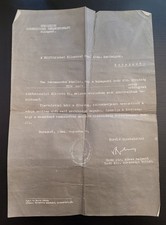
Holocaust Hero WWII RAOUL WALLENBERG document scarce
$3000.00
OSKAR & EMILIE SCHINDLER PSA AUTHENTICATED PHOTO WORLD WAR II HOLOCAUST HEROES
$1795.00
Holocaust Hero Polish WWII Jan Karski book 1st Edition Karski Wood & Jankowski
$1000.00