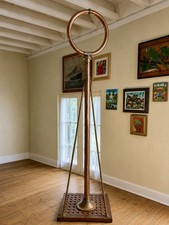
WWII BLUDWORTH Marine Bronze ADF/RDF Radio Direction Finder Loop Antenna Vintage


When you click on links to various merchants on this site and make a purchase, this can result in this site earning a commission. Affiliate programs and affiliations include, but are not limited to, the eBay Partner Network.

WWII BLUDWORTH Marine Bronze ADF/RDF Radio Direction Finder Loop Antenna Vintage:
$8500.00
*Ai generated photos #1 & #2 /edited to remove background clutter. Photos that follow after are the actual item.
Museum-grade piece of maritime and military history: an authentic, monumental WWII-era Bludworth Marine Automatic Direction Finder (ADF) / Radio
Direction Finder (RDF) antenna assembly.
Standing at an impressive 10.5 feet tall, this magnificent artifact features a striking bronze and copper construction. Originally utilized aboard large naval or merchant vessels during World War II, this exact style of equipment served as a foundational technological cornerstone for Allied victory.
With its massive scale, glowing vintage metallic patina, and iconic circular loop antenna, this piece seamlessly bridges the gap between critical wartime history and breathtaking industrial sculpture. It is an ideal ultimate centerpiece for luxury coastal homes, maritime collections, yacht clubs, galleries, or upscale industrial-style decor.
During World War Il, shipborne automatic direction-finding antennas were not just passive navigation aids-they were high-stakes instruments of combat:
• Anti-Submarine Warfare: During the Battle of the Atlantic, German U-boats frequently transmitted short radio signals back to European headquarters. Armed with shipborne direction finders, Allied convoy escorts instantly intercepted these signals to calculate precise compass bearings, allowing them to locate and hunt down enemy submarines before they could strike.
• Crucial Convoy Navigation: Warships and merchant fleets frequently maintained absolute radio silence to avoid detection.
Master masts like this Bludworth unit allowed naval navigators to safely track land-based radio beacons or friendly command transmissions, keeping massive fleets aligned through dense fog and perilous waters without giving away their coordinates.
• The Legacy of "Huff-Duff": The instantaneous capability of automated direction finding fundamentally turned the tide of the war, breaking the German submarine offensive and saving thousands of Allied lives.
Item Specifications & Details
• Manufacturer: Bludworth Marine Inc. Nameplate on loop is embossed "BLUDWORTH" on both sides.
• Era: World War II (circa 1940s)
• Material: Hollow Bronze and Heavy-Gauge Copper
Authentic Naval Engineering: True shipborne masts were built hollow to allow internal coaxial cables and wiring to run cleanly from the top antenna ring down through the ship's deck directly into the radio room. This feature confirms it is an authentic piece of functional maritime equipment, not a modern reproduction.
• Approximate: Height 10' 10". Mast 9 1/2" circumference. Flange 12 3/4"Diameter. Struts 7'. Wooden grid 29" x 27".
• Components: Distinctive top circular loop antenna, industrial support struts, flared bronze deck-mounting flange, and a wooden grid base plate.
• Design Aesthetic: Nautical Heritage, Military Antiquities, Maritime Industrial, Steampunk.
Condition Report
• Visual: Stunning vintage condition with a beautiful, natural warm bronze/copper patina. Ding on loop at lower left area, some scratches here and there, and dust, as shown in photos.
• Structural: Sturdy and structurally sound. No structural cracks or deep damage to the main column or antenna ring.
• Functionality: Sold strictly as an untested, historical/decorative collector's centerpiece.
Important Shipping & Logistics Notice
Due to the massive 10 ft 10 inch height this item is available for local pickup only.
• Location: Saint Augustine, Florida (FL) U.S.A
More Details:
In WWII, shipborne Automatic Direction Finder (ADF) antennas were crucial for anti-submarine warfare and navigation. They were used in conjunction with radio direction finding (RDF) technology to locate enemy submarines based on their radio transmissions. The ADF system, essentially a "radio compass," helped determine the bearing of a known radio transmitter, like an enemy submarine's radio, allowing for triangulation and pinpointing the transmitter's location.
Purpose:
ADF systems on ships were a key part of anti-submarine warfare. They helped locate enemy submarines by detecting their radio signals and determining the direction from which those signals were coming.
How it worked:
The ADF instrument in the cockpit (or on the ship's bridge) would display the relative bearing of a selected beacon or transmitter. By taking bearings on multiple known transmitters, the ship's position could be determined through triangulation.
Key technology:
The ADF relied on RDF technology. Early RDF systems used rotating antennas to compare signal strengths, while later systems employed phase or Doppler techniques for more accurate direction finding.
Importance:
The ability to pinpoint the location of enemy transmitters was invaluable in the Battle of the Atlantic and other naval operations. It's estimated that the UK's "huff-duff" (high-frequency direction finding) systems were responsible for a significant percentage of U-boat sinkings during the war.
Integration:
ADF systems were often integrated with other technologies like airborne radar and the Leigh light (a powerful searchlight) to enhance anti-submarine capabilities.
WWII BLUDWORTH Marine Bronze ADF/RDF Radio Direction Finder Loop Antenna Vintage:
$8500.00
Related Items:
WWII BLUDWORTH Marine Bronze ADF/RDF Radio Direction Finder Loop Antenna Vintage
$6875.00