NASA Concept Art Painting McDonnell Douglas MORL Program Saturn NACA Spacex ISS

When you click on links to various merchants on this site and make a purchase, this can result in this site earning a commission. Affiliate programs and affiliations include, but are not limited to, the eBay Partner Network.

NASA Concept Art Painting McDonnell Douglas MORL Program Saturn NACA Spacex ISS:
$200000.00
Please note the listing shows other images of concept work by this same artist and models related to the NASA Program (none of which are included with this sale).
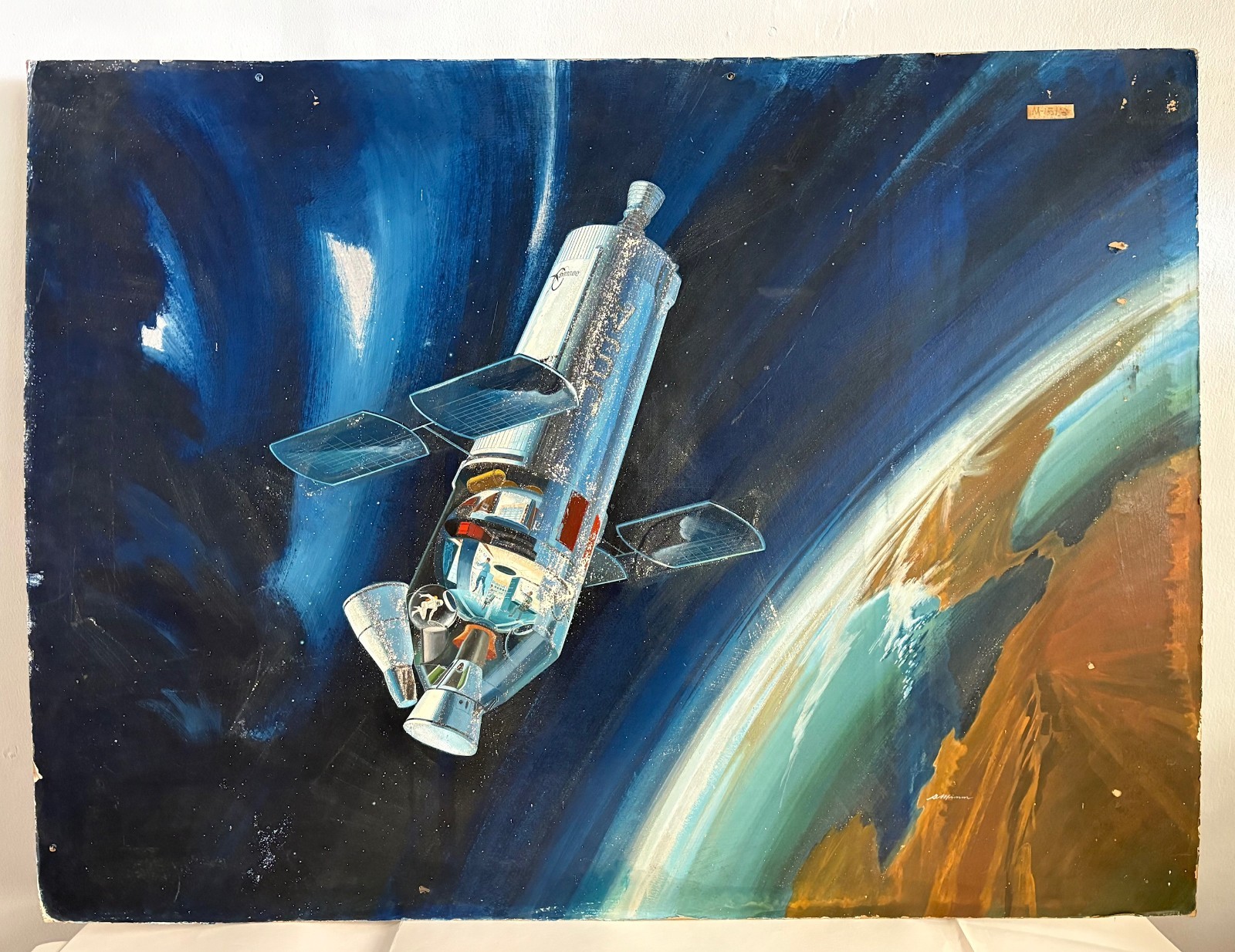
You are not looking at a widely recognized or flown spacecraft, but rather a genuine working concept from an era when the architecture of space exploration itself was still being invented—an idea made tangible through paint, vision, and engineering ambition.
- A Museum-Quality Artifact of Early Space Exploration
At once both a work of art and a technical document, the painting captures a moment when aerospace companies were not merely building spacecraft, but actively inventing the architecture of space exploration itself.
Executed in rich, atmospheric tones, the composition depicts a sleek, cylindrical spacecraft in low Earth orbit, equipped with deployable solar arrays and modular structural elements. The curvature of Earth below—rendered with sweeping gradients of blue, white, and ochre—contrasts with the deep, expansive void of space, emphasizing both the isolation and promise of human activity beyond the planet. The vehicle itself reflects a utilitarian, engineering-driven aesthetic, characteristic of McDonnell Douglas design studies of the period, suggesting roles in orbital research, station support, and long-duration habitation.
The MORL Program and Early Space Station ConceptsThe MORL program was an early 1960s initiative that laid the conceptual groundwork for what would later become the Manned Orbiting Laboratory (MOL). These studies explored the feasibility of sustained human presence in orbit—decades before the realization of modern stations such as the International Space Station.
This painting is directly tied to those formative investigations. MORL concepts included rotating sections for artificial gravity, modular laboratories, and docking configurations based on Apollo spacecraft hardware. One notable variation—referenced in associated studies from 1965—extended these ideas toward an ambitious near-term manned Mars flyby mission, proposed by McDonnell Douglas engineers for potential execution as early as 1973. These designs envisioned astronauts traveling to Mars using modified Apollo-derived systems, supported by orbital infrastructure developed through MORL research.
As such, this artwork is not merely illustrative—it represents a visualization of real engineering studies that bridged early orbital experimentation with humanity’s first serious considerations of interplanetary travel.
Artist: Stewart S. MinnStewart S. Minn was part of McDonnell Douglas’s elite in-house illustration team, often referred to as Presentation, Operations & Proposal Services (PO&PS Illustrations). These artists worked in direct collaboration with engineers and program managers, translating complex aerospace concepts into compelling visual narratives for internal development, government proposals, and presentations to agencies such as NASA.
Unlike commercial or speculative space artists, Minn’s work was grounded in real design data and technical input. His paintings were tools of innovation—used to communicate ideas that, in many cases, existed only on paper. As a result, surviving works by artists like Minn are exceedingly rare and represent a unique intersection of art, engineering, and Cold War–era technological ambition.
Physical Characteristics and Provenance MarkingsThe painting is executed on original illustration board and measures an impressive 40.25 x 29.75 inches, consistent with large-format presentation works of the period. The surface exhibits visible age and handling wear, including edge chipping and minor abrasions, further supporting its authenticity as a working studio piece.
The reverse retains important original markings, including:
- A printed label reading “McDonnell Douglas Property”
- Instructions to “Return to PO&PS Illustrations”, confirming its origin within the company’s internal art department- Property log number 607
- Cataloging number attracted to the front (tag) of the painting M-1513
- Additional handwritten annotations, likely referencing personnel and internal tracking information
Associated archival imagery tied to this body of work includes photographic catalog numbers (e.g., “M-1513”), part of McDonnell Douglas’s internal system for documenting and reproducing concept illustrations for proposal use.
The Rarity of Aerospace Concept ArtOriginal aerospace concept paintings from the 1950s–1970s are exceptionally scarce. Unlike commercial artwork, these pieces were:
- Produced for internal corporate use
- Often discarded, reused, or archived without public access
- Rarely signed or credited publicly
- Created in limited quantities, often as one-off visualizations
Many such works never left corporate archives, and only a small number have surfaced through deaccessioning, estate releases, or institutional collections such as the San Diego Air & Space Museum.
Because they were directly tied to real engineering proposals, these paintings occupy a unique category: they are not merely artistic interpretations, but primary historical artifacts of technological development.
Legacy and RelevanceThe ideas visualized in this painting—modular spacecraft, solar-powered orbital systems, and long-duration human habitation—form the foundation of modern spaceflight. Concepts explored under MORL directly influenced later programs, from Skylab to today’s International Space Station, and continue to inform current initiatives in deep-space exploration.
Modern programs led by NASA, including Artemis and long-term Mars mission planning, still rely on principles first explored in studies like those represented here. In this sense, the painting is not only a relic of the past but a visual ancestor of contemporary space exploration.
This work stands as a rare and important artifact from the dawn of human spaceflight—a period when aerospace companies like McDonnell Douglas were not only building spacecraft, but imagining the very future of humanity beyond Earth. Created by Stewart S. Minn as part of the MORL program, the painting captures a moment when orbital laboratories, artificial gravity, and even manned missions to Mars were being seriously envisioned for the first time.
Condition: The Painting has a signifcant amount of paintloss, damaged edges, overall ware from age and handling. It absolutely remains as a stunning piece of Space Art. This painting is over 60 years old.
NASA Concept Art Painting McDonnell Douglas MORL Program Saturn NACA Spacex ISS:
$200000.00
Related Items:
NASA Concept Art Painting McDonnell Douglas MORL Program Saturn NACA Spacex ISS
$200000.00
1964 NASA Space Concept Art, Vic Kenderski, RARE Westinghouse AstroNuclear 40x29
$6751.00
NASA Concept Artwork Saturn Rocket Mercury Gemini Apollo Skylab Vintage Space
$1999.99